
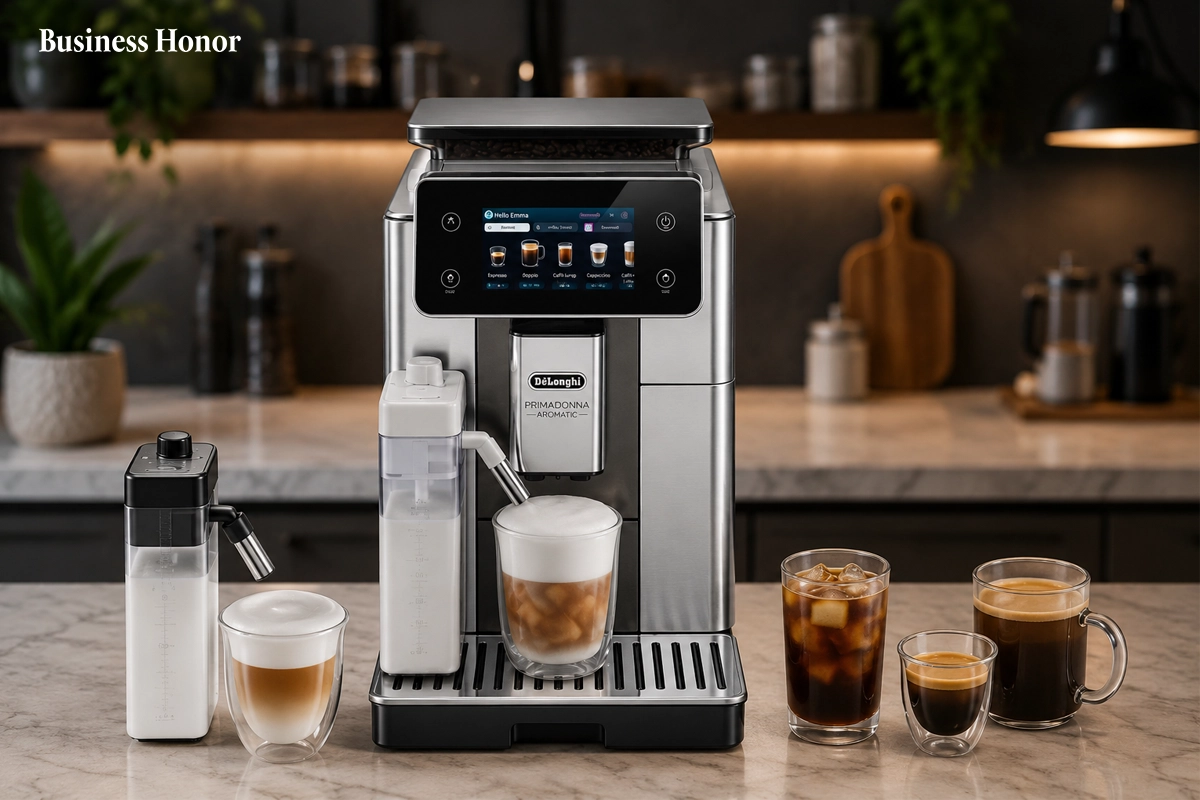
At $2,500, De'Longhi's PrimaDonna Aromatic Fully Automatic Espresso Machine is not simply a device for brewing espresso. It represents a commitment to automation and convenience that promises to eliminate the guesswork from home coffee preparation. Launched in the United States in April 2026, one year after its European introduction, the machine positions itself as a revolutionary solution for those seeking café-quality espresso without the technical expertise traditionally required. With thirty-eight drink presets, intelligent profile programming, and systematic screen guidance, the PrimaDonna claims to transform how home users approach their daily coffee ritual.
A Setup That Practically Sets Itself Up
The setup experience reveals the PrimaDonna's greatest: strength its refusal to allow users to fail. When first plugged in, the machine guides users through every step of the initialization process with on-screen instructions and accompanying imagery, eliminating any need to hunt through instruction manuals. Full operability was achieved within twenty minutes of unboxing, including the initial rinse cycle and water hardness test. This assumption of user inexperience becomes an asset rather than a liability, particularly for those intimidated by high-end appliances.
The software interface accommodates up to four user profiles, allowing family members to establish individualized preferences. During testing, separate profiles were created for different household members, and De'Longhi claims the machine learns drinking preferences and offers suggestions based on time of day. While this learning function was not prominently observed during the review period, this likely reflects the wide variety of drinks tested across all hours rather than a software limitation.
Built to Remove the Guesswork
The water hardness test exemplifies how thoroughly the machine addresses potential user confusion. The test strip's purpose was not immediately apparent from packaging alone, yet the machine provided on-screen diagrams and detailed instructions for its use. Similarly, the two included carafes—one for hot drinks and one for cold—required attachment guidance that the screen helpfully provided. This comprehensive on-screen support transforms what could be an intimidating experience into a straightforward process.
The machine's espresso performance stands as its most impressive feature, particularly when leveraging its automatic bean-recognition mode. Users can manually adjust brew intensity across five levels, from weakest to strongest, or activate the "Bean Adapt" mode, which automatically customizes grind, temperature, and dose based on the specific coffee being brewed. The distinction between these approaches becomes immediately apparent in the cup.
Bean Adapt: Where the Magic Happens
Manual intensity settings produce dramatically different results. At level four, espresso emerged bitter and smoky; level three retained an unpleasant bitterness; level two produced watery, weak shots. Switching to Bean Adapt mode delivered noticeably more balanced shots with superior flavor profiles. In side-by-side comparisons, household testers consistently preferred the Bean Adapt results to manually configured options, suggesting the machine's artificial intelligence genuinely enhances the final product. The brewing speed proves impressive, with espresso ready approximately thirty seconds after the grind cycle begins. An on-screen display tracks progress through grinding and brewing phases. The grinding process represents the loudest operational phase, registering approximately sixty-eight decibels—comparable to a running dishwasher—though this noise persists for only several seconds.
From Cappuccinos to Cold Brew
The machine's preset milk beverage recipes performed admirably across different milk varieties. Testing with both whole milk and coconut milk produced cappuccinos and lattes characterized by full-bodied flavor and smooth microfoam. Iced coconut lattes emerged equally successful, delivering delicious results without the wateriness sometimes associated with cold beverages made by automatic machines. A household member with professional barista experience expressed particular satisfaction with the cold brew function, noting he would willingly abandon café visits in favor of the machine's output, despite acknowledging that minutes-long brewing cannot fully replicate the depth achieved through 12 to 24 hour steeping.
Maintenance without the Mystery
The PrimaDonna's on-screen guidance extends beyond initial use into daily maintenance routines, further distinguishing it from conventional espresso machines. The display prompts users when water tank refills are needed, grounds require emptying, drip trays need cleaning, and milk carafes require rinsing. Beyond simple notifications, the machine walks users through each maintenance task with accompanying images and detailed instructions. This comprehensive support system removes uncertainty from maintaining an investment-level appliance.
A Premium Machine That Fits—If Your Kitchen Does
Physically, the machine occupies approximately eighteen inches in width, ten point three inches in depth, and sixteen inches in height. This footprint accommodated placement on a standard countertop beneath open shelving, and the front-loading water tank design allows the unit to sit flush against walls. While some reviewers have cited spatial constraints as challenging, this particularly depends on individual kitchen configuration. Users with upper cabinets should measure clearance before purchase to ensure compatibility.
Conclusion: Convenience Is the Real Luxury
At $2,500, the PrimaDonna Aromatic demands excellence across all performance dimensions—and largely delivers. The machine stands as the most user-friendly espresso machine tested to date, systematically eliminating guesswork from setup, operation, and maintenance while consistently producing excellent hot and cold beverages with minimal required knowledge or intervention.
What becomes increasingly clear through extended testing is that users are not primarily purchasing superior coffee quality. While the espresso is genuinely very good, the machine's true value proposition centers on ease of use and the transformation of an intimidating, complex piece of equipment into an accessible appliance anyone can operate confidently. For those prioritizing an elevated coffee experience at home without the associated learning curve and maintenance complexity, and for those with the resources to justify the investment, the PrimaDonna represents an excellent option worthy of serious consideration.
(This review was originally written by Amy Moran, Senior Home & Kitchen Editor at Forbes Vetted.)
FAQs:
Q: How long does setup take?
A: Approximately 20 minutes from unboxing to full operation, with on-screen guidance throughout.
Q: Does it really make better coffee than cheaper machines?
A: Coffee quality is very good, but the main value is ease and convenience, not superior taste.
Q: What is Bean Adapt mode?
A: Automatic feature that recognizes beans and customizes grind, temperature, and dose for optimal flavor.
Q: How loud is the grinding process?
A: About 68 decibels, roughly as loud as a dishwasher, but only lasts a few seconds.
Q: Can it make both hot and cold drinks?
A: Yes, it produces excellent espresso, cappuccinos, lattes, and cold beverages using preset recipes.
Q: How much counter space does it need?
A: Measures 18 inches wide, 10.3 inches deep, and 16 inches high; fits most countertops comfortably.
Q: Is maintenance complicated?
A: No, the machine guides you through every maintenance step with on-screen instructions and images.
Q: How many user profiles can you create?
A: Up to four profiles, allowing different household members to establish personalized drink preferences.
Q: How fast does it brew espresso?
A: Approximately 30 seconds from grinding to finished cup, with on-screen status updates throughout.


































.webp)

.webp)




.webp)



Comments
0 Comments