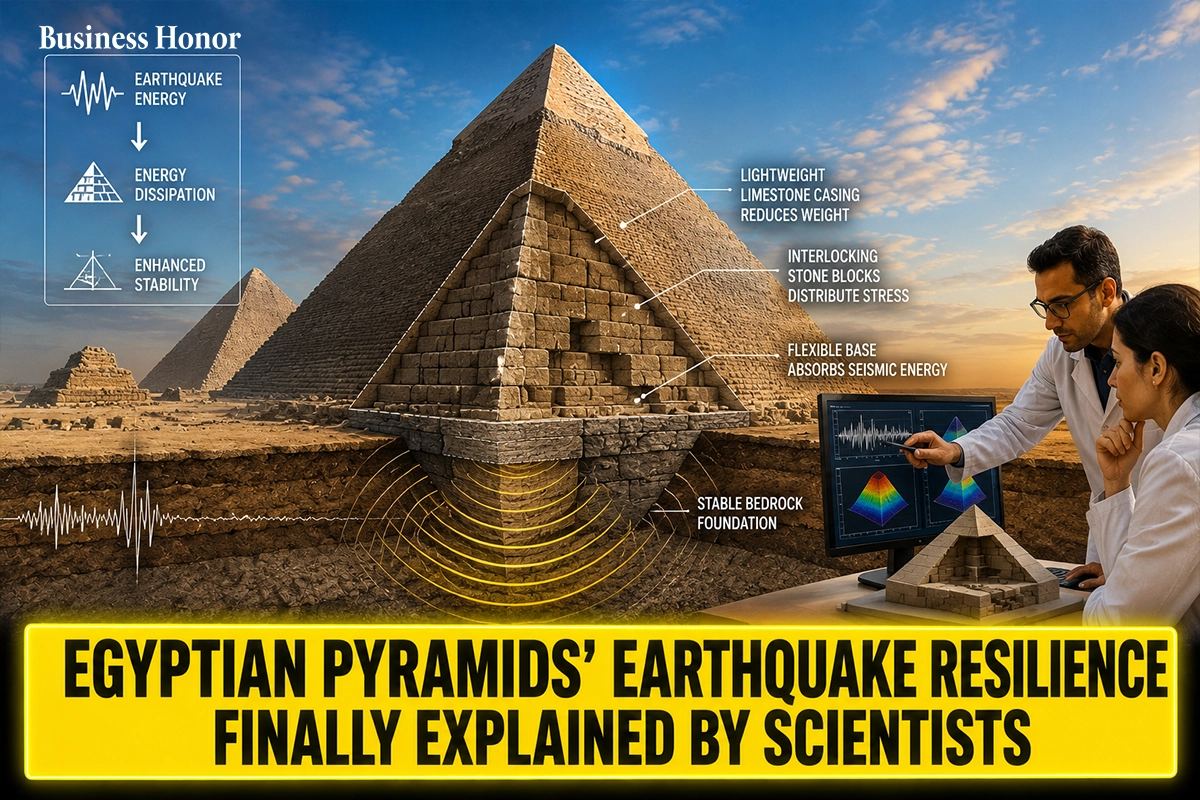
Scientists discover Egyptian pyramids vibrate differently than ground, explaining their extraordinary seismic resilience for millennia.
|
For the past 4,500 years, Khufu's Great Pyramid has served as an everlasting sentinel on the Giza Plateau in Egypt – enduring all that nature has thrown at it – earthquakes, violent sandstorms and the unfaltering course of human history. A team of scientists led by seismologist Asem Salema from Cairo's National Research Institute of Astronomy and Geophysics (NRIAG), have uncovered an important secret about the long life of this ancient monument. The research team discovered that while the Pyramid is built of stone, it vibrates at a different frequency than the ground it sits upon.
Through recovering data from 37 different motion sensors placed throughout and around the Egyptian Pyramids, the researchers conducted a comprehensive study of the Pyramid's seismic performance using horizontal-to-vertical spectral ratio analysis (HVSR) to record minute vibrations produced by both the interior chambers of the Pyramid as well as the surrounding earth.
The study was published by the research team in Scientific Reports and confirmed that this frequency difference created the "frequency mismatch" necessary for the protection of the Pyramid from the damaging effects of earthquakes. When two structures resonate at the same frequency and experience a seismic event - the resonances become amplified leading to catastrophic structural failure. The Great Pyramid will generally experience a lesser degree of seismic energy, than the surrounding sand, as it will be vibrating with a different frequency than that of the supporting sand.
"Reduced resonance risk may contribute to the monument's remarkable seismic endurance over millennia," Salema explained, though he cautioned that any intentional seismic optimization by ancient architects "remains purely speculative."
The pyramid's earthquake resilience likely stems from multiple sophisticated design features. Its four walls radiate outward and downward, promoting balanced mass distribution from the center. Most of the structure's weight concentrates near the base, gradually diminishing toward the apex—a configuration that naturally resists toppling forces. The limestone that makes up the base and body of the pyramid not only gives the structure its renowned strength but also takes away upwards of the ground vibrations created by earthquakes. The mid-level King's Chamber also has chambers above it; these may relieve stress from earthquake-induced exterior forces that act higher up in the structure than at the base.
The pyramid's original construction consisted of 2.5-ton limestone blocks built during the Old Kingdom (2600–2450 BCE) and subject to extraordinary geological forces (e.g., being hit by the 1992 Cairo earthquake measuring 5.9 on the Richter scale and suffering no substantial damage) points toward a superior level of engineering skill by the ancient Egyptian builders. Results from this research indicate a profound understanding of geotechnical design by ancient Egyptian architects, who structurally designed buildings with site characterization such that they last for many millennia (millennium) against the effects of possible future earthquakes.
It is not known if parts of the pyramid, such as the pressure-relief chambers, were originally created for preserving the pyramid through earthquake activity or for helping to support the weight of the pyramid. Nevertheless, the conclusion is that the Great Pyramid is an example of extraordinary foresight in engineering design. Khufu's still-defying time and the earth's tremors is yet another example of superior engineering design, regardless of whether the result from detailed engineering, lucky architectural decisions, or both.
Business Honor is of the view that the Great Pyramid's frequency differential represents a strategic advancement in ancient Egyptian structural engineering and seismic resilience capabilities.
FAQsQ: Why has the Great Pyramid survived so many earthquakes? A: Its vibration frequency differs from ground frequency, preventing resonance and earthquake damage amplification. Q: How did researchers measure the pyramid's vibrations? A: They placed 37 sensors inside and around the structure using horizontal-to-vertical spectral ratio analysis. Q: What is resonance and why does it damage buildings? A: Resonance occurs when structures vibrate at same frequency as ground, drastically amplifying earthquake tremors. Q: Did ancient Egyptians intentionally design the pyramid for earthquakes? A: Evidence suggests possible knowledge, but scientists say intentional seismic optimization remains purely speculative. Q: What specific features help the pyramid resist earthquakes? A: Pressure-relief chambers, limestone composition, symmetric walls, and mass distribution near base provide protection. Q: How old is the Great Pyramid? A: Over 4,500 years old, built during Egypt's Old Kingdom between 2600 and 2450 B.C.E. Q: What damage did the 1992 Cairo earthquake cause? A: The 5.9 magnitude earthquake caused only minimal damage to the Great Pyramid structure. |










































.webp)

.webp)



.webp)