- Sandra Kelembeth
Technology vendors tend to agree on what makes an enterprise deployment succeed: the platform, the integration, and the implementation partner. What gets mentioned far less often is the conversation that should have happened before any of that. Across the Asia Pacific, that missing conversation accounts for a significant share of the billions spent on enterprise technology that never delivers what the purchase order promised.
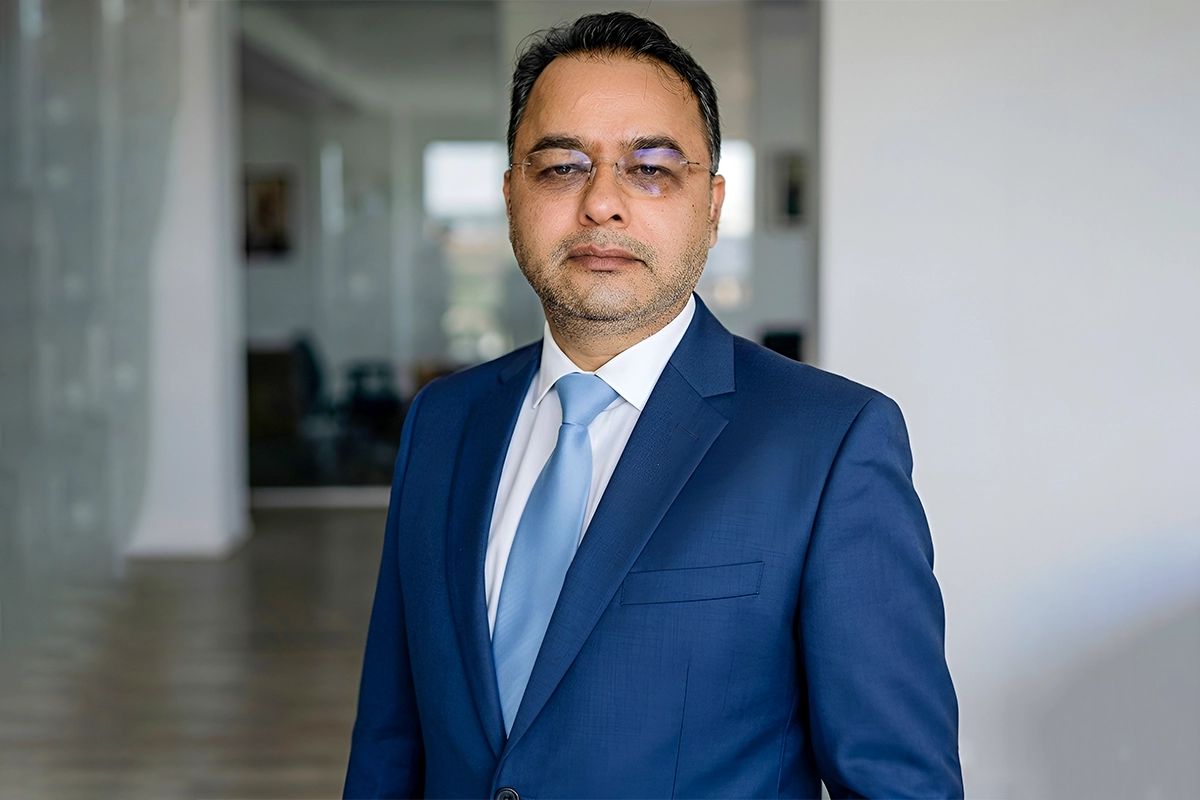
Rahul Chhibber has spent more than 25 years getting that conversation right. Singapore-based and widely regarded as one of Asia Pacific's foremost experts in enterprise technology architecture and industrial AI commercialization, he puts it plainly: "It doesn't matter how sophisticated your technical solution is," he says. "If it doesn't translate into a clear business benefit for the customer, if they can't see it in their numbers, it simply won't get implemented."
Coming from someone who began his career as one of ten engineers selected from 200 candidates at Ericsson, the conviction carries weight.
A Foundation Built on First Principles
Rahul didn't come to technology through a straight line. Growing up in India during a period when the economy was just beginning to open up, he stumbled onto telecommunications almost by accident. "I read something in high school about what telecoms could do for the country," he recalls. "I thought, that's where I want to be."
He pursued a Bachelor of Engineering in Electronics and Communications at North Maharashtra University, graduating with First Class Distinction in 1996, and within months, he was sitting before Ericsson interviewers alongside more than 200 other candidates. Out of more than 200 candidates interviewing for Ericsson trainee positions, he was among the 10 selected, gaining his first hands-on experience in mobile telephony, transmission networks, and radio systems across the Asia Pacific.
Chiranjeev Singh is currently Vice President and Head of Customer Operations at Radisys, a Reliance Industries company.
Chiranjeevi recalls that Rahul's technical distinction was obvious immediately: "What had been scoped as a nine-month engagement he completed in six, which was impressive.
“Rahul was able to strengthen confidence among both customers and partners. That ability to combine deep technical expertise with genuine customer focus is a combination rarely seen outside the most senior engineering and transformation leaders."
Chiranjeev also held leadership roles at Sun Microsystems, where Rahul served as General Manager and Regional Head of Sun Services from 2001 to 2008
He recalls that during this period, observing Rahul’s work on a mission-critical engagement defined how an entire sector approached modernization: "He played a central role in designing and implementing a nationwide core banking platform for one of India's largest government banks.
Chiranjeev adds: "The deployment achieved 100% uptime in its first year and drove contract expansion from roughly 250 branch locations to nearly 10,000. What Rahul built became the reference architecture for the sector; other government banks pursuing similar programmes cited that deployment as the benchmark they were working toward."
That recognition has extended to formal awards in the company. Rahul received the Global Vision Mission Value Award at the APAC level and the Service Excellence Award for his contributions to advancing India as a leading services market within Asia South, before being selected for Sun's Leadership Development Programme, a cohort reserved for professionals identified as having the capacity to lead at a significantly higher level.
What that grounding gave Rahul was something no MBA programme teaches clearly: "I can walk into a room with a Chief Technology Officer and speak their language," Rahul says.
"I have that ability to move between deep technical understanding and commercial terms that executives can act on, that's the thing I've built my entire career around."
From Ericsson and Sun, his career moved through NetApp, Oracle, Siemens, and eventually into industrial AI with AspenTech, a division of Emerson Software, each move placing him at the forefront of the technology transformation reshaping that moment in the market. Along the way, he completed a Mini-MBA at Singapore Management University and a Services Excellence programme at the Indian School of Business in Hyderabad.
Commercializing Complexity: The Oracle Years
Rahul's reputation as a technology commercialization specialist was firmly established during nearly eight years at Oracle India. Serving first as Sales Director for Enterprise Business and later as Director and Head of Cloud Business, he exceeded quota by 250% for three consecutive years: 2017, 2018, and 2019. He was inducted into Oracle's Unlimited License Agreement Hall of Fame, a distinction reserved for those who have successfully structured Oracle's most complex long-term licensing arrangements.
It also earned him membership of the Sales Club for the company's top global achievers, and he also won the Top Asia Pacific Oracle Cloud Sales award for 2018.
However, the achievement that mattered most to him wasn't a number. It was a methodology. During this period, Rahul developed what he calls the Account Workshop, a structured client engagement model designed to surface the business and technical challenges that organizations hadn't yet been able to articulate.
He outlines the reason for developing the process: "Most clients struggle to convert their technical problems into business problems, “ he says.
“They know something isn't working, but they haven't connected it to what it costs them. The workshop brings the right people into the room, engineering, finance, operations, leadership, and forces the kind of cross-functional conversation that most technology projects never have before deployment begins. By the end, you know precisely what problem you're solving and what solving it is worth to the business."
However, the Account Workshop methodology was not just effective in isolation; it was subsequently adopted globally by Siemens upon Rahul's joining the company.
Oracle was so impressed it was embedded across the organization's international client engagement model. What Rahul had built as a personal working method became a company-wide standard, replicated by teams who hadn't been in the room when he developed it.
Additionally, during his Oracle tenure, Rahul structured one of India's first Perpetual Unlimited License Agreements (PULA) for a rapidly growing payment bank.
A PULA grants an organization the right to use an unlimited number of software licenses in perpetuity, rather than within a fixed term.
Rahul explains: "The client was growing fast and needed certainty," Rahul says. "A standard Unlimited License Agreement gave them flexibility for a defined period. A perpetual structure gave them certainty indefinitely. The architecture of the deal had to reflect the architecture of their business."
Following its completion, Oracle's internal teams invited him to present the model to colleagues worldwide, mentoring peers across the globe on how to construct and close high-complexity, multi-million-dollar agreements of this kind.
Building Ecosystems That Scale: The Siemens Chapter
Joining Siemens Digital Industry Software in 2019 as Head of Sales for the Cloud Business in Asia Pacific meant starting with 10 customers and a mandate to build from scratch. He wasn't a random hire.
Rajiv Ghatikar, who served as Vice President and Head of Portfolio Development for Asia Pacific at Siemens, had encountered Rahul years earlier while evaluating candidates on a leadership panel. The impression held. "His command of cloud technology, digital transformation strategy, and enterprise customer engagement was immediately evident," Ghatikar says. "When Siemens needed someone to build and scale the cloud business across Asia Pacific, he was the profile we were looking for. Everything that followed confirmed that."
What Rahul built became a widely referenced model for commercializing industrial digital transformation through partner ecosystems. "You don't scale a cloud business in APAC by hiring more salespeople," he says. "You scale it by building relationships with the right partners, the ones who already have the customer relationships, the industry expertise, the implementation capability. Your job is to make it worth their while to carry your technology into markets you'd never reach on your own."
By the financial year 2022, the portfolio had grown from a nascent base to a scaled operation across the region. Partnerships with 3rd-party OEMs produced joint go-to-market strategies for the Industrial Internet of Things (IoT), which is the practice of connecting physical industrial equipment to digital platforms for real-time monitoring and optimization. Those partnerships generated a multi-million dollar pipeline
The deployments behind those numbers were, in several cases, the first of their kind in their respective industries. A major semiconductor manufacturer in Asia came to Rahul with a problem that was almost hard to believe: their wafer production testing, the critical first stage of integrated circuit chip fabrication, was being run entirely on spreadsheets, with sixteen engineers manually processing results over the course of a full month per cycle.
"When I heard that, I thought, there's a business case here that writes itself," Rahul recalls. "We migrated the whole process onto a digital platform.”
His work cut that testing time by 70 to 80%: “Faster chips to market, people freed for work that actually needed them, and a competitive edge the board could see immediately in the numbers. That was the impact," Rahul says.
An automotive manufacturer faced a similar issue during engine testing. Ghatikar, who had direct visibility into the deployments Rahul was leading during this period, is precise about what was achieved: "The cloud-driven optimization he implemented for an automotive manufacturer reduced engine tuning cycles from several hours to minutes," he says. "That is not an incremental improvement. It is a fundamental transformation of how a critical production process works, with direct consequences for how quickly new products reach the market." For a manufacturer where speed to production carries decisive commercial weight, the impact was immediate and measurable.
"I never approach a client to sell them technology," Rahul says. "I approach them to understand their problem. If I can't show them, in numbers, what solving that problem is worth to their business, I haven't done my job."
Industrial AI Architecture at Scale: AspenTech
AspenTech, a global leader in industrial software for asset optimization across energy, chemicals, and manufacturing, is where Rahul's ecosystem-building expertise found its fullest expression. He joined as Head of Partner Sales and Alliances for Asia Pacific in 2023, taking on a regional partner structure that he would transform over three years into one delivering a 60% compound annual growth rate in indirect business.
"When I got there, there were partners on the books who hadn't been meaningfully engaged in years," Rahul says. The first thing I had to do was change that. Not with promises, with action. Consistent engagement, clear expectations, real investment in their capability." He established Centers of Excellence and structured capability-building hubs, with a GSI for Asset Performance Management and a Big4 for Supply Chain Management, ensuring that AspenTech's Industrial AI platforms were not merely sold but successfully deployed across energy, utilities, chemicals, and manufacturing clients throughout the region.
An example of how the person being discussed has had a wider impact and influence in his field: the transformation model Rahul designed for the Asia Pacific didn't stay in the Asia Pacific. It was adopted and replicated across other global regions, shaping AspenTech's broader international partner strategy and establishing more structured, performance-based partner governance practices worldwide. A regional rebuild became a global standard.
Manish Chawla served as Chief Revenue Officer and Chief Customer Officer at AspenTech, with global oversight of partner ecosystem performance across all regions. Chawla, who previously held the role of Global General Manager of IBM's Industrial Sector, observed Rahul's work with direct executive visibility. "In my experience overseeing global revenue organizations, it is rare to observe a regional leader whose structural innovations influence organizational practice at a global level," he says.
"Rahul's ability to architect a comprehensive partner transformation, align senior stakeholders across the ecosystem, and deliver both measurable revenue acceleration and lasting improvements to partner capability reflects sustained excellence well beyond what is ordinarily encountered in this field."
Chawla also speaks directly to what the ecosystem enabled in practice: "The partner infrastructure he built allowed enterprise customers across the region to implement advanced industrial AI applications that had previously been out of reach, predictive maintenance, asset performance management, grid reliability analytics, digital twin deployments, and data-driven supply chain optimization. These are not peripheral applications. They represent the core of what industrial digital transformation delivers, and they were made possible by the partner capability he constructed."
Rahul received the Partner Region of the Year award for the financial year 2024 and was nominated for AspenTech's Leadership Development Programme, placing him among the top-performing partner leaders globally with 135% quota attainment for two consecutive years.
From Innovation to Industry Standard
An example of how, in general, some aspect of his work is already of major significance in the field: the track-and-trace technology deployments Rahul led are among the clearest illustrations of his wider influence on industry practice. At the time, using Internet of Things sensors and blockchain records to create end-to-end supply chain traceability was experimental. Today it is the recognized standard across food and beverage, pharmaceuticals, and logistics throughout the region and beyond, and much of what made it standard was first built in deployments Rahul led.
The problem he was solving for a major beverage producer was straightforward in human terms, if technically demanding: counterfeit bottles were reaching customers, and nobody in the supply chain had a reliable way to know whether what they were holding was genuine. "The wine producer had a real problem," Rahul says. "Counterfeit bottles were reaching customers with no way to verify authenticity at the point of sale. We put an RFID (Radio Frequency Identification) tag on every bottle, linked it to a blockchain record, and connected the system to the cloud. The moment a customer opened a bottle, the system pinged the producer: genuine or fake. Simple in concept, but the architecture behind it had to be bulletproof."
Ghatikar recalls the outcomes with precision: "In consumer product and retail deployments across Australia and Thailand, the cloud-based traceability systems Rahul implemented achieved zero counterfeit exposure in the targeted product flows," he says. "These were not pilot projects. They were production systems that fundamentally changed how those clients managed supply chain integrity." The same framework was later applied for a pharmaceutical client whose temperature and pressure-sensitive medicines required verified cold-chain integrity at every point in the supply chain, ensuring that a patient receiving medication could be certain it had been stored correctly throughout its journey. "The solutions we built back then, people are now searching for by name," Rahul says. "What was a new idea at the time has become the expected standard. That's what happens when technology is deployed in a way that genuinely solves a problem that matters."
A Career Defined by What Comes Next
With the sole exception of his first role at Ericsson, every position in Rahul's career has come through direct outreach from organizations who needed someone capable of doing exactly what he does: “I take a technology that is new, complex, and commercially unproven, and build the architecture, commercial, human, and technical, that makes it scale,” he says.
That pattern has not changed at Botsync, where he is Senior Vice President of Sales for Asia Pacific. Rahul is now leading the company's largest territory,
And he is helping position the robotics startup for funding and potential global expansion into Physical AI, which refers to artificial intelligence systems that operate in the physical world, encompassing autonomous mobile robots and related technologies.
"I've been lucky to work on the cutting edge at every stage," he says. "Telecom when India was just opening up. Cloud when the market didn't yet understand what it was buying. Industrial AI, when manufacturers were still figuring out what the question even was. And now Physical AI, where the same journey is beginning again.”
He adds: “Yes, the technology changes. But what doesn't change is the work of making a market ready for it. You also need to understand the business problem deeply, build the case that compels investment, and construct the ecosystem.
“Then you can turn a promising idea into something that actually runs at scale."
About the Author
Sandra Kelembeth is an experienced writer who specializes in healthcare, health technology, fitness, and sports. With a sharp attention to detail and a deep passion for wellness, she creates compelling content that educates, engages, and motivates her audience. Her writing skillfully simplifies complex medical concepts, making them accessible and relevant to everyday life. She is dedicated to empowering readers with practical knowledge that supports healthier, more informed lifestyle choices.





































.webp)
.webp)


.webp)