
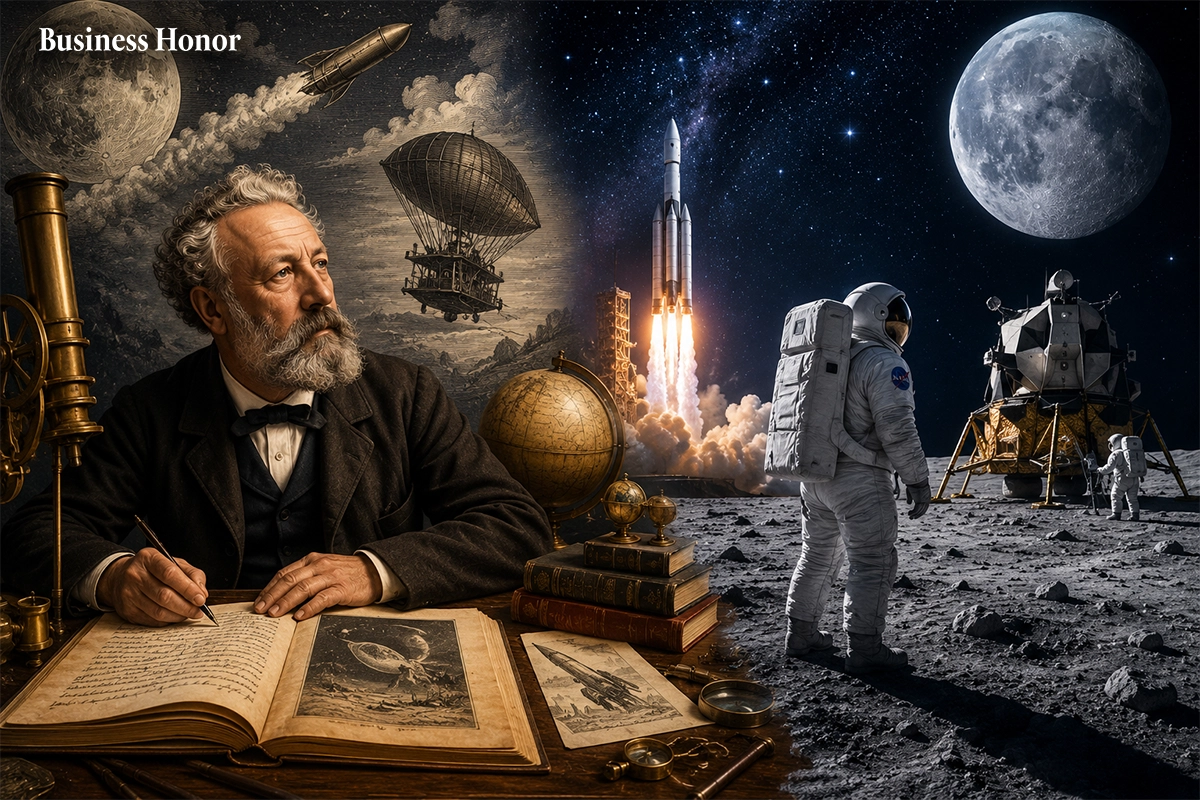
NASA Artemis 2 mission mirrors 160-year-old Jules Verne lunar exploration blueprint with stunning accuracy.
|
Rob Navias, a commentator for NASA, made an interesting comment about how the Artemis 2 integrity spacecraft returned to earth after the mission this past April. "Here we are, with a new chapter in our exploration of celestial bodies by way of Jules Verne's writings, all the way from the Earth to the Moon." He said this because that is how far ahead of his time Jules Verne was with his fictional space exploration novel.
Jules Verne’s' 1865 novel "From the Earth to the Moon," was published while most science fiction writers were dreaming of balloon rides to another planet. In contrast, Jules Verne wrote about space travel based on the scientific knowledge of his time, such as how fast something must go to break out of the earth's gravitational pull, the mechanics of getting into orbit, using the moon's gravity to propel a spacecraft, and how to correct the spacecraft course when it was off course. While Verne did not get everything about space travel correct, he did understand the physical laws of space travel more accurately than most.
The book begins with many of the darkly humorous chapters that have come from the members of the Baltimore Gun Club, a club whose members were highly skilled in the use of artillery, and were left without any purpose after the American Civil War. The president of the club, Impey Barbicane, proposed that they use their talents for something new and outrageous, that being to launch a projectile to the moon via enormous cannon. The cannon, which Verne called the Columbiad, was planned to measure 900 feet (274 meters) in length. What made Verne’s approach unique was his dedication to detail in both mathematics and science. Instead of hastily brushing over each technical aspect, Verne took great care to provide detailed descriptions of the physical attributes of Barbicane’s cannon. He provided extensive calculations of the projectile’s trajectory in such detail that his readers and fellow scientists would be astounded. His dedication to documenting truthful facts set his writing above the norm for other writers at that time, who were generally known for speculative fiction. For example, his reasoning for where to do the NASA Artemis 2 launch from was by far the most insightful of any of his era; Verne understood that launching from areas of the earth near the equator would greatly aid his calculations for added velocity by using the rotational power of the earth. This fact is based on the basic laws of orbital mechanics and is now used extensively in the planning of all modern space programs.
A launch site was chosen by Verne near Fort Myers, Florida, which is located on the western coast of the peninsula. Incredibly, this location was right around the same latitude as Cape Canaveral, which NASA eventually turned into one of the most famous spaceports in the world about 90 years later. The author intuitively understood through numerical reasoning and mathematical reasoning how the engineers doing actual space travels, using technology that did not exist at that time, would go about doing those things. Verne left behind a legacy that extended beyond chance encounters with success. He was the first to have science fiction stories that relied heavily on scientific credibility through imagination, and now that he has supported 'real' astronauts completing the missions that he imagined in print and numbers, his genius continues to inspire and amaze future generations.
Business Honor is of the view that Jules Verne's scientific methodology established a foundational framework for modern space exploration, with NASA's Artemis 2 mission validating the author's prescient understanding of orbital mechanics and equatorial launch strategy.













.webp)

.webp)




.webp)

