
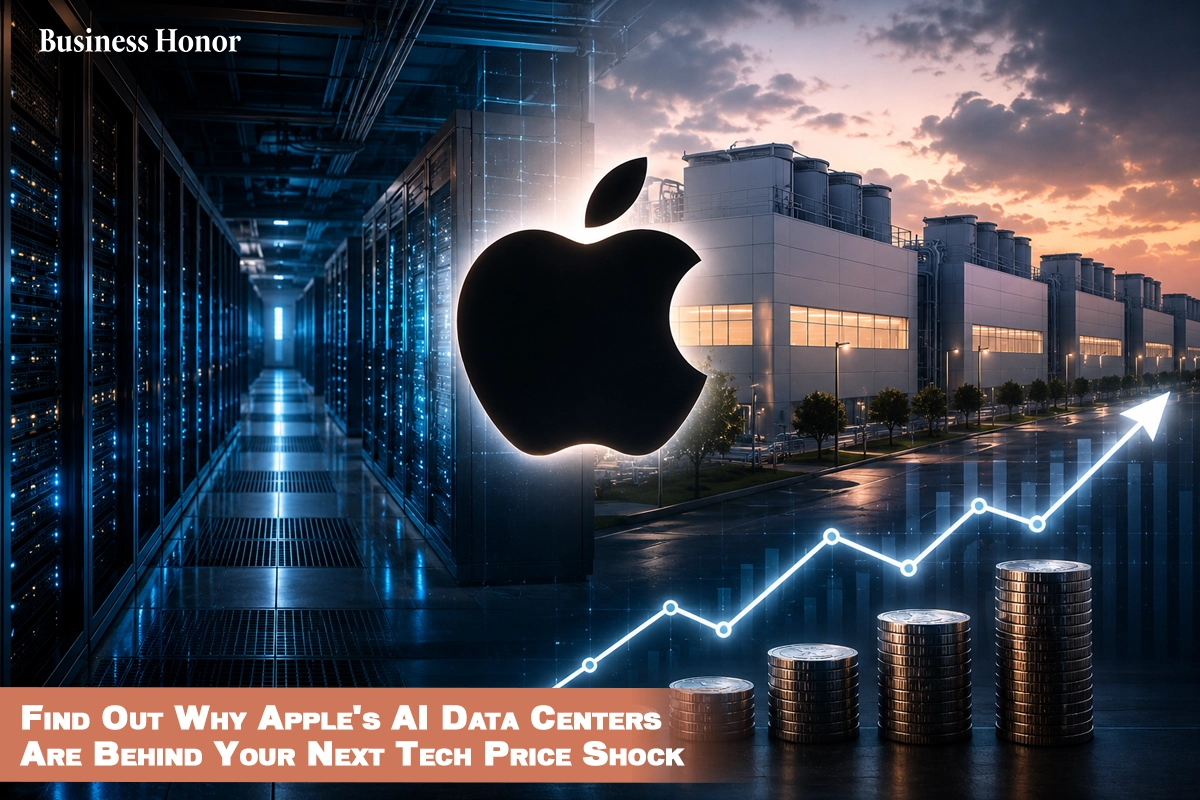
Apple's massive price hikes signal how AI data centers are reshaping consumer technology costs globally.
Apple Draws a Line in the Sand
Apple has set the bar for other leading consumer tech companies after publicizing price increases due to the significant amount of money being spent by companies on Artificial Intelligence (AI) computing infrastructures (AI data centers) around the globe. Apple recently announced price increases (larger than 15%) of many of its MacBook and iPad product-line items citing the rapid increase in demand for memory and storage components due to the rapid expansion of AI data centers globally.
Consumers Face Immediate Sticker Shock
The increase in Apple pricing affects all of Apple's products; in fact, the entry level MacBook Air's price jumped from $1,099 up to $1,299—an increase of $200. Similarly, the most affordable iPad Air's price rose dramatically from $599 to $749. According to Apple, both of these price adjustments represent an unavoidable position due to the overall changes in the market for MacBooks/iPads. These price increases are far beyond minor adjustments or rounding; they will influence millions of consumers because of apple's price increasing.
An Unusually Candid Explanation
Prior to the announcement, Tim Cook (Apple CEO) foreshadowed the price increases and openly stated; "We're going to have to raise prices—these are unavoidable." In the official company statement regarding the subject, Apple used direct and honest language to explain the why behind the pricing increase: The exponential growth in AI data centers has caused a situation in which demand for memory and storage has dramatically increased.
“We have never seen a component price increase this much, this quickly." The statement suggests that these announced increases may be only the beginning, with Apple indicating it "needs to begin raising prices on a number of products." The fate of iPhone pricing remains uncertain, though industry observers are watching closely to see whether Apple will implement similar adjustments when it introduces new models in the fall.
More Than Just Higher Prices
What makes Apple's announcement significant extends far beyond the immediate impact on consumers shopping for new computers and tablets. It represents a crucial inflection point in the broader societal conversation about artificial intelligence. For months, the AI debate has largely centered on speculative futures—either utopian visions of breakthrough medicines and transformed industries, or dystopian warnings about bioweapons and economic displacement. Apple has now injected a dose of present-tense reality into this abstract discussion.
The AI Infrastructure Race
The underlying cause traces back to the massive capital investment flowing into AI infrastructure. Technology companies and startups are racing to build enormous data centers to support AI model training and deployment. This frantic expansion has created what economists describe as an "extraordinary surge" in demand for the semiconductor components that power these facilities. The competition for limited chip supplies has driven prices upward at a pace and scale that chip manufacturers themselves describe as unprecedented.
Who Benefits—and Who Pays
This dynamic has created winners and losers within the technology sector. Memory and storage chipmakers like Micron and SK Hynix have benefited handsomely from the increased demand and higher pricing power. Meanwhile, virtually every other company that depends on chips for their products—which encompasses most of the consumer electronics industry—faces margin compression and cost pressures.
A Supply Chain Story Reaches the Public
Until now, much of this economic squeeze has played out in the opaque world of supply chains and component markets, largely invisible to ordinary consumers.
Apple's public statement changes that calculus entirely. By explicitly connecting price increases to AI data center demand, Apple has translated an abstract tech-industry phenomenon into something tangible and personal. Millions of people who might never follow semiconductor market reports or understand data center economics will now grasp one concrete fact: artificial intelligence is making the devices they want to buy more expensive.
A Message That Sticks
That straightforward cause-and-effect relationship has a stickiness that survives intact no matter how it is discussed or debated.
Technology's Traditional Value Proposition
The tech industry has historically succeeded through two primary mechanisms: introducing genuinely novel products or dramatically reducing the cost of existing ones. The entire post-war electronics revolution rested on the foundation of exponential price declines made possible by Moore's Law and manufacturing scale. Consumers could justify buying new devices because they offered either revolutionary capability or unprecedented affordability, or ideally both.
AI Changes the Equation
The narrative of AI has similarly emphasized its revolutionary potential—miraculous medical discoveries, transformed industries, new capabilities that seemed impossible just years ago.
Yet Apple's announcement introduces a different narrative entirely. The same products consumers bought yesterday now cost substantially more today, with no fundamental redesign or capability enhancement—only the indirect effects of infrastructure investments in AI systems.
Paying More for the Same Product
The company is asking consumers to pay more not for better products, but for the privilege of maintaining access to existing product lines in a world where component costs have been dramatically reshaped by AI's infrastructure demands.
When Wallets Shape Public Opinion
Breaking this news directly to consumers forces a reckoning with AI's tangible costs in the present moment, not merely its speculative promise in the future. The AI industry possesses substantial financial resources and cultural influence. The messaging apparatus promoting AI's transformative potential is formidable and well-funded.
A Watershed Moment for Transparency
Nevertheless, messaging often crumbles when it collides with consumers' direct experience of their own wallets becoming lighter. Apple's announcement has made AI's economic costs concrete, immediate, and impossible to ignore. That kind of personal, visceral understanding is extraordinarily difficult to counter argue with abstract promises about future benefits.
Business Honor is of the view that Apple's explicit attribution of price increases to AI data center expansion represents a watershed moment in consumer technology cost transparency and industry accountability.
|
Why did Apple raise prices on MacBooks and iPads? How much did Apple increase MacBook Air prices? What about iPad Air prices—did they increase too?
|





































.webp)

.webp)



.webp)



Comments
0 Comments