
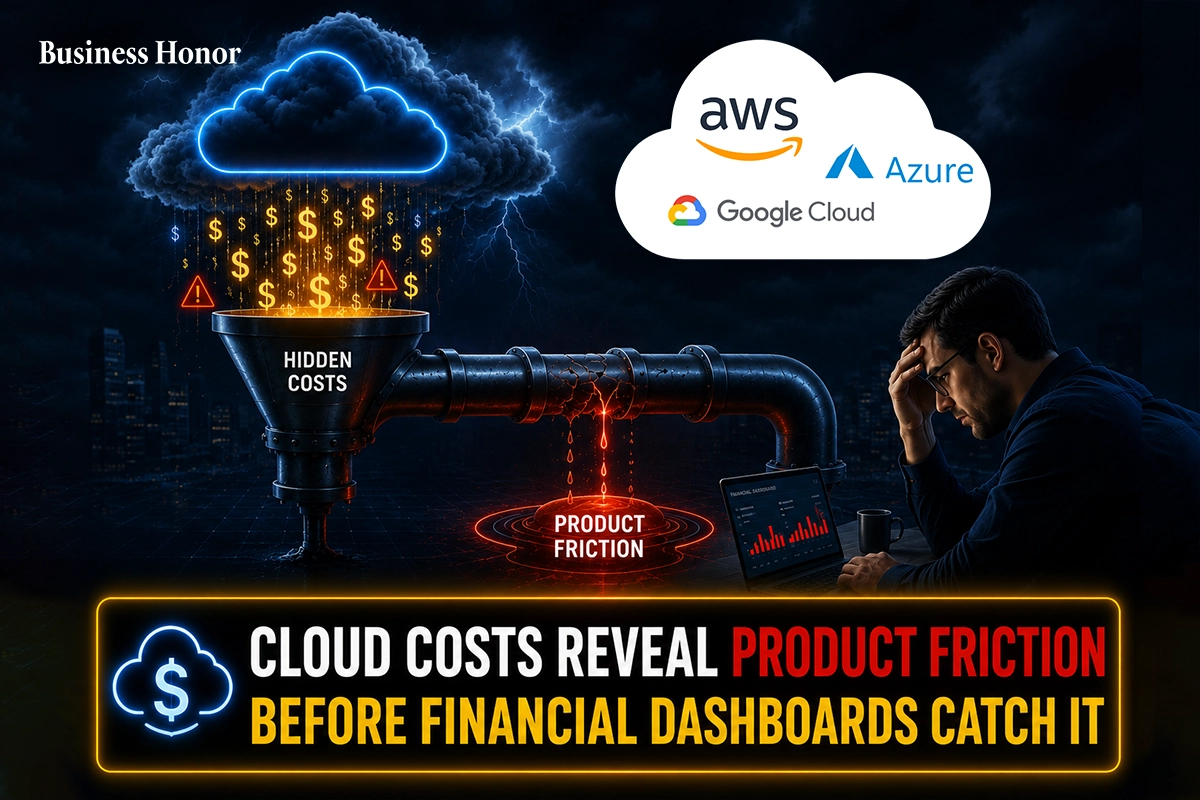
Cloud costs function as product performance signals, exposing operational inefficiencies that balance sheets miss entirely.
|
Across North America, the UK and Europe, technology leaders are beginning to view their growing cloud costs through a different lens than just the balance sheet. As cloud costs continue to rise, more technologically advanced startups and product teams see the correlation between their cloud costs and the health of their products as well as their operational efficiency; their realization comes from firsthand experience scaling businesses that depend on infrastructure. For example, when latency increases on a critical onboarding flow, companies react by provisioning larger instances of resource. If user activation slows, teams push more traffic through the funnel that permanently pushes the systems further than intended does. When retention increases but the architecture is not designed to support longer sessions, it results in a relatively high cost for growth. These scenarios all leave traces behind in the cloud monthly invoice.
Typically, the initial response to reducing cloud costs has been to reduce the amount of resource allocated to the application. Unfortunately, reducing the resource will lead to degraded performance and increased user churn, creating greater cloud infrastructure costs per retained customer. The invoices may seem to improve in the short term, but the business is structurally weaker as a result. This confusing situation highlights the very different nature of the cloud cost; namely, clouds costs are not primarily a finance issue that needs to be solved at the accounting level, but rather a product issue requiring product discipline.
The beginning point of the paradigm shift encompasses the complete reframing of the discussion. Instead of asking, “How much did we spend?” the conversation should shift to asking, “What does it cost us to create or maintain one activated user? What is the cost associated with producing a successful transaction? What is the cost associated with maintaining one retained account?” This reorientation of perspective provides teams with the means to transform spending associated with the Cloud into quantifiable metrics associated with delivered products and services.
The FinOps community refers to this new perspective as “cloud unit economics.” Here, Cloud infrastructure costs are mapped directly to actual business outcomes rather than being tied to gigabytes or instance hours. The principle echoes the philosophy embedded within the AWS Well Architected Framework: delivering business outcomes at the lowest sustainable cost rather than just spending less. Most organizations are optimizing toward the wrong dimension. The first dimension addressed in the optimization process is product behavior. Organizations need to understand where users perceive value where they drop out of user flows and what user actions will create retention. The second dimension addressed in this optimization process is related to technical performance; this will include response times, rates of error, cache effectiveness and how systems perform under spikes in traffic.
Business Honor is of the view that cloud spending represents a product execution problem requiring friction elimination rather than accounting-driven cost reduction.













.webp)

.webp)




.webp)

