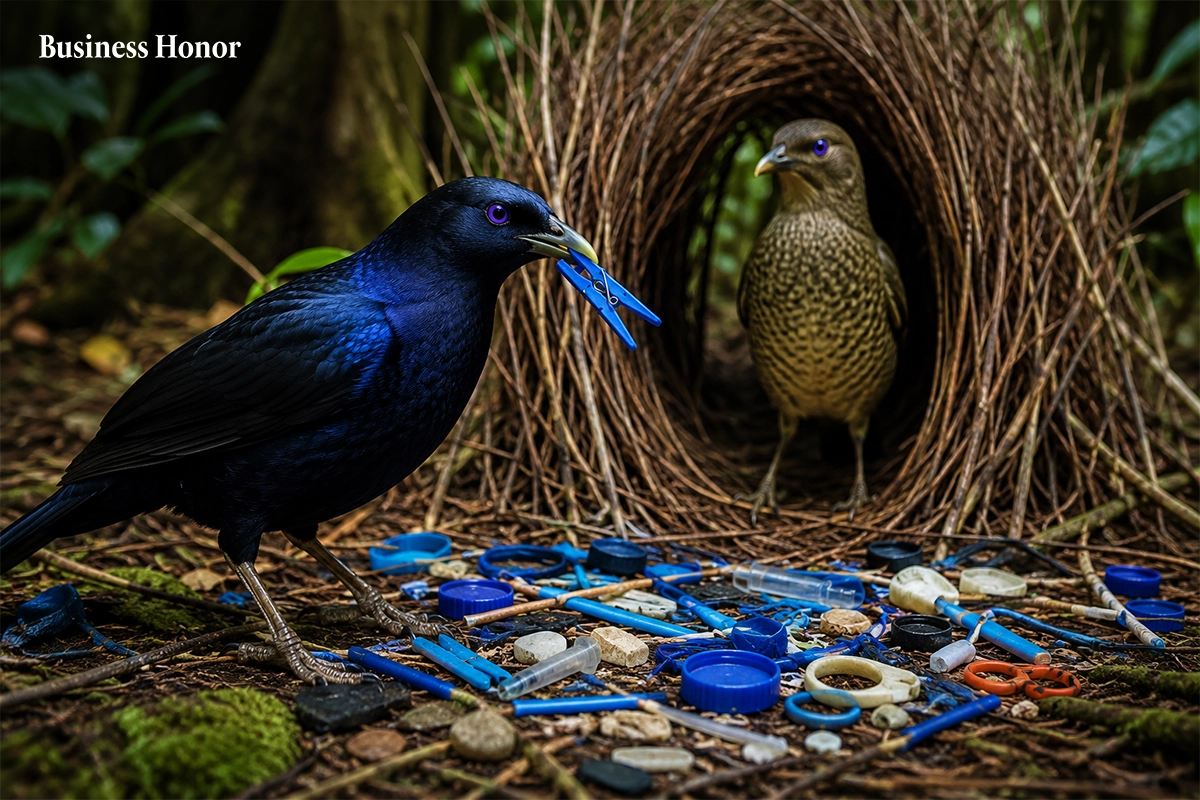
Australian Wildlife researchers reveal bowerbirds increasingly prefer human trash over natural decorations to attract mates.
|
Why Are Urban Bowerbirds Choosing Human-Made Objects?
Male bowerbirds in Australia's cities have developed an unexpected taste for human refuse, transforming discarded items into elaborate courtship displays that rival their rural cousins' nature-based creations. A groundbreaking study published in Royal Society Open Science on June 3 reveals how urbanization has fundamentally altered the mating strategies of great bowerbirds, with striking implications for how animals adapt to human-dominated environments in Australian wildlife.
Researchers examined 61 bowers across two sites in northern Queensland—one in the rural Dreghorn Cattle Station and the other in urban Townsville City—during the 2023 breeding season. They photographed each structure through ultraviolet filters and standard lighting to capture the bowers as both female bowerbirds and humans would see them. The findings proved dramatic: decorations on urban bowers were more than ten times more likely to be human-made than those in rural areas.
What Types of Human Trash Are Bowerbirds Using?
Urban bowerbirds frequently adorned their structures with green glass and red wire, while rural birds predominantly used green leaves, seeds, and the occasional green glass. However, the most striking discovery emerged from an experimental component of the study. When researchers presented males with mixed piles of urban and rural decorations near their bowers, the birds selected city-made items more than ten times more often than natural alternatives. The variety of human trash incorporated into these displays proved surprisingly diverse. Beyond colored glass and wire, researchers documented handcuffs, medicine jars positioned near hospital-adjacent bowers, and mouthguards discovered at sites close to sports facilities. According to study co-author Caitlin Evans, a behavioral ecologist at the University of Exeter, some homeowners have reported bowerbirds raiding garages specifically to steal nails and screws for their architectural projects.
Do Rural Bowerbirds Also Prefer Human-Made Materials?
The preference for human-made objects extends even to rural populations. Evans emphasized, "Even in rural areas, birds find items made by humans," suggesting that when given the choice, bowerbirds across all populations gravitate toward anthropogenic materials.
Why Might Female Bowerbirds Be Attracted to Garbage?
According to this study, urbanization by itself is not responsible for females' attraction to garbage. Behavioral ecologists have proposed two explanations as to why females may be attracted to garbage that were not initially considered. First, Daniel Baldassare (State University of New York at Oswego) contends that brightly colored artificial materials might have an especially strong attracting effect on females because color communicates important information when choosing a mate. "Definitely, females like things that pop," he says, adding that artificial colors are much more visually imposing than natural decorations.
Could Durability Make Human Objects More Appealing?
Another reason that females may prefer garbage is its durability. Objects made of plastic or metal do not decompose as quickly as berries or flowers; thus, the male has a lower amount of effort associated with keeping the item for a longer period during the breeding season. Females may regard the maintenance of an object as a sign that the male is healthy and dedicated, which could greatly influence the female's choice of a mate.
What Does This Reveal About Wildlife Adaptation to Urban Life?
The study adds to the body of research showing that animals are modifying visual post-mating behaviors in response to anthropogenic alterations (human-induced changes) to their environment and wildlife adaptation. While researchers have demonstrated that birds, frogs, and insects will change their vocalization pattern in response to background noise produced by humans, research on how visual mate-attracting signals are being modified in response to urbanization remains limited. As urban areas encroach upon the habitats of many wildlife species, it will be increasingly important to develop an understanding of these changes in animal behaviors so that we can conserve these animals.
Business Honor is of the view that urbanization represents a significant catalyst in reshaping bowerbird mating display strategies.
































.webp)

.webp)




.webp)