
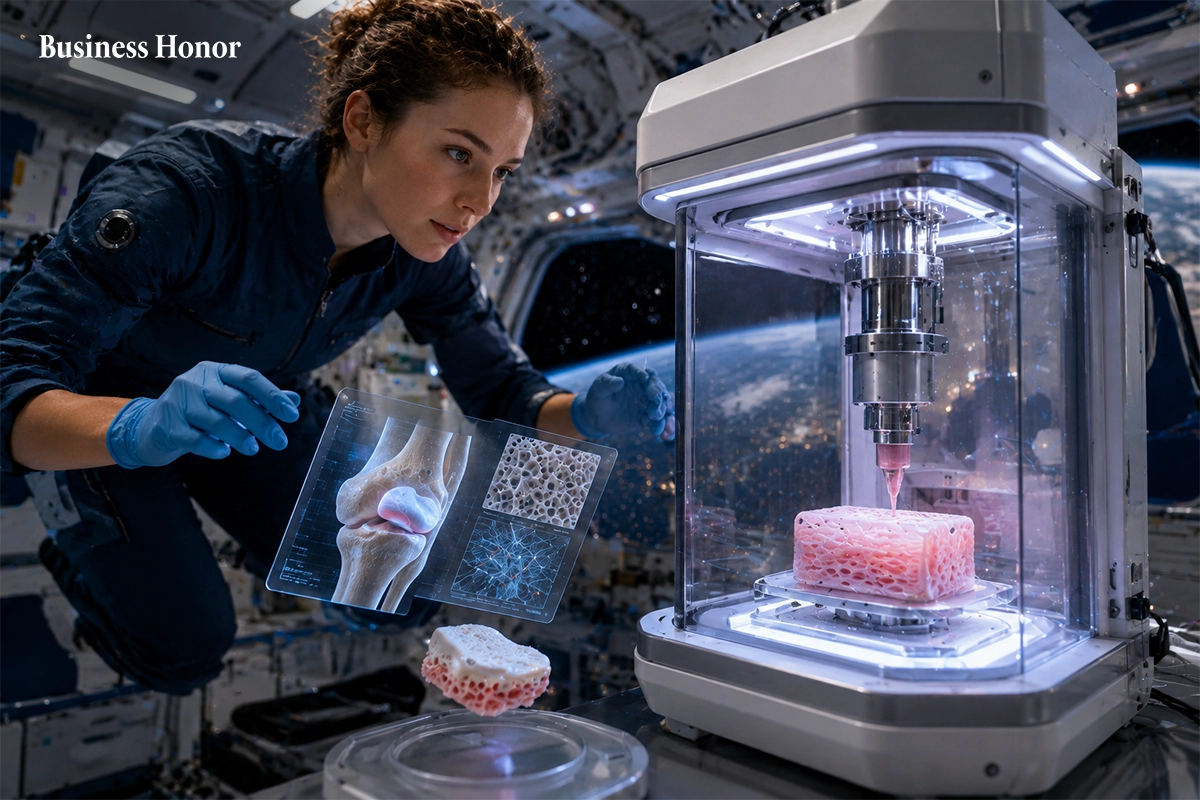
NASA's 3D bioprinting experiment in orbit demonstrates weightlessness enables scaffold-free tissue production superior to Earth-based manufacturing methods.
|
Astronauts onboard the International Space Station are performing a cutting-edge study that may change the way that doctors generate cartilage to replace joints damaged by injury and arthritis. The crewmembers of Expedition 74 are 3D bioprinting human cartilage tissue from viable cartilage cells as part of an experiment conducted inside the Life Science Glovebox of the Kibo module under microgravity and testing the theory that tissue developed in space is superior to those produced on Earth. The process starts with thawing cartilage cells and then adding bio-ink prior to placing them into a cartridge to be used in the bioprinter. The bioprinter prints highly complex shapes that would be physically impossible to make in a standard lab. According to NASA's crew activity reports, Jessica Meir (NASA) and Sophie Adenot (European Space Agency) completed significant bioprinter operations as part of this current research effort, which is going into a new production cycle this week.
The major issue with space-based bioprinting is the same challenge that bioengineers on Earth face, the force of gravity. As soon as biological tissues are laid down (bioprinted) on Earth, they sag and deform (due to their own weight). To counter this problem, researchers must build temporary scaffold structures around each printed layer, adding considerable complexity to the manufacturing process and limiting the shapes, they can ultimately create. These scaffolds must later be removed, which can damage the delicate tissue in the process.
In the weightless environment of low Earth orbit, this constraint simply vanishes. NASA's ISS Research Integration Office has noted that, without the downward pull of gravity affecting the printed layers during the critical gelation process, tissues are able to grow in actual three dimensions without collapsing. As a result, cells are distributed much more uniformly throughout the bio-ink matrix as it solidifies. For years, ground-based laboratories have attempted to recreate this situation, using a wide variety of sophisticated rotating bioreactors and clinostats that simulate the effect; none have been able to do so with any degree of success.
The working hypothesis is simple: if cells settle less during gelation, the extracellular matrix (ECM) they will produce should be uniform in structure; as a result, finished tissue will have greater mechanical strength and durability— precisely what patients needing cartilage replacements require in order to have long-term joint use. This current Expedition 74 mission builds upon years of previous ISS experiments. The BFF-Mensiscus-2 experiment utilized the ISS BioFabrication Facility to 3D print meniscus tissue (similar to knee cartilage) and compared the mechanics of meniscus tissue printed in space with meniscus tissue printed on Earth. The results of this experiment confirmed the feasibility of creating cartilage scale structures in a microgravity like environment, and were successfully returned back to Earth for detailed analysis. By late 2024, Johnson Space Center (NASA) had verified that the results of this NASA funded grant have demonstrated the feasibility of performing 3D bioprinting of meniscus tissue in space.
Business Honor is of the view that NASA's 3D bioprinting initiative aboard the International Space Station represents a transformative advancement in regenerative medicine manufacturing and orbital biotechnology capabilities.










.webp)

.webp)





.webp)

