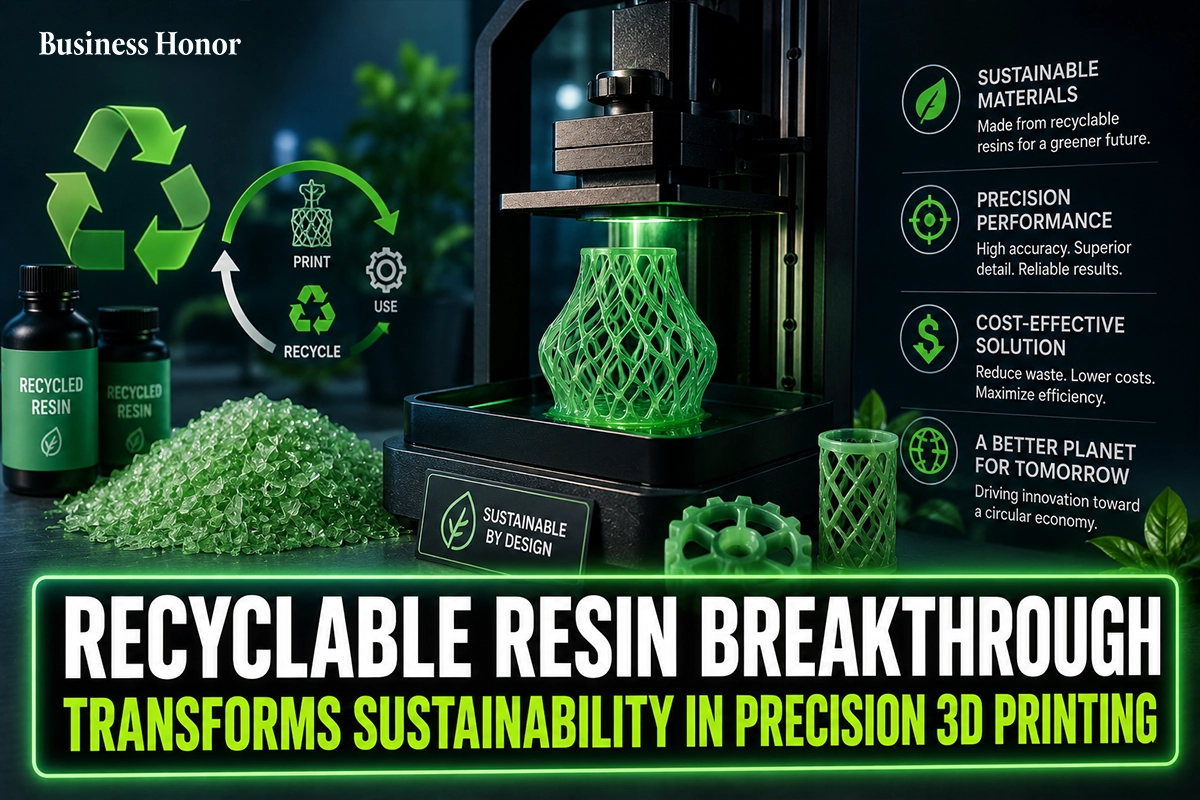
Japanese researchers unveil recyclable resin technology that survives ten printing cycles, revolutionizing sustainability in high-precision 3D printing manufacturing processes.
|
YOKOHAMA National University is working on new developments in the area of sustainable manufacturing by producing a new type of recyclable resin specifically designed for high-precision 3D printing. One issue that has a significant impact on the environment, caused by traditional stereolithography, is the irreversible waste caused by curing photo-cured resin with light.
The highlight of this project is a chemical compound known as anthracene, which can undergo reversible light-driven reactions. Unlike conventional resins that become solid after curing, this new material undergoes photodimerization when exposed to light and forms cross-linked structures. The reverse of this reaction occurs through heat, allowing the resin to return to its liquid state for reuse. This means that this resin can be reused multiple times before needing to be discarded and eliminates the need for photoinitiators, chemicals used to cure photo-cured resins in 3D printing systems utilizing ultraviolet light.
"3D models made from photocured resin can be wasted because there is no way to recycle them, creating concerns about the environmental impact of discarding 3D-printed photopolymers," said Project Lead Professor Shoji Maruo. "The elimination of photoinitiators reduces the complexity of the resin formula, while also eliminating contamination that can occur during the recycling process due to additives found in non-recyclable photopolymers."
YOKOHAMA has developed a method for creating resins that can be recycled multiple times without the use of initiators or additives, unlike previous attempts that experienced severe degradation after only a few cycles. This study compared the method of testing with laser scanning technology (i.e., the creation, and replication of a butterfly) against other traditional methods. The researchers created the word “YNU” ten times of equal quality in terms of surface finish using the same technique (i.e., laser scanned) and the same material as was used for creating the butterfly. For verification purposes, the researchers used the same material and made a cubic prototype, heating it to 150 ° Celsius (302 ° Fahrenheit) for 15 minutes, turning it into a disc. After testing, they are able to confirm that their recycled material had much less degradation as opposed to existing recyclables used for stereolithography.
"The results illustrate that the recyclable resin can be patterned in any shape, with precise patterns, using laser scanning technology which confirms that it is a suitable material for two-photon lithography," said Robyn Dossey, Assistant Professor (Special Appointee), and researcher. "The reversible photodimerisation of anthracene provides a feasible pathway to the development of recyclable materials used in light-based 3D printing procedures."
The researchers' goal is to take this work further by adapting the resin to larger-scale 3D printing equipment while enhancing the longevity of the materials. This project provides a possibility for helping to eliminate waste in precision manufacturing, while still delivering the unparalleled production quality of stereolithography products.
Business Honor is of the view that YOKOHAMA National University's recyclable resin represents a transformative advance in sustainable 3D printing technology and environmental responsibility.
FAQsQ: What makes this recyclable resin different from traditional 3D printing materials? A: It can be heated and melted repeatedly without losing performance, unlike permanent resins. Q: How many times can the resin be recycled? A: The researchers successfully tested it through ten complete print cycles with minimal degradation. Q: What chemical process enables the resin's recyclability? A: Anthracene undergoes reversible photodimerization, allowing hardened prints to return to liquid state when heated. Q: Why was removing photoinitiators important for this innovation? A: It simplified composition, reduced contamination from additives, and improved the recycling process significantly. Q: What are the next steps for commercializing this technology? A: Adapting the resin for larger-scale printing systems while improving long-term material stability and durability. |


































.webp)

.webp)



.webp)