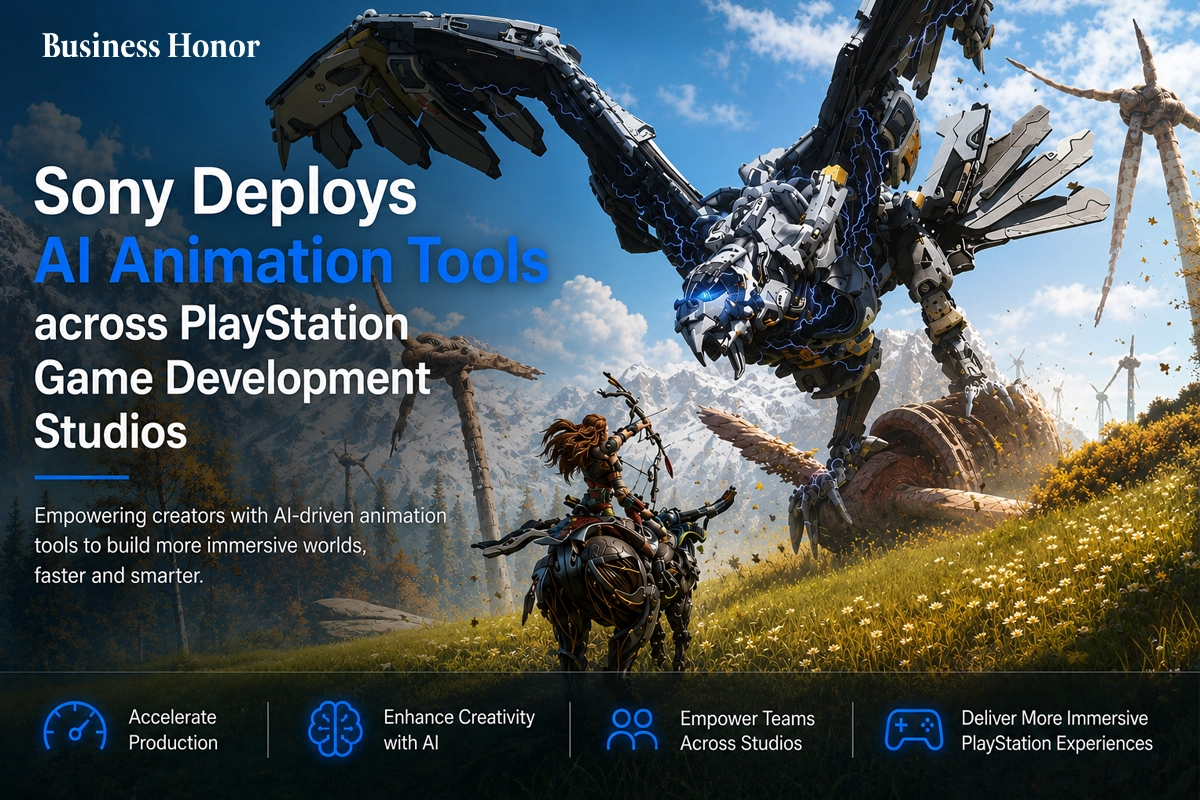
Sony's adoption of AI animation tools in game development marks a strategic shift toward automating production workflows.
|
Sony Interactive Entertainment (SIE) has implemented AI technology in an integral way to enhance its ongoing video game development business. Earlier this month, President and CEO Hideaki Nishino presented at a company-wide strategy meeting on how SIE is currently using AI animation tools to help automate its video game design methodology. Instead of solely developing fully generative AI content, the company has adopted a productivity-oriented approach that utilizes AI to automate repetitive tasks, allowing creative professionals to focus on their art and the creation of emotionally resonant stories.
Where does AI fit into game development?
AI animation tools now exist at many of SIE’s PlayStation Development Studios. For example, the Mockingbird Tool allows for the generation of three-dimensional facial animation based on performance-capture data. This represents an important advancement for reducing production timelines. As developed with the remastered version of Horizon Zero Dawn, hairstyles inspired by real-world hair were converted into highly detailed three-dimensional models using video footage. Previously, building hairstyles like these required extensive manual work.
Nishino indicated that both Naughty Dog (the developer of the Last of Us franchise) and San Diego Studio, which is also part of the PlayStation studios, used AI Animation technology to accelerate production processes, streamline their production pipelines, and enhance productivity by automating repetitive production tasks (e.g., quality assurance/test automation, three-dimensional modeling, etc.). Currently repetitive production tasks dominate development resources but offer no creative value to the games developed by these studios.
Can AI improve efficiency without replacing creativity?
Even with the emphasis on being efficient, Sony has been clear that "the vision of our games, the design of our games, and the emotions that we want to portray through our games will always come from the talent of the individuals who create them, whether they are from our studios or from other studios." This type of statement shows an increasing concern among video game developers in the industry that AI will have a greater influence on the culture of creativity than any other aspect of our society. Sony previously announced that they are collaborating with Bandai Namco to determine ways that AI can work in conjunction with existing technologies to help achieve the vision of their creators in producing video content.
Sony also mentioned that they plan to continue using AI in the production of their hardware. They have advised that the use of AI will help produce higher quality images for the PlayStation 5 Pro, providing a much more immersive experience for players and providing publishers with a much better environment in which to produce video games.
How is the industry handling AI disclosure?
An interesting note is that there is no mention of AI game development on the Fallout: New Vegas (PC) Steam store. The absence of the AI disclosure is a result of Valve's current policy, which states that developers only need to disclose AI-used assets (like a game character model) when the entire creation of the asset is automated by AI. The distinction between fully AI-generated assets and assets that were assisted in the workflow process by AI has become increasingly relevant as the gaming industry tries to find a way to balance technological advancement with consumer uncertainty and skepticism.
Business Honor is of the view that Sony's deployment of AI animation tools represents a strategic advancement in game development efficiency and creative production capabilities.



































.webp)

.webp)



.webp)