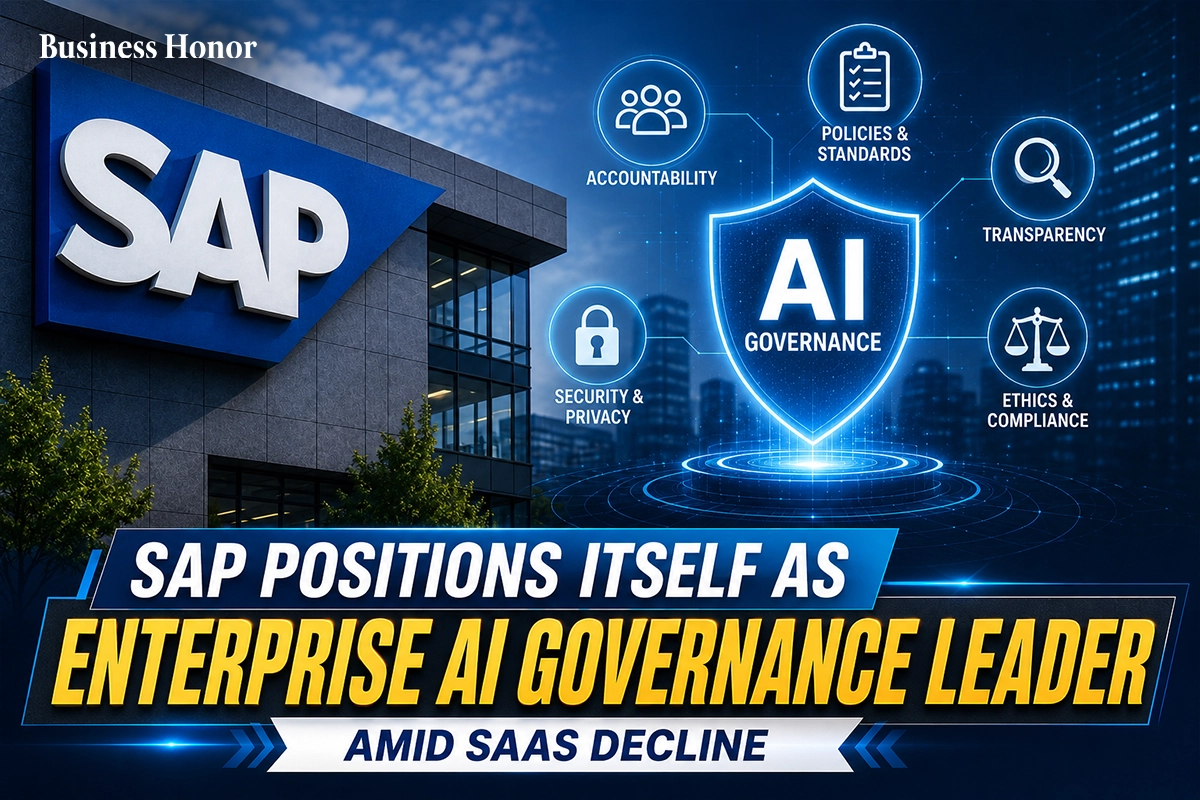
AI Governance emerges as critical differentiator as enterprises demand trustworthy artificial intelligence within mission-critical business operations globally.
|
In 2026, the enterprise software industry faced an existential threat from the so-called "SaaSpocalypse" in Wall Street. In anticipation that large language model-based artificial intelligence would disrupt traditional subscription models, billions in market value were wiped off the books in a matter of days. The world's largest enterprise resource planning software vendor, SAP, suffered tremendously, with share prices dropping nearly 30% over the course of a year after analysts disappointed in cloud revenue growth and were looking for confirmation of longer-term prospects.
Can enterprise software survive the “SaaSpocalypse” disruption?
Rather than retreat, SAP's leadership seized the moment to reframe the competitive landscape. At Sapphire, the company's flagship annual conference, CEO Christian Klein directly addressed the technological disruption reshaping his industry. "Some time ago, I asked myself, 'Will SAP actually be a software company in the future?'" Klein told assembled business leaders and developers.
While acknowledging AI's revolutionary capabilities, he pointed out a major limitation: businesses require decision-making to be more accurate than today's best language models produce. An 80% correct answer does not meet the standards of enterprise architecture, where a mistake can have grave ramifications.
Why isn’t “80% accurate AI” enough for enterprise decisions?
Klein's insight is predicated on the existence of a major chasm between the capabilities provided by general-purpose AI systems versus the demands placed on enterprises to operate successfully in a complex manner. General-purpose AI systems such as large language models do an excellent job of generating content from publicly available (internet-based) content - i.e., generating text, images, and code; however, they do not have training on a business's proprietary information nor their organizational processes. Additionally, they do not enforce compliance with established AI governance requirements, such as security frameworks, privacy frameworks or identity authorization processes.
SAP has taken advantage of its history as a leader in the field. With a rich experience of over fifty years, SAP has amassed valuable experience in enterprise resource planning (ERP) systems. To tap into this vast store of domain knowledge, SAP has proposed using knowledge graphs—complex representations of the relationships between people, places, things, etc.—within AI agents. For example, a supply-chain knowledge graph contains the components, suppliers, shipments, and locations of each item that can be traded within a supply chain in one place, allowing for the creation of a digital twin based on real data and not on the assumptions of an individual.
How do knowledge graphs strengthen enterprise AI systems?
The core solution for SAP Business AI at Sapphire is based on these knowledge graphs, along with domain models trained on SAP's own codebase and the introduction of a data management solution needed to create a unified master data record. Via SAP's AI agent framework (Joule), SAP demonstrated the entire architecture of this solution via a financial forecasting task that was accomplished using the language model capabilities of SAP's AI and from actual access points to exact ERP processes and data fields governed by company policies before sharing results.
Can AI agents safely operate across complex enterprise systems?
Philip Hertzig, Chief Technology Officer, SAP, provided details on the benefits associated with practical implementations. The vast majority of traditional discovery processes that required days of workshops can now be replaced with a simple question-and-answer process. Additionally, process-consulting agents can diagnose issues and allow for rapid deployment of specialized agents. Customers such as ABB have automated over 15,000 requests for quotes per year, creating millions of dollars in savings.
The strategy reflects recognition that large enterprises operate heterogeneous technology environments. SAP's approach incorporates non-SAP systems within a semantic data layer, ensuring agents function across diverse infrastructure while maintaining AI governance integrity.
Business Honor is of the view that SAP's strategic pivot toward AI governance represents transformative repositioning of enterprise software leadership capabilities amid industry disruption.
































.webp)

.webp)



.webp)