
Rising material costs in the luxury jewelry industry have created a need for a shift toward a more cost-conscious approach.
But when luxury has long been measured in carats, rarity, and price, how can this be achieved without compromising quality and aesthetic preference?
It has meant a shift toward more rigorous discipline: every gram of metal must justify itself through structural necessity or visual contribution.
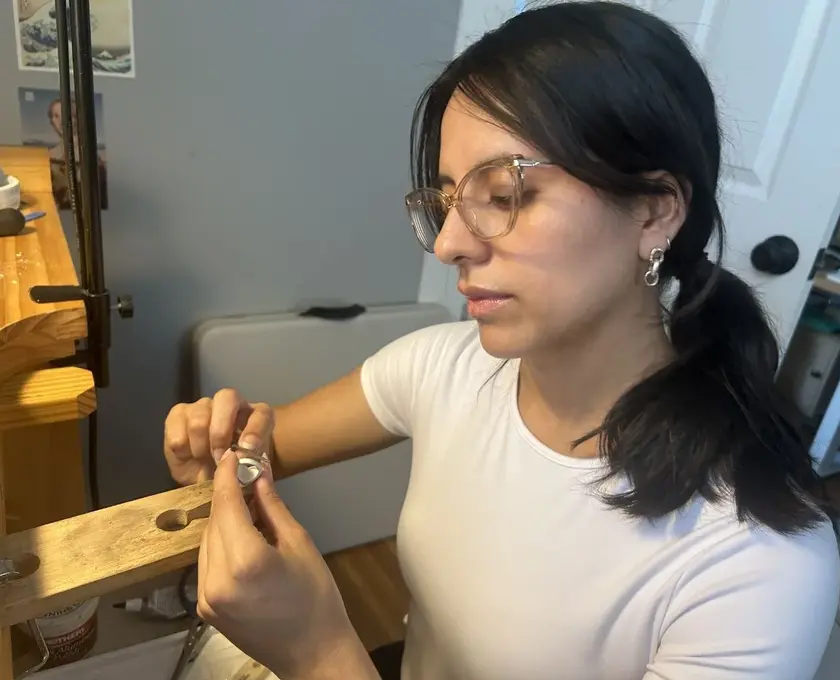
At the forefront of this shift is Andrea Ortiz, a New York-based jewelry designer, who believes a refined, practical material-optimization framework can maximize visual impact and structural integrity while deliberately reducing unnecessary weight.
Rising material costs, Ortiz explains, pushed her toward a more rigorous discipline: “Now every gram of metal must justify itself through structural necessity or visual contribution,” she says.
Ortiz does it by asking how little material she can use while still achieving the exact form, balance, and presence the concept demands. Nothing is added for weight alone.
She begins designs by asking how little material she can use while still achieving the exact form, balance, and presence the concept demands. Nothing is added for weight alone.
The framework is straightforward but exacting. Optimize the relationship between form, structure, and materiality so the piece remains strong, refined, and emotionally resonant at the minimum viable weight. In a commercial setting, Ortiz notes, brands discover they can maintain refinement and storytelling while significantly reducing material expenditure.
"The goal is never to make jewelry look less valuable," she says. "It is to make every element work harder, so the finished object feels considered, precise and precious for reasons that go beyond the raw cost of the metal."
Economy, in this system, is not a constraint to be endured. It becomes another form of precision. One that forces cleaner decisions about form without any loss of artistic integrity.
Alongside this structural discipline sits an equally deliberate philosophy of value. For Ortiz, luxury is determined not by the rarity of materials but by the meaning embedded in an object. The story it tells, the craftsmanship that shaped it, and the emotional connection it builds with its wearer.
A jewelry consultation with Ortiz, then, does not begin with a metal chart. There is no immediate discussion of preferred stone shape or whether the finished piece should feel “classic” or “modern.” Instead, she might ask a client to imagine the person they love as a quality of light. Or a landscape. A plant. An animal. A season.
It is a nice way to begin designing a piece of jewelry. It is also, for Ortiz, the point.
The answers tend to travel somewhere that conventional design questionnaires cannot reach. A landscape might become resilient; a particular kind of light might suggest tenderness; a season might reveal playfulness or quiet strength. Slowly, almost imperceptibly, the conversation becomes less about jewelry and more about the emotional architecture of a relationship. By the time Ortiz begins drawing, the object already has a story to tell.
She calls this process Symbolic Inquiry, a methodology she developed and named herself. It is one expression of that same conviction: meaning and awareness are the true starting point of design.
Ortiz says: ‘’An object becomes precious through the intention invested in it, the discipline of its making, and the bond it forms with its eventual wearer. Materials matter, but they are not the whole story. Craft matters because it gives feeling a durable physical language.’’
That philosophy has carried Ortiz between worlds that are often treated as separate: contemporary art jewelry and commercial design, conceptual experimentation and production, cultural memory and the demands of the marketplace.
Along the way, her work has received IDA recognition, been selected for Art Jewelry Forum’s Outstanding Students of 2023, appeared at Design Miami and New York City Jewelry Week, and been exhibited at the Woodrow Wilson House in Washington, D.C.
The accolades are varied, but the thread running through them is remarkably consistent: an interest in transforming something intangible into something exact.
A Colombian Foundation
Ortiz’s expanded idea of luxury has roots in Colombia. She grew up surrounded by regional craft traditions in which handmade objects could carry far more than decorative value. They could hold memory, identity, place and cultural history. Yet many artisanal traditions have also occupied an uneasy position within conventional ideas of value, often celebrated culturally while being undervalued economically.
That tension became part of Ortiz’s vocabulary. The question, as she frames it, is not whether a material is conventionally precious, but what has passed between material and maker. A rare stone approached with little intention may carry less meaning than an everyday substance transformed through patient hands and a compelling idea. Luxury, understood this way, is not a function of expense. It is a measure of attention.
Her creative process therefore begins with what cannot be held: feelings, memories, associations, ideas, and treats emotion not as a theme but as a compass, directing decisions about shape, material, proportion, and finish.
Craftsmanship is the mechanism that allows those decisions to become physical, to turn an impulse into an object capable of surviving outside the moment that inspired it.
This distinction is important. Ortiz is not arguing against refinement or technical sophistication. Quite the opposite. Her work depends on them.
The point is that technical mastery should serve meaning rather than substitute for it.
That idea becomes especially vivid in her use of unconventional materials. Coffee beans, tea-dyed salt, porcelain, natural reed and paper fibers appear in her work as materials capable of carrying cultural, emotional and symbolic associations. They are not gimmicks. Ortiz refines, facets, treats and structures them, placing them into deliberate relationships with traditional metals.
For Ortiz, everyday materials are not novelties but equal carriers of meaning, refined, structured, and integrated until they function as legitimately as any precious metal. In her hands, a material crosses a boundary: from kitchen to gallery, from ritual to ornament, from ordinary substance to bearer of memory. The transformation is conceptual as much as technical.
The everyday is not made interesting merely because it is unexpected. It is made significant through context.
The Art of Asking Different Questions
The most distinctive part of Ortiz’s practice may be the moment before anything is made.
In conventional jewelry commissions, the conversation often begins with preference: metal, stone, silhouette, color, references. Ortiz instead searches for associations. She asks clients to describe another person through imagery, trusting that metaphor can reveal emotional information that direct questioning tends to flatten.
She guides clients through associative prompts, inviting them to describe a partner as a color, a landscape, a plant, an animal, a quality of light, or a season. The responses unlock qualities like tenderness, resilience, quiet strength, playfulness. That, as she puts it, "almost never surfaces in a standard conversation."
It is an approach that treats a relationship almost as a design problem. One whose dimensions are invisible but no less real.
The result is what Ortiz describes as a more precise emotional portrait. A ring or necklace is no longer simply an interpretation of aesthetic preferences; it becomes an attempt to give physical form to qualities that are difficult to articulate.
The method has also traveled beyond her own studio. Designers who studied with Ortiz at Savannah College of Art and Design (SCAD) have incorporated related approaches into their exhibition work, while other practitioners have adapted elements of her material treatments and consultation frameworks for commissioned and bridal design. The reported result is greater narrative coherence and a stronger emotional attachment to the finished work.
Influence in design is often difficult to measure. Here, it has a tangible footprint: techniques and questions moving from one practitioner to another.
That matters because Ortiz’s ambition is not simply to make objects that communicate her own ideas. She is also interested in changing the conditions under which objects acquire meaning in the first place.
The Architect’s Eye
Before jewelry, there was architecture. Ortiz earned her BA in Architecture, with a minor in Plastic Arts, from the University of Los Andes in Bogotá. She later trained directly in jewelry fabrication in Bogotá before completing an MFA in Jewelry at SCAD. The sequence is revealing. Her jewelry practice did not abandon architecture; it brought architecture closer to the body.
Ortiz continues to view each piece as a small-scale architectural intervention. One that engages the body rather than the built environment, negotiating with a human form rather than a landscape. The dialogue between structure, material, and human experience remains central to her practice.
For Ortiz, proportion matters. So does balance. Negative space matters. So does the exact relationship between an object and the person wearing it. A jewel must occupy space without becoming inert within it; it has to respond to movement, scale and the physical presence of the wearer.
Architectural education gives this instinct a structural vocabulary. It informs, she notes, a practical side of her work. A material-optimization system developed partly in response to volatile precious-metal costs. Ortiz looks for ways to maximize visual and structural impact while reducing unnecessary metal weight. Here, economy does not mean compromise. It becomes another form of precision.
Her MFA thesis collection, Linking Realms, offers perhaps the clearest synthesis of these ideas. The collection grew from the intersection of a personal coffee ritual and pre-Columbian golden objects associated with the linking of heaven and earth. Something intimate and contemporary meets something inherited and historical. The resulting pieces translate ritual and cultural memory into forms that are structurally resolved enough to function as jewelry while retaining the ambiguity of art.
The work received an IDA 2023 Silver Award in Conceptual Products, Food & Beverage and an IDA Copper in the Accessory/Jewelry category. It was also selected for Art Jewelry Forum’s Outstanding Students of 2023 and presented in a solo thesis exhibition in Savannah.
The recognition is notable precisely because the work resists easy categorization. It operates between object, ritual, and adornment.
When Emotion Becomes Form
If Linking Realms demonstrates Ortiz’s intellectual and cultural range, Beauty Interrupted reveals the emotional force behind the practice.
The award-winning necklace began, as Ortiz describes it, with a powerful emotional impulse: “It was a technical exercise, as well as a material experiment, and most importantly a feeling that demands physical form. Translating that feeling into something tangible without diminishing it became the challenge.”
That is where the rigor of the practice becomes visible. Raw emotion may be the beginning of a piece, but it cannot be its entire method. Jewelry has to be resolved. It has to be balanced. It has to withstand touch, movement, and time.
Beauty Interrupted receiving an IDA 2022 Silver Award in Accessory/Jewellery was a recognition that placed an emotionally driven work within the same competitive framework as more conventionally design-led objects.
Professor Jay Song, Chair of Jewelry at SCAD's School of Fashion and one of Ortiz's graduate supervisors, saw that quality firsthand.
"Andrea stood out from the very beginning of her graduate studies through a rare combination of technical command, original thinking, and conceptual clarity that few students at that stage possess," Song says. "Her necklace Beauty Interrupted remains one of the strongest student works I have supervised. An unconventional and sophisticated use of pearls that demonstrated both compositional intelligence and refined craftsmanship at a professional level. Her work carries a clarity of vision and artistic maturity that many practitioners take years, sometimes decades, to achieve."
Other works followed the same pattern of recognition. Cup of Home and The Salt Left On My Skin received IDA 2022 Honorable Mentions. Ortiz was a finalist for the CFDA Design for Justice MFA/MA competition in 2021. Her academic and creative trajectory was later recognized through the SCAD Outstanding Academic Achievement Award in the School of Fashion.
Ortiz’s work does not ask viewers to choose between feeling and technique. In fact, it insists that one should sharpen the other.
Between the Studio and the Market
There is another dimension to Ortiz’s practice that becomes visible outside the gallery. Commercial design requires a different kind of discipline. Ideas must move through specifications, suppliers, factories, deadlines and budgets. Brand identity has to survive the transition from concept to production.
Ortiz has worked in precisely that space. At The Accessory Think Tank, she designed jewelry, accessories and hardware for client brands, translating identities into CAD models and production-ready designs. At Deepa Gurnani, where she has worked in design and merchandising, her responsibilities have extended from seasonal collection development and trend and color research to material sourcing, factory coordination and private-label management. The experience has reinforced rather than diminished her conceptual approach.
Ortiz's system has also attracted attention from commercial players navigating the high-cost gold market without wanting to sacrifice design quality. Brands such as Natural Inclusion, Anturio Atelier, and The Accessory Think Tank have begun incorporating her Symbolic Inquiry method and material-optimization framework into their own processes.
These companies find that the structured questioning methodology of Ortiz’s Symbolic Inquiry not only yields more emotionally resonant pieces but also streamlines decision-making, reducing wasted material and production time in the process.
That balance is increasingly central to a design culture in which the distance between an artist’s idea and a manufactured object can determine whether the idea survives at all.
Ortiz knows both sides of that equation. Her professional life has also taken her through the contemporary craft and jewelry ecosystem: Design Miami, New York City Jewelry Week, the American Craft Council, AQUA, SNAG’s IN FOCUS exhibition, and the Fashioning Power, Fashioning Peace exhibition and gala at the Woodrow Wilson House.
The work has appeared in contexts ranging from galleries and academic exhibitions to fashion presentations, while professional memberships in Klimt02 and the Society of North American Goldsmiths place her within broader conversations around contemporary jewelry.
Teaching adds another layer. She has also worked as a Jewelry Teaching Assistant and Studio Monitor at SCAD and, in 2026, served as a guest lecturer in Professional Practices at Pratt Institute.
The movement between these settings suggests a designer comfortable with translation. It translates ideas into objects as well as between communities that speak different versions of the same design language.
The Wearer Finishes the Work
Perhaps the most revealing test of Ortiz's philosophy, and one she says is quietly being picked up by other designers, comes after the object leaves her hands. "A piece can carry the designer's intention while also becoming something entirely personal," she says. "It is shaped by the memories, emotions, and experiences of the person who wears it."
In her experience, a jewel absorbs the life of its wearer. Its meaning is not fixed at the moment of completion.
Meanwhile, in a museum, jewelry can be contemplated as an autonomous object. On a body, it becomes something else: a companion. It is present at dinners, departures, ordinary mornings and difficult days. It catches traces of a life that the designer cannot predict.
This is where Ortiz’s definition of luxury becomes most persuasive: “A jewel can be valuable because of its material, she says.
“It can also be valuable because of its workmanship. However, it can become valuable because someone has lived inside its story long enough for the story to become inseparable from their own.
A Different Measure of Precious
Ultimately, Ortiz’s practice invites a fundamental reimagining of jewelry’s purpose. While the traditional lexicon of luxury often centers on scarcity, the unattainable gem or the limited-edition artifact, she expands on these notions.
Her work demonstrates that genuine luxury can manifest through any substance when guided by deliberate intent and awareness. In this framework, meticulous craftsmanship, ethical discipline, and emotional resonance serve as the authentic metrics of preciousness.
This philosophy has yielded a tangible record of success, and her material-optimization systems and Symbolic Inquiry methodology have garnered significant IDA recognitions, Honorable Mentions, and Outstanding Academic Achievement Awards.
As well as this, Ortiz’s portfolio has been showcased at Design Miami, NYC Jewelry Week, the American Craft Council, and the Woodrow Wilson House for the Fashioning Power, Fashioning Peace exhibition.
In the commercial sector, studios grappling with volatile metal markets have actively adopted her optimization logic and narrative frameworks. Partners like Natural Inclusion, Anturio Atelier,
and The Accessory Think Tank have noted that her methodology fosters deeper wearer connection while simultaneously minimizing material waste and lead times. Her professional tenure at Deepa Gurnani, coupled with her pedagogical contributions at SCAD and Pratt Institute, underscores the utilitarian scalability of her conceptual vision.
Through this intersection of accolades, commercial validation, and academic reach, Ortiz proves that frugality and depth are not antithetical. A simple bean or a grain of salt becomes significant precisely because the architect’s eye and the maker’s discipline allow the wearer’s experience to finish the narrative.
What emerged as a pragmatic reaction to economic pressure has matured into a definitive paradigm for cost-conscious luxury: objects that remain emotionally potent and structurally precise while justifying every gram of their existence.
About Author: Liyaga Suresh Babu is an experienced news writer with strong expertise across a wide range of topics. She combines clear thinking with solid research to present news and industry trends in a simple, easy-to-understand manner. Her writing focuses on clarity, accuracy, and relevance, helping readers grasp complex issues effortlessly. With a strong understanding of current affairs, she delivers well-structured and informative content that appeals to both general readers and professionals seeking reliable insights.













.webp)


.webp)

