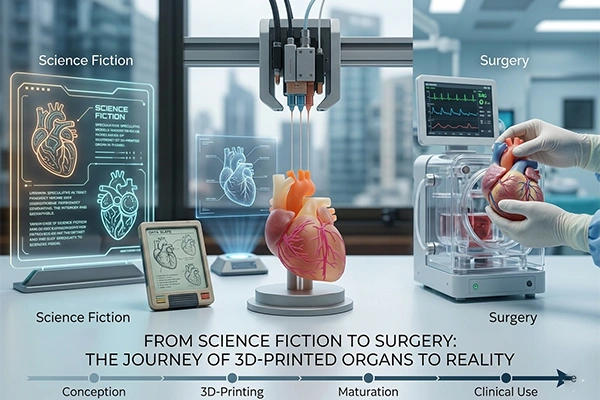
In the past, 3D-printed organs were viewed as something out of a science fiction movie, however, they have now created a new medical development. Scientists are now working towards one day delivering 3D-printed organs created from a patient’s own cells, foregoing the need to wait years to receive an organ from a donor. Acceptance rates by the body will greatly increase because of this new process. However, fully developed working hearts and lungs will still be many years away from becoming available.
What Are 3D-Printed Organs?
3D printed organs are replicas of human tissue engineered using bioprinting methods. Rather than plastic, bioprinters utilize what is called "bio-ink," a combination of living cells and other supportive material containing collagen, gelatin, or alginate. The bio-ink is deposited in layers according to an electronic 3D representation of the organ being printed, which is normally based on either MRI scans or CT scans.
To be functional, three-dimensional printed organs must not only have the proper external shape, but also have the multiple types of cells found inside an organ, all positioned exactly where they are needed to allow all of the parts of the organ to work together. For kidneys, for example, there are over 30 different types of cells required to create a fully functional kidney, none of which will be useful if positioned incorrectly.
The early experiments with bioprinting used modified inkjet printers to deposit protein-based materials like collagen. As research has progressed, scientists have been gradually adding scaffolds, which are biodegradable supports that allow cells to attach and grow in order to help produce the cells for the printed organ. Some laboratories have started to use scaffold-free printing methodologies, with small clumps of cells named spheroids that can then fuse together to form tissue.
Milestones Achieved
While we do not currently have fully functional internal organs, there are some significant achievements that have been made in this area. For example, in 1999 researchers at the Wake Forest Institute for Regenerative Medicine successfully implanted a laboratory-grown bladder into a patient. The bladder continues to function properly after more than 10 years. Because bladders consist of two types of cells, they are easier to bioprint than other types of organs.
More recently, 3DBio Therapeutics successfully implanted a 3D-printed ear made from a patient’s own cartilage. Also, mobile bioprinters can print skin onto wounds, and 3D printed tracheas have been used temporarily to save patients’ lives. These examples indicate that simpler organs and structures are transitioning from research to limited use in clinical settings.
What is the importance of 3D printed organs?
Shortages of organs are a global hindrance to medical practice. Each year, thousands of patients do not survive while waiting to receive an organ transplant. In the United States alone, an estimated 100,000 individuals are on a waiting list with the help of the Organ Procurement and Transplantation Network.
Using a printing process, there are great advantages of the usage of 3D printed organs:
-
Personalization: Printed organs made with the patient’s cells will reduce the chances of rejection.
-
Speed: Organs can be printed within weeks rather than years, waiting for a donor.
-
Cost Reduction: Even with the cost of donating organs, organ transplants are costly. The use of bioprinting technology could eventually lead to lower process of transplantation.
-
Reduction of Animal Testing: Bioprinted tissues are currently used to test new drugs and cosmetic products. This will assist in reducing the use of animals in research.
Major challenges
Even with progress in this area, the printing sophisticated organs like hearts or lungs remain extremely difficult.
- Blood Vessels
Big organs need several tiny blood vessels in order to transport oxygen and nutrients. Without them, cells will die within short order. Small networks of blood vessels have successfully been printed but expanding them to large sizes poses even larger problems.
- Complexity
Organs like kidneys contain dozens of cell types, that are organized in specific spatial patterns. It is essential that the printer prints these cell types in the correct location for the organ to function properly.
- Biomaterials
The scaffolds must be able to hold the cells while still being biocompatible, which will not harm the patient, and biodegradable after completing their task. So far, no combination of materials has been discovered that meets these conditions and can be printed.
- Cell Viability
Printing cells with high pressure or without adequate nutrient supplies can cause damage to the cells. Maintaining cell viability (keeping the cells alive) when printing large structures is difficult.
- Regulation
Even if it is physically possible to print an organ, there will be a significant amount of time before the first organ will be clinically available, due to the regulatory process that must be followed in order to have the necessary data to demonstrate to the regulatory agency that it is safe and effective before it can be used in humans.
Are we close to achieving this goal?
Medical professionals estimate that transplantable human internal organs could be available in 15 to 30 years. Simpler tissues (skin, cartilage) or other types of patches (heart) can likely be made and available sooner. Organoids or "mini-organs," have been created from stem cells and are currently being used as research tools and as testing platforms for drugs. Researchers would like to increase their size to provide similarly functional organs, but several problems must be resolved first, including how to vascularize and perfectly position each cell.
Printed hearts are not yet a reality; however, the progress made in bioprinting some human organs continues forward. As the medical field progresses through each new milestone, we move one step closer to eliminating death caused by organ shortages. 3D organ printing is no longer an imagination, rather, it is being done by scientists today. As the research continues, it is likely that this generation will witness the ability to print and transplant functional organs.




































.webp)

.webp)



.webp)