
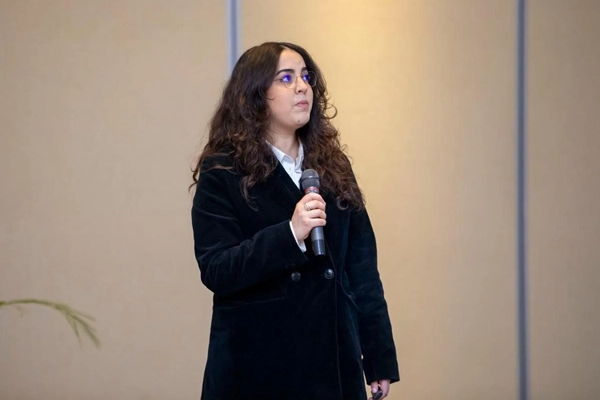
Innovation is in every industry—from transportation to food—but many companies still struggle to turn big ideas into lasting success. The most successful products are rarely the most technologically advanced. Instead, they fit naturally into people’s daily routines.
Unfortunately, many companies overlook this. Nearly 80% of new consumer products fail within their first year, often because they don’t fit naturally into consumers’ routines. In the CPG space, this has played out repeatedly. For one, Coca-Cola’s “New Coke” famously flopped in 1985 despite heavy marketing, because it replaced a taste people already loved.
Even smaller brands struggle when innovation misses the mark — for example, protein bars with unusual flavors or packaging that feels inconvenient often get abandoned on shelves. These show just how risky it is for businesses to launch products before fully understanding how consumers actually behave, and it is the very gap that Soukayna Lakhsassi aims to bridge.
She approaches this challenge by grounding innovation in human-centered insights: “Technology and ideas can scale, but understanding daily habits is what tells you which products will stick. The hardest part is truly understanding consumers, and not falling into the trap of thinking they see the world the same way you or your team do,” she explains.
Applying this mindset in the CPG sector, this business development specialist focuses on designing products and strategies that align with how people actually live their daily lives, believing that lasting growth begins with a simple question: how do people really live their everyday routines?
To answer that question, Lakhsassi combines consumer research, data analysis, and strategic experimentation to ensure products are built around real needs rather than assumptions: “A lot of people assume customers think the same way they do,” she says. “That’s why many products miss the real pain points, habits, or little moments that make people happy. Sometimes the real insight comes from something small, like watching how someone makes tea or uses an app, and suddenly you start to see larger behavioral patterns.”
For Lakhsassi, meaningful insights emerge only when quantitative analysis is paired with real-world observation: “One thing I’ve learned is that data alone doesn’t tell you the full story. You have to pair the numbers with observation, how people actually move through their day, the shortcuts they take, the friction points they tolerate,” she adds.
Today, this human-centered lens guides much of Lakhsassi’s work across industries. Whether evaluating a mobility service or designing a shelf-stable food product, she begins with the same core question: “How does this fit into someone’s daily routine? If the answer isn’t obvious, the product probably needs to evolve,” she shares.
She emphasizes that this philosophy is particularly important in consumer packaged goods: “Food products succeed when they solve a real everyday need—speed, comfort, familiarity, nutrition. If you don’t understand that context, it’s very hard to build something people will adopt.”
Lakhsassi didn’t develop this perspective overnight. It was shaped over time through a career that spans engineering, policy research, and strategy consulting. Each stage gave her a different perspective on the challenges of innovation.
Her path also differs from the typical business development route. Instead of starting with an MBA, Lakhsassi began her career in engineering, working on renewable energy and international development initiatives.
The technical training gave her a systems-oriented way of thinking about complex problems: “Engineering trained me to think in systems. But working across policy, consulting, and now CPG, taught me something equally important: systems only work if people adopt them,” she shares.
Recognizing that technological solutions often fail without social and economic alignment, she later expanded her expertise by earning a Master’s in International Affairs with double majors in Data Analysis and International Economics.
Lakhsassi’s time as a Fulbright Scholar at American University’s School of International Service gave her a unique edge. The program combined data analysis with policy studies, helping her turn complex datasets into insights that reflect real-world economic trends. On top of that, she built strong technical skills in tools like R, MATLAB, Tableau, and geospatial platforms, which she used in consulting and research projects: “Data analysis is powerful, but the real value comes when you translate it into strategic decisions,” she shares.
This interdisciplinary experience and expertise allowed her to connect quantitative analysis with real-world market behavior: “The mix helps me spot opportunities others might miss. A lot of my work sits at the intersection of numbers and behavior—you build the quantitative model, but then you pressure-test it against how people actually live.”
Lakhsassi first applied this principle early in her career while working with the German Development Agency (GIZ), advising Morocco’s Ministry of Energy on efficiency initiatives. She also conducted more than fifty energy audits in the private sector: “My early work was very technical—energy audits, efficiency systems, and development programs. But those experiences taught me even the most sophisticated systems fail if people don’t actually use them,” she recalls.
That lesson stayed with her. She also conducted research at CSIS, focusing on renewable energy and post-conflict reconstruction in the Arab world.
She recalls: “When I was at CSIS, I worked on a major project looking at how to restore power systems in countries affected by conflict in the Middle East. One key finding was that many previous foreign assistance efforts struggled to achieve tangible impact. Large infrastructure projects are often the default approach, but they don’t always address the on-the-ground challenges communities face after conflict,” she shares.
The research emphasized the importance of scalable, community-centered solutions: “Large systems change rarely happens through one big intervention. Even in conflict-affected areas, the solutions that worked best were those that people could integrate into their everyday routines, not those imposed from above,” she says.
These early experiences would later shape how she approached innovation challenges in the private sector.
Lakhsassi later brought this behavioral perspective into strategy consulting during her time at McKinsey & Company, where she worked on diversification strategies in the transportation sector while contributing research to the McKinsey Center for Future Mobility.
The Center is a global research initiative examining how transportation systems are evolving as electrification, shared mobility, and new ownership models reshape the industry.
Within the initiative, Lakhsassi focused heavily on understanding how consumer behavior influences the adoption of emerging mobility solutions. Much of her work involved interpreting large consumer datasets to uncover patterns in how people adopt new transportation models: “The value of the data wasn’t the numbers themselves, it was translating behavior into strategy—what consumers are actually willing to change in their routines,” Lakhsassi explains.
Transportation discussions often revolve around engineering and infrastructure, but Lakhsassi’s research highlighted the critical role of human behavior: “The key question is behavioral—why does someone choose a car instead of a bus, or a shared bike instead of walking,” she shares.
Her research contributed to proprietary datasets analyzing global mobility trends, particularly the rise of shared transportation systems such as car subscriptions, bike-sharing platforms, and electric scooters: “We generated proprietary data on global transportation futures—looking at shared mobility, public transit, and energy reduction scenarios. The goal was to understand not just the technology, but the consumer drivers behind adoption.”
While much of Lakhsassi’s research focused on large-scale mobility systems, her work also extended to detailed product design decisions.
In a project with her team, she conducted extensive user research on vehicle infotainment systems, testing screen interfaces, background displays, and app integration to understand how drivers interacted with the vehicle’s digital environment: “Even something as simple as screen layout can affect satisfaction. Those insights come from observing behavior,” she explains.
She led consumer insight programs, including surveys and focus groups, to understand how drivers used digital features inside electric vehicles. She then translates those insights into product improvements and higher user satisfaction.
In one user test, just moving a placement on features reduced driver frustration by almost half. Findings like this taught her an important lesson: people often behave similarly, no matter what product they’re using. As she puts it: Consumers behave similarly whether they’re choosing transportation or choosing food.
Lakhsassi’s analytical approach became particularly valuable when she began working on venture-building and corporate diversification initiatives. One example was her work through McKinsey’s LEAP program, a venture-building initiative designed to test new business models.
Lakhsassi conducted extensive market sizing for six startup concepts, evaluating revenue potential, cost structures, and addressable markets: “We narrowed it to two viable ventures—one already launched—by grounding ideas in consumer data,” she recalls.
While working in McKinsey’s LEAP venture-building program, she tested new startup concepts by analyzing what customers wanted, how competitors were performing, and whether the business model could scale effectively. Her work helped leadership teams decide which ventures were commercially viable and worth launching.
Market sizing, she explains, is often misunderstood as purely technical work: “Market sizing sounds technical, but it’s really about understanding people—how big the demand could realistically become and whether behavior supports it. If the consumer behavior isn’t there, the business model rarely works—no matter how interesting the technology is,” she shares.
The project also involved forecasting long-term trends and ensuring that diversification strategies were grounded in realistic consumer adoption patterns rather than speculative innovation.
While mobility and energy systems may seem far removed from grocery store shelves, Lakhsassi sees strong parallels: “Consumers behave similarly whether they’re choosing transportation or choosing food. They’re balancing price, habit, convenience, and values,” she explains.
That realization made her transition into consumer packaged goods feel less like a career shift and more like a continuation of the same analytical approach: “At the end of the day, it’s still about understanding daily decisions—what someone picks up from the shelf, what they repurchase, what becomes part of their routine,” she adds.
Today, this business development expert is developing a shelf-stable food product designed to meet everyday consumer needs through ethical, consumer-first design: “Working in CPG today feels like the natural convergence of everything I’ve learned. You combine consumer insights, market sizing, operational strategy, and product design—but the ultimate test is whether people pick the product up again next week,” she shares.
Lakhsassi’s inspiration and philosophy partly come from her upbringing: “My mother has run a catering business in our hometown for more than fifteen years. Watching her manage quality, customer expectations, and daily operations taught me the importance of aligning products with what people actually want,” she explains.
Being around food preparation while growing up also influenced how she thinks about product development: “Convenience doesn’t have to mean sacrificing authenticity. In CPG, the challenge is translating traditional cooking values into formats that work for modern routines.”
Lakhsassi emphasizes that it's important to start by asking where consumer demand is already emerging, then design the product around that signal rather than forcing a concept into the market. As she puts it: “It’s about listening to the market first, then innovating on top of what’s already working.”
Others are quick to confirm her abilities in the consumer sector. Yasser Sbihi is a Senior Manager and has worked with Lakhassi. They met when he was recruiting for a freelance role on a demanding consulting project. After reviewing her profile and speaking with her, they worked together on several workstreams and client-facing deliverables throughout the engagement.
He says: “Soukayna has a rare ability to combine sharp analytical thinking with strong communication and positioning instincts. She can develop a strategy and ensure it lands effectively with stakeholders.
“What is also unique about Soukayna is her talent for making complex topics accessible without losing substance. She shapes ideas into clear, resonant narratives that different audiences can truly understand.”
Speaking to one specific project, he recalls: “‘When we worked together, Soukayna consistently stepped back during our project to ask whether we were addressing the core issue clearly and practically. That reflective approach strengthened both our thinking and our final deliverables. There is no doubt she excels at translating complex recommendations into simplified, sharpened messaging. Under tight timelines, Soukayna helped us refine storylines and improve the overall flow of presentations, making them far more impactful.”
He adds: “Soukayna brings structure and practicality together beautifully, which is a highly sought-after skill in this area of work. She ensures work remains rigorous while staying relevant and actionable — a balance that is incredibly valuable in strategy consulting.”
Across industries—from energy systems to mobility and food—Lakhsassi sees a consistent lesson: “True resilience comes from human insights—understanding pain points to create adaptable growth,” she says.
Whether designing a shared mobility service or a snack brand, the principle is the same: study real behavior, not assumed behavior. For her, clarity emerges when companies combine consumer research with market analysis: “Companies often come to advisors because decisions feel foggy. When you combine consumer research, market data, and a sense of human behavior, the path forward suddenly becomes obvious,” Lakhassi explains.
As industries face rapid disruption, from electrification to sustainability demands, Lakhsassi emphasizes starting with people: “One thing about this industry is that the feedback loop is immediate. You can see how people interact with a product in real life. That’s where innovation becomes meaningful.”
Across mobility, energy, and CPG, she proves that growth rooted in human-centered insights is sustainable. The secret, she notes, is simple: start with real human behavior, and build from there. “The industries may look different, but the principle is consistent,” she adds.
About the Author
Liyaga Suresh Babu is a skilled writer known for creating clear, engaging, and informative content. With a strong attention to detail, Liyaga simplifies complex ideas into easy-to-understand insights. Passionate about delivering value to readers, her writing combines accuracy with clarity, aiming to inform, engage, and make content accessible and meaningful to a wide audience across diverse topics.









.webp)

