
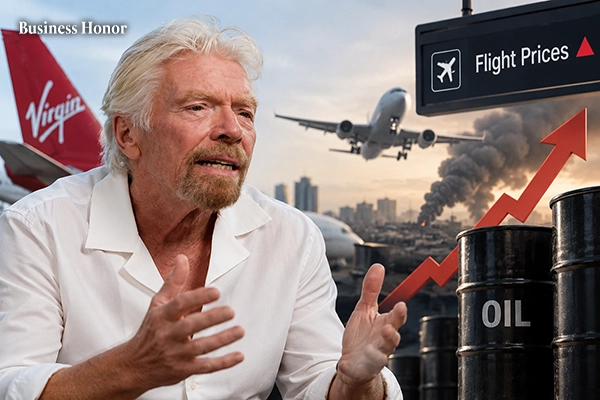
Richard Branson blames war for rising Flight Price costs as expensive jet fuel pushes airlines to raise fares and add new surcharges.
-
Richard Branson blames wars for rising Flight Price costs as oil and jet fuel prices climb.
-
Virgin Atlantic adds fuel surcharges, reaching £360 for business-class passengers.
-
Jet fuel prices jumped above $1,800 a tonne, putting fresh pressure on airline fares.
-
Ryanair warns of higher fares and has reduced parts of its winter schedule.
-
Virgin Atlantic plans to fly 95% of its normal winter schedule, despite continued fuel-cost pressure.
Virgin Group founder Richard Branson has blamed “foolish leaders” starting wars for rising Flight Price pressures, arguing that the conflict involving Iran has pushed oil and aviation fuel costs sharply higher.
Branson said the Iran conflict was unnecessary and pointed to the earlier nuclear agreement involving Iran, the U.S. and European powers. He argued that the breakdown of that arrangement helped create economic consequences that are now reaching airline passengers through higher fuel costs and inflation.
But who ultimately pays when geopolitical decisions reach the airport counter?
European benchmark jet fuel prices, which had been around $800 a tonne, climbed above $1,800 in April following the outbreak of the conflict. Prices have since eased to about $1,450, but remain well above earlier levels.
Virgin Atlantic responded in May by introducing a Fuel Surcharge, adding £50 to economy fares, £180 to premium and £360 to business tickets.
The airline’s chief executive, Corneel Koster, said the surcharge was necessary at current Jet Fuel Prices, while acknowledging continued uncertainty around the Middle East.
Are airlines simply passing on higher costs or are passengers becoming the easiest target?
Virgin is not alone. Other airlines have also raised fares or reduced flights since the conflict began. Teneo said in April that air fares had risen by 25% in connection with the Iran war.
Ryanair has since announced cuts to its winter schedule because of higher fuel costs. The airline has warned that European short-haul fares could rise further if fuel prices stay high until next summer.
Virgin Atlantic does not expect major cuts. Koster said the airline plans to operate about 95% of its normal winter schedule. Some weaker routes could see smaller reductions.
Could expensive fuel change the routes airlines choose to keep?
The problem is simple but costly. War can push up oil prices. Higher oil prices raise fuel bills. Airlines then pass some of that cost to passengers.
Branson’s comments put that issue squarely in the spotlight. Airlines can control their schedules and fares. They cannot control wars or the oil market.
Virgin Atlantic does have one bright spot. It has won the contract to fly Team GB and ParalympicsGB to Los Angeles for the 2028 Olympics, replacing British Airways.
Business Honor examines that the immediate issue is the Flight Price. If fuel remains expensive, cheaper tickets may be harder to find. And that means the cost of conflict could continue showing up on airline bills long after the fighting leaves the headlines.





































.webp)

.webp)



.webp)



Comments
0 Comments