
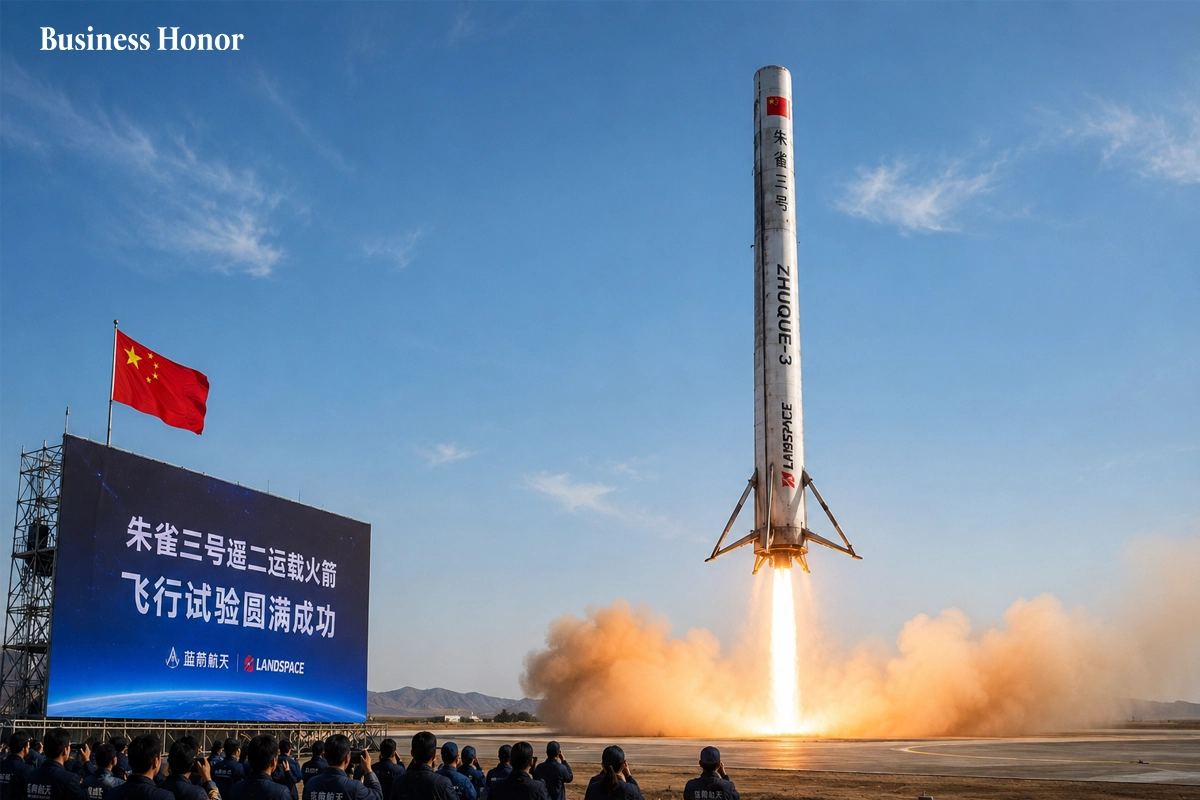
China reusable rocket development takes a bold step as Zhuque-3 Y2 lands its first stage, bringing cheaper, faster and more frequent launches closer to reality.
|
China has taken a major step toward reusable spaceflight. LandSpace’s Zhuque-3 Y2 successfully completed its orbital flight test on Wednesday, delivered the Honghu-03 satellite into its designated orbit and then brought its first stage safely back to Earth.
At around 7:41 am, the first stage made a planned soft landing at the Zhuque-3 landing site in Minqin county, Gansu Province. LandSpace said the mission marked China’s first recovery of an orbital-class rocket first stage using landing legs and its first land-based recovery of such a stage.
Is China’s reusable rocket race finally moving from tests to business?
Traditional rockets are largely discarded after launch. Reusable launch vehicles aim to change that model by recovering major components and flying them again. LandSpace estimates that a first stage can represent about 70 percent of a liquid rocket’s cost, making successful recovery critical to cutting expenses and boosting launch frequency.
The Zhuque-3 reusable rocket is a two-stage, liquid oxygen-methane vehicle designed for commercial missions, including satellite constellations, individual launches and rideshare services. Its first stage uses nine Tianque-12A engines, along with grid fins, attitude-control systems and landing legs.
For Y2, LandSpace refined the landing propulsion system, reduced the number of engines used during landing ignition and added an autonomous safety system to predict and adjust the landing point.
Recovery is only the first step. Companies must also inspect, refurbish and relaunch rockets quickly and cheaply enough to make reuse economically worthwhile.
The achievement also exposes China’s growing dual-track aerospace strategy. State-owned programs and private companies are pursuing different recovery methods. The Long March-10B recently completed a sea-based recovery test, while companies including Galactic Energy, Orienspace, i-Space and CAS Space are advancing their own reusable vehicles.
Experts believe reusable rocket technology could support satellite internet, space-based information networks and other large-scale applications by reducing launch costs and increasing mission frequency.
Business Honor Examines that China reusable rocket technology must now prove it can deliver repeated, safe and commercially viable launches. Zhuque-3 Y2 has shown that China can bring an orbital-class rocket home. The bigger question is whether it can make that return routine and profitable.
FAQs
What is the latest China reusable rocket breakthrough?
LandSpace’s Zhuque-3 Y2 successfully recovered its first stage after completing an orbital flight test.
What is the Zhuque-3 Y2?
It is a reusable launch vehicle developed by LandSpace for commercial missions such as satellite constellation deployment.
Why is the Zhuque-3 reusable rocket important?
Its reusable first stage could help lower launch costs and increase the frequency of commercial space missions.
How does China reusable rocket technology reduce costs?
By recovering and reusing expensive rocket hardware instead of discarding it after every launch.
What is the next challenge for China’s reusable rockets?
The biggest challenge is turning successful recovery tests into a reliable cycle of launch, recovery, inspection, refurbishment and reuse.




































.webp)

.webp)




.webp)



Comments
0 Comments