
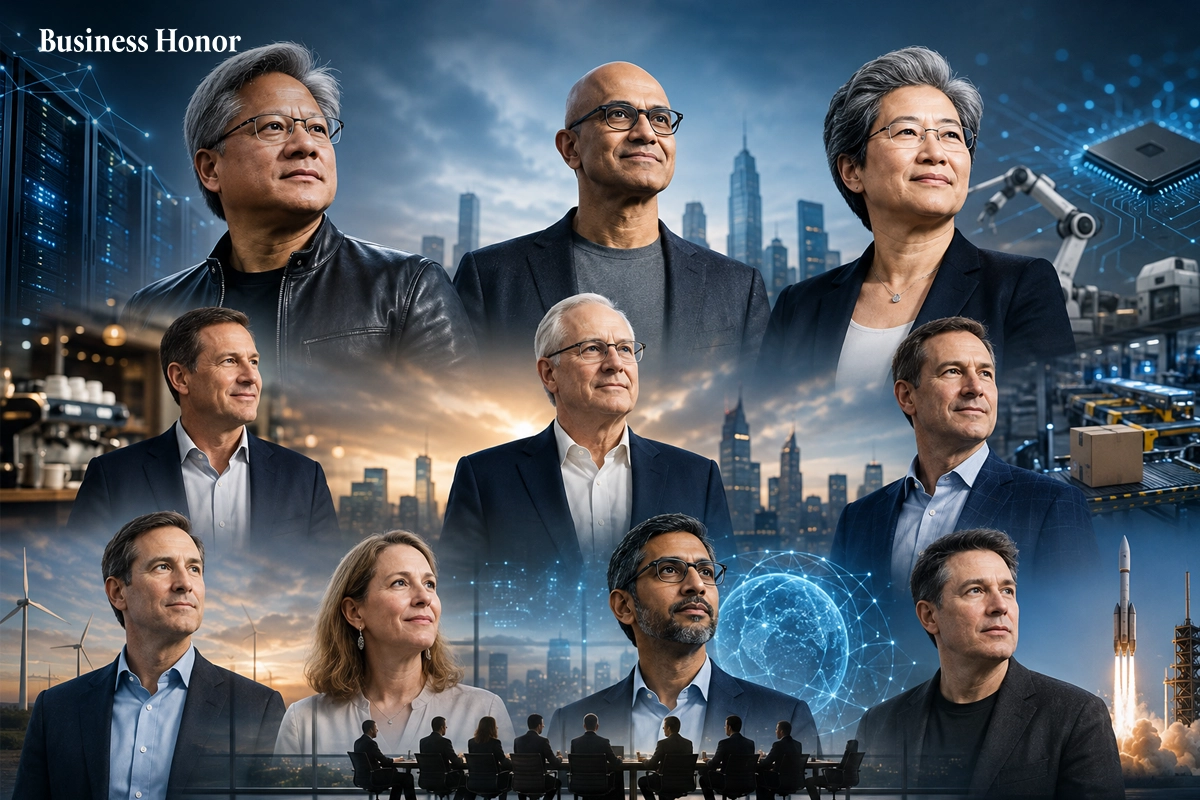
Discover how Successful CEOs 2026 are driving enterprise transformation across global markets. As global industries navigate rapid artificial intelligence integration, supply chain restructuring, and shifting economic landscapes, corporate leadership has become the primary factor distinguishing industry pioneers from lagging legacy brands. Navigating modern enterprise challenges requires unprecedented agility, technical foresight, and operational resilience.
To evaluate where market power is concentrating, studying Successful CEOs 2026 provides a clear roadmap of industrial innovation. From semiconductor architectures and generative AI engines to electric mobility and global retail transformations, these executives are shaping how modern enterprise operates.
Business Honor lists the top executives defining market direction combine deep domain engineering with transformative strategic execution. The following comprehensive analysis highlights the Top Business Leaders 2026 driving global transformation, detailing their executive origins, the sectors they command, and why their strategic decisions matter for the future of enterprise.
Top 10 Best CEOs to Watch in 2026
-
Jensen Huang (NVIDIA): Accelerating the AI era with engineered platforms
Jensen Huang is the kind of leader who builds the future by designing the infrastructure that makes it possible. Born in Taiwan and later co-founding NVIDIA in 1993, Huang’s vision focused on advanced computing for graphics and that foundation became central to enterprise AI and modern accelerated computing.
NVIDIA’s key contribution is more than just GPUs; it is the full stack approach, including CUDA, which helps software developers harness accelerated performance for AI workloads. In 2026, that matters because AI adoption is increasingly dependent on reliable compute ecosystems, not just models.
What to watch in Huang’s leadership:
- Full-stack enablement:hardware + developer architecture accelerates adoption.
- Platform thinking:NVIDIA remains positioned where AI workloads are built and optimized.
- Data center momentum:AI infrastructure demand supports long-term growth narratives.
-
Satya Nadella (Microsoft): Making enterprise AI practical at scale
Satya Nadella took over Microsoft as CEO in 2014, and his leadership has been strongly associated with shifting Microsoft toward cloud-first and platform-driven growth. Nadella’s background and rise through engineering leadership helped shape a strategy focused on integrating software, infrastructure, and developer ecosystems.
In 2026, Microsoft’s advantage is its ability to distribute AI across real enterprise surfaces Azure, productivity tools, and integrated AI experiences. The result is a leadership model centered on adoption: not “AI somewhere,” but AI embedded into daily enterprise workflows.
What to watch in Nadella’s leadership:
- Azure ecosystem leverage:cloud transformation continues to expand.
- Productivity and infrastructure pairing:AI spreads where people work.
- Enterprise transformation credibility:large organizations prioritize platforms that reduce complexity.
-
Lisa Su (AMD): Turning performance engineering into AI hardware momentum
Lisa Su became CEO of AMD in 2014, leading a major turnaround with a focus on high-performance computing. AMD designs processors, graphics, and specialized chips that serve PCs, servers, gaming, and data centers.
In 2026, her positioning remains relevant because AI requires not only software innovation, but also hardware diversity and efficiency. AMD’s role in accelerators and data center chips makes it a meaningful “supplier of capabilities” to AI-driven enterprises.
What to watch in Su’s leadership:
- Turnaround discipline:execution underpins long-term credibility.
- Data center relevance:AI workloads demand efficient computing.
- Performance-driven strategy:engineering excellence remains the brand.
-
Brian Niccol (Starbucks): Operational transformation meets customer experience
Brian Niccol, his path to CEO leadership is unusual in a way that may matter for 2026. He previously led major consumer brands and demonstrated the ability to improve operations at scale. At Starbucks, that background positions him to refine the customer journey while improving execution consistency.
Starbucks is a complex retail operator thousands of stores, global supply chains, franchise dynamics, and high expectations for service speed and product quality. A CEO who can strengthen operational systems has leverage: they can reduce friction, improve throughput, and protect margins.
What to watch in Niccol’s leadership:
- Execution focus:operational transformation is itself a competitive moat.
- Global retail scale:leadership must handle consistency across regions.
- Brand + process modernization:customer experience depends on dependable operations.
-
Greg Abel (Berkshire Hathaway): Risk-aware leadership across real-economy businesses
Greg Abel is a representative of a different category of leadership: the CEO-infrastructure model. As successor to Warren Buffett, Abel’s strength is managing a diversified holding structure that includes insurance, energy, freight rail, utilities, manufacturing, and retail services.
In 2026, this kind of leadership matters because not all transformation is digital-only. Some of the biggest wins come from improving efficiency in physical industries, strengthening risk management, and investing with disciplined capital allocation.
What to watch in Abel’s leadership:
- Portfolio resilience:diversification supports stability through cycles.
- Operational governance:performance management across subsidiaries.
- Long-term capital discipline:protects against speculative swings.
-
Andy Jassy (Amazon): Cloud, commerce, and logistics as an integrated machine
Andy Jassy became CEO in 2021 after founding Amazon Web Services in 2003 and building AWS into a cloud powerhouse. His leadership is defined by the ability to scale systems: logistics at global intensity, commerce at retail scale, and cloud infrastructure for enterprise computing.
In 2026, Amazon’s ecosystem advantage continues to grow in relevance: enterprises want cloud partners that can deliver reliability, performance, and innovation while keeping costs and operational complexity under control.
What to watch in Jassy’s leadership:
- AWS transformation capacity:remains central to enterprise adoption.
- Operational integration:commerce + logistics + cloud learnings reinforce each other.
- Infrastructure scale:supports expanding demand for AI-ready platforms.
-
Sundar Pichai (Alphabet / Google): AI research to product execution
Sundar Pichai’s CEO story is tied to technical leadership rising from roles like leading Chrome development to managing Alphabet’s strategy as CEO. Alphabet’s portfolio covers search, advertising, Android, Google Cloud, and AI research.
In 2026, Pichai’s most important attribute is continuity between research and deployment. AI initiatives matter far less when they stay in laboratories; they matter when integrated into products that users rely on daily whether in tools for enterprises, developer platforms, or AI models deployed across services.
What to watch in Pichai’s leadership:
- AI-to-product pipeline:research becomes usable capability.
- Cloud and platforms:continued pressure to deliver usable AI at scale.
- Ecosystem leverage:Google’s distribution remains a strategic advantage.
-
Elon Musk (Tesla / SpaceX / xAI): Frontier ambition with cross-industry momentum
Elon Musk’s leadership is often described as aggressive, but 2026 may be the year where execution becomes the real differentiator. Musk leads companies that sit at the intersection of manufacturing, engineering, energy storage, aerospace systems, and frontier AI.
Tesla turns AI-adjacent computing into real-world automation for vehicles and energy management. SpaceX builds reusable rockets and communications infrastructure. xAI adds a frontier AI dimension pushing models and hardware-oriented AI capabilities.
What to watch in Musk’s leadership:
- Crossindustry engineering:ideas transfer between manufacturing and computing.
- Hardware acceleration:supports AI ambitions with real systems.
- Long-cycle vision:large engineering bets can compound over time.
-
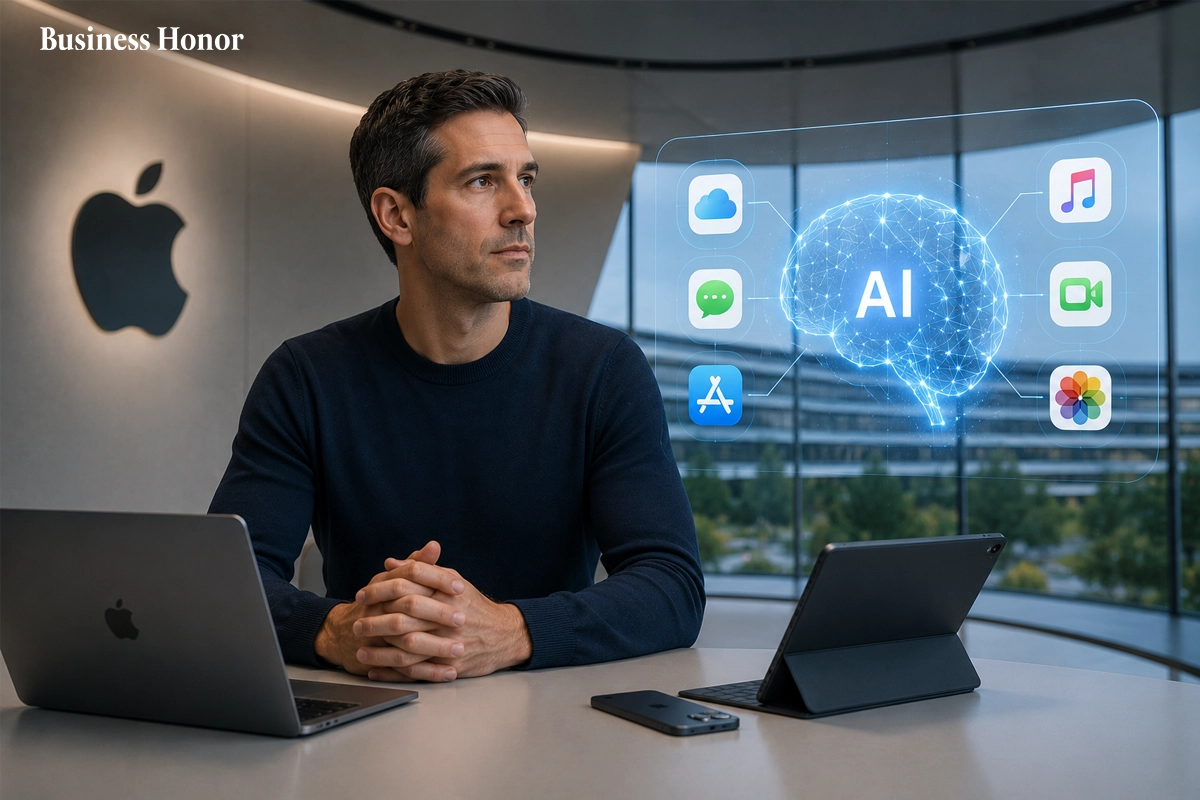
John Ternus (Apple): Designing integrated systems for consumer and enterprise value
John Ternus is part of Apple’s leadership lineage of product engineering. With experience overseeing hardware design across major devices Mac, iPad, iPhone Ternus represents a leader category that protects the quality of the entire stack, not just software features.
Apple’s ecosystem approach matters because users expect seamless integration and performance, while businesses care about device reliability, security, and productivity workflows. In 2026, that intersection becomes more important as AI-enabled experiences expand across consumer and workplace environments.
What to watch in Ternus’s leadership:
- Integrated design philosophy:hardware + software consistency.
- Long term ecosystem strength:strengthens customer retention and enterprise adoption.
- Security and quality as strategy:differentiates in competitive device markets.
10. Wang Chuanfu (BYD): Building the supply chain advantage for the energy transition
Wang Chuanfu founded BYD in 1995 after starting in battery manufacturing. Over time, BYD expanded to cover electric vehicles, solar systems, rail transit systems, and advanced battery cells making the company a supply-chain-led transformation powerhouse.
In 2026, BYD represents a key trend: success in clean tech depends on controlling critical components. Battery chemistry capability and manufacturing depth provide cost and scaling advantages that pure assemblers often struggle to match.
What to watch in Wang’s leadership:
- Vertical integration:supply chain control reduces bottlenecks.
- Battery-centric strategy:supports EV competitiveness and energy storage expansion.
- Scaling industrial systems:manufacturing capability becomes a durable moat.
Why Execution-driven leadership is creating the emerging CEO leaders in 2026.
A major theme behind top business leaders 2026 is that strategy only becomes visible when implementation happens. That’s where IT services companies enter the picture. In 2026, organizations are seeking partners that can:
- Modernize systems to improve productivity
- Scale cloud and hybrid infrastructure responsibly
- Accelerate AI adoption with governance and practical outcomes
- Enhance cybersecurity and enterprise data management
- Transform operations with automation and end-to-end engineering
This is reflected in the momentum of leading IT services providers firms that are positioning themselves as transformation executors rather than simple vendors. The most influential players are increasingly focused on connecting emerging platforms with existing enterprise environments and turning AI investment into operational gains.
If you’re tracking Successful CEOs 2026, a helpful way to think about it is this: the best CEOs are often those who align corporate transformation with the capabilities of major transformation ecosystems including IT services leaders.
The CEOs most worth watching in 2026
The Best CEOs to Watch 2026 are integrators who convert AI, cloud infrastructure, and automation into operational improvements that hold up in the real world. From hardware acceleration at NVIDIA and enterprise cloud AI at Microsoft to semiconductor performance leadership at AMD, retail execution at Starbucks, and scaled infrastructure at Amazon, The Business Honor Examines the pattern: transformation succeeds when leadership drives execution, not just experimentation.
As enterprises modernize their systems, the link between CEO ambition and transformation execution becomes more important, especially in the IT services ecosystem. In 2026, winners will be defined by reliability, security, and practical AI enablement that delivers measurable business value.
Related article : Best Women Entrepreneurs in the World 2026








.webp)
.webp)
.webp)


Comments
0 Comments