
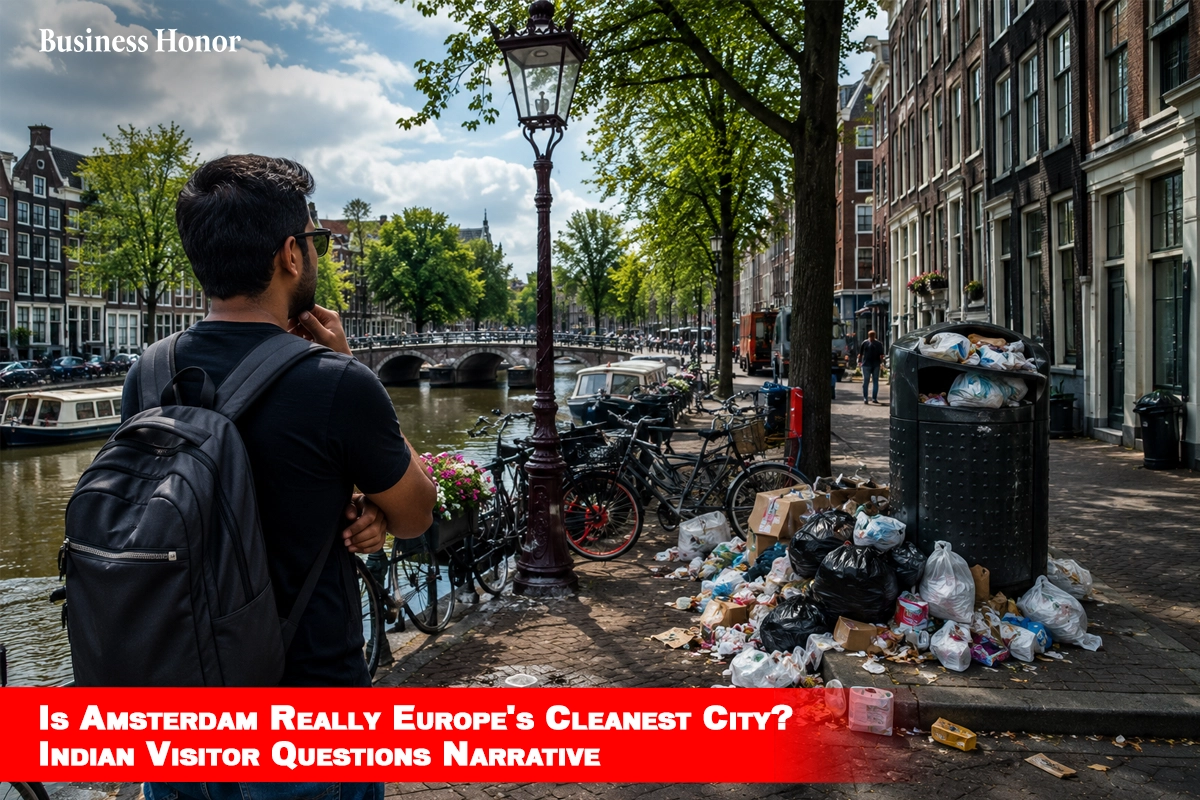
Indian woman's viral video of litter-strewn Amsterdam streets challenges global perceptions about European urban cleanliness standards
|
A video of an Indian woman showing waste dumped in the city of Amsterdam has started a huge online debate over civic sense and cleanliness of urban areas across the globe. The clip questions the common assumption that European cities always have higher hygiene levels compared to Indian cities and makes citizens think twice about their stereotypes about the ways different places take care of their cities. Pragati Pathak Wadhwa, who is visiting Amsterdam, shared the video on her Instagram account showing how rubbish is all over the streets of one of the biggest tourist spots in Europe. Wadhwa, speaking to the camera, expressed surprise at the large garbage lying in various places of the city.
|
"Hey, this is Europe, and look at this—there's trash lying around right in central Amsterdam. Europe, seriously? Oh my God, there's absolutely no civic sense. There's litter everywhere. I'm not even kidding," she remarked in the video. |
The accompanying caption, written partially in Hindi, conveyed a nuanced perspective on the discovery. Wadhwa noted that even if India achieved similar cleanliness standards to what she observed in Amsterdam, it would represent substantial progress. She acknowledged that most Indian locations maintain adequate hygiene and cleanliness standards, suggesting the comparison revealed uncomfortable truths about urban maintenance globally rather than vindicating any particular region.
|
The post's text overlay simply read "Open trash in central Amsterdam," drawing direct attention to the visible waste. |
A significant number of users argued that the fundamental distinction between European and Indian cities lay not in the absence of litter, but in response speed and systemic efficiency.
|
One thoughtful comment highlighted this nuance: "It will be cleaned up within a few hours. It won't remain there for months." This perspective suggested that infrastructure quality and municipal responsiveness, rather than civic consciousness alone, determine urban cleanliness outcomes. |
Several commenters broadened the discussion beyond individual observations, noting that littering transcends geographical and cultural boundaries.
|
"People are always quick to blame India, but no one seems to notice the trash on the streets of Europe," read a representative comment; challenging the narrative that irresponsible waste disposal represents a uniquely Indian phenomenon. |
A popular video illustrates a growing fact: meeting urban cleanliness challenges is a worldwide issue for both rich and poor countries around the globe. Despite the fact that European countries have better conditions for managing waste, the litter found in Amsterdam indicates that there is the problem of civic social responsibility present in all cities. Wadhwa's research presents us with a valuable lesson that our ready-made ideas about cities in different parts of the globe obscure the complicated truths about how cities all over the world face similar problems.
Business Honor is of the view that the Amsterdam litter incident represents a significant reassessment of European civic responsibility narratives globally.
(Disclaimer: This report is based on user-generated content from social media. BusinessHonor.com has not independently verified the claims and does not endorse them.)






































.webp)

.webp)



.webp)



Comments
0 Comments