
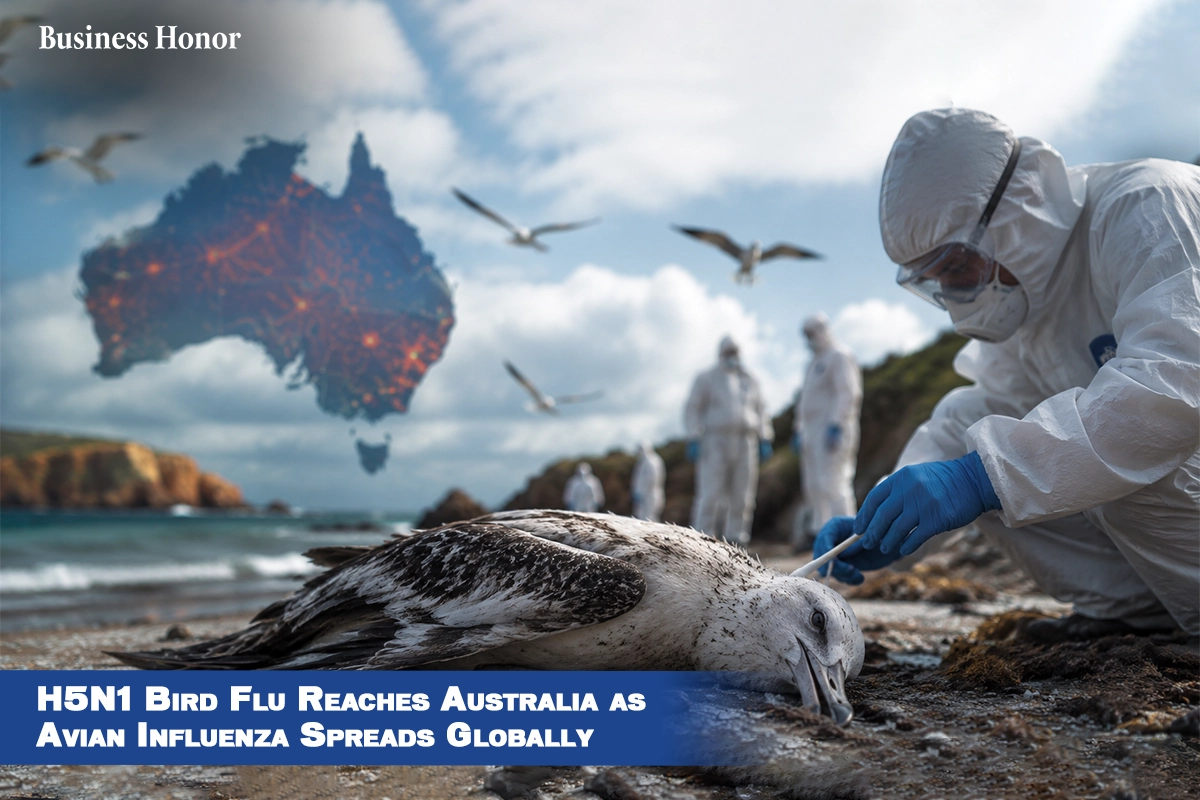
Australia confirms its first H5N1 Bird Flu case, marking the spread of the virus to every continent and raising global wildlife health concerns.
H5N1 Bird Flu Virus is now for the first time in Australia. This is a crucial incident in terms of the global spread of Avian Influenza Virus. It is the most contagious strain of this virus that was discovered in a migratory bird in Western Australia, which means that it has already infected all continents.
Australia's agriculture minister Julie Collins revealed that the virus was found in a brown skua that was spotted near Cape Le Grand National Park near Esperance. An emergency surveillance has been announced since it remains unclear if the virus had already been introduced into other wildlife populations. The arrival of H5N1 Bird Flu Virus in Australia highlights growing concerns over global avian influenza spread among wild birds, as migratory birds still play a crucial role in transporting this virus. There have been no reports of mass deaths of animals on mainland Australia.
In addition, there is another suspected case of infection on a southern petrel from the same region. The veterinary officials in Australia have stated that they had made plans for the eventuality of the virus coming their way, and the necessary emergency procedures have been set in motion. This latest report of the virus has come about after earlier reports of infection on Australia's remote Heard and McDonald Islands, where scientists found that thousands of seal pups died following infection from the virus, and some species of penguins reported higher than normal mortality rates.
The Avian Influenza outbreak among wildlife species is a cause for international concern as the virus spreads through migratory birds. While there are few cases of human infection, health experts continue to warn against handling infected animals. According to scientists, migratory birds brought the disease into Australia after contracting it from the affected areas. The H5N1, which has been around for many years now, has continued to evolve and spread among wild birds and poultry as well as sometimes among other animals.
Monitoring is going to continue to establish whether or not the disease has infected other types of animals, according to the Australian government. It is important to detect the infection at an early stage to safeguard animals, the agricultural industry, and the people. Business Honor observes that the H5N1 Bird Flu spread highlights the importance of global disease monitoring, agricultural preparedness, and stronger wildlife protection systems.














.webp)

.webp)




.webp)


Comments
0 Comments