
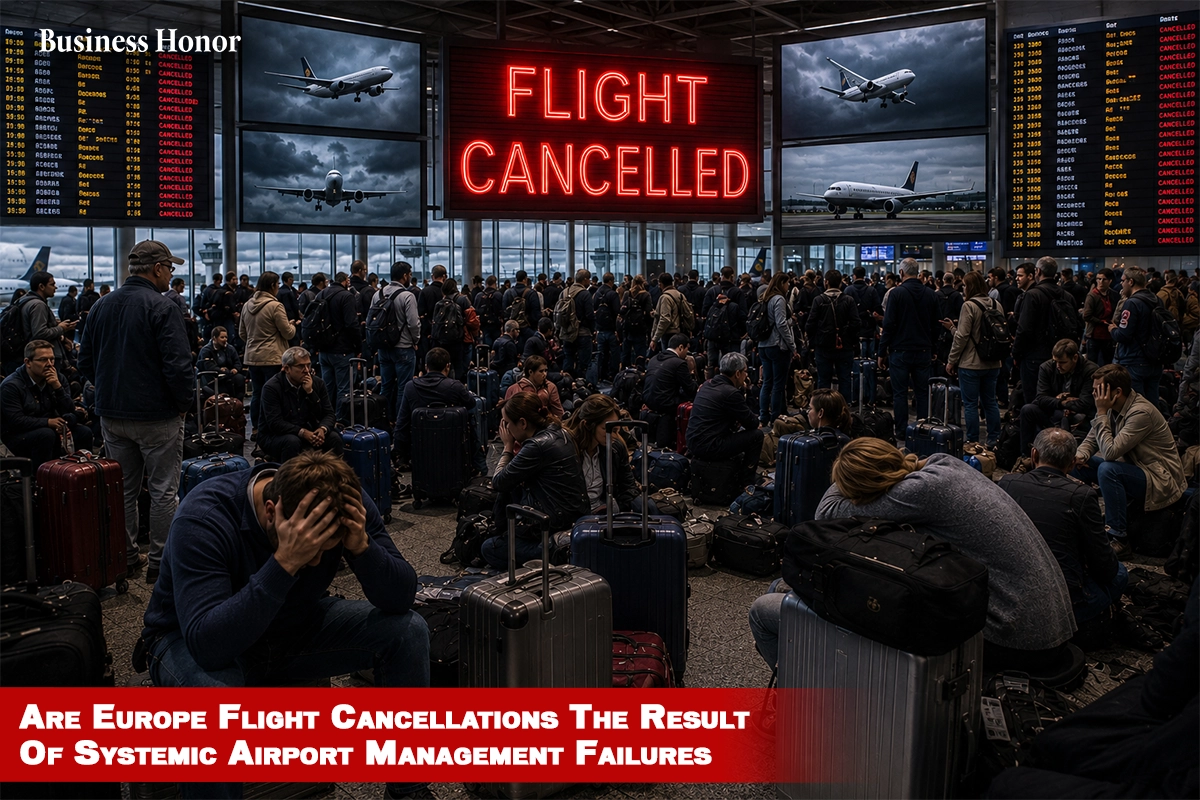
Europe flight cancellations surge dramatically as operational mismanagement and crew scheduling failures compound network disruptions across continent.
|
Europe Flight Cancellations: Europe's aviation network experienced unprecedented disruption on June 24 with 189 flight cancellations and 2207 delays cascading across 12 countries and affecting millions of passengers attempting to traverse the continent. The disruptions rippled through 18 major airports with Amsterdam Schiphol in the Netherlands recording the highest impact handling 256 delays and 40 cancellations. Frankfurt Airport in Germany followed closely with 240 delays and one cancellation while London Heathrow reported 172 delays and 17 cancellations. Barcelona, Rome Fiumicino and Madrid-Barajas also experienced severe congestion, each handling between 150 and 170 delayed flights.
Industry analysts attributed the unprecedented disruption to a convergence of operational challenges. Airport congestion, crew scheduling difficulties, and aircraft rotation constraints formed the core of the problem, compounded by air traffic management restrictions at major hubs. Technical inspections and weather-related complications further strained European networks already operating at capacity. The cascade of disruption at hub airports resulted in a significant amount of damage. Generally, if an individual hub airport has delays that cause delays for other flights across an airline network; all flows of air traffic across continents will be disrupted downstream due to primary routing hub congestion issues. The impact of disruption on operations may be felt well beyond where the disruption occurred as well as for a much longer period than just when the disruption occurred.
The major challenge that passengers encountered was that with most airlines suggesting that passengers rebook directly through the airline's web or mobile application and not simply show up at the airport without rebooking confirmation to be able to travel, there were no options for rebooking. The major advice from airlines was to monitor real-time flights, and to use an alternative airport when a passenger's flight is delayed, if possible. Travel experts also suggested that passengers be flexible with their rebooking plans, to arrive to the airport at least 2 hours before their flight time, and to have their booking confirmation.
Travel documents readily accessible for when a flight is cancelled and airlines need to be contacted for request for assistance for retrieving accommodation or applying for refund eligibility based on the laws protecting the rights of passengers travelling within Europe and vice versa. Throughout the evening as airlines adjust their flight schedules to accommodate the current situation, there will likely continue to be a significant level of flight cancellations on the day that was affected by the earlier concerns. The situation that has arisen demonstrates that the entire air transport system in Europe is very fragile and highly susceptible to the effects of multiple, simultaneous, major constraints placed on the operations of the major hub airports of Europe.
Business Honor is of the view that widespread Europe flight cancellations reflect systemic vulnerabilities in operational coordination and hub management capabilities.





































.webp)

.webp)




.webp)



Comments
0 Comments