
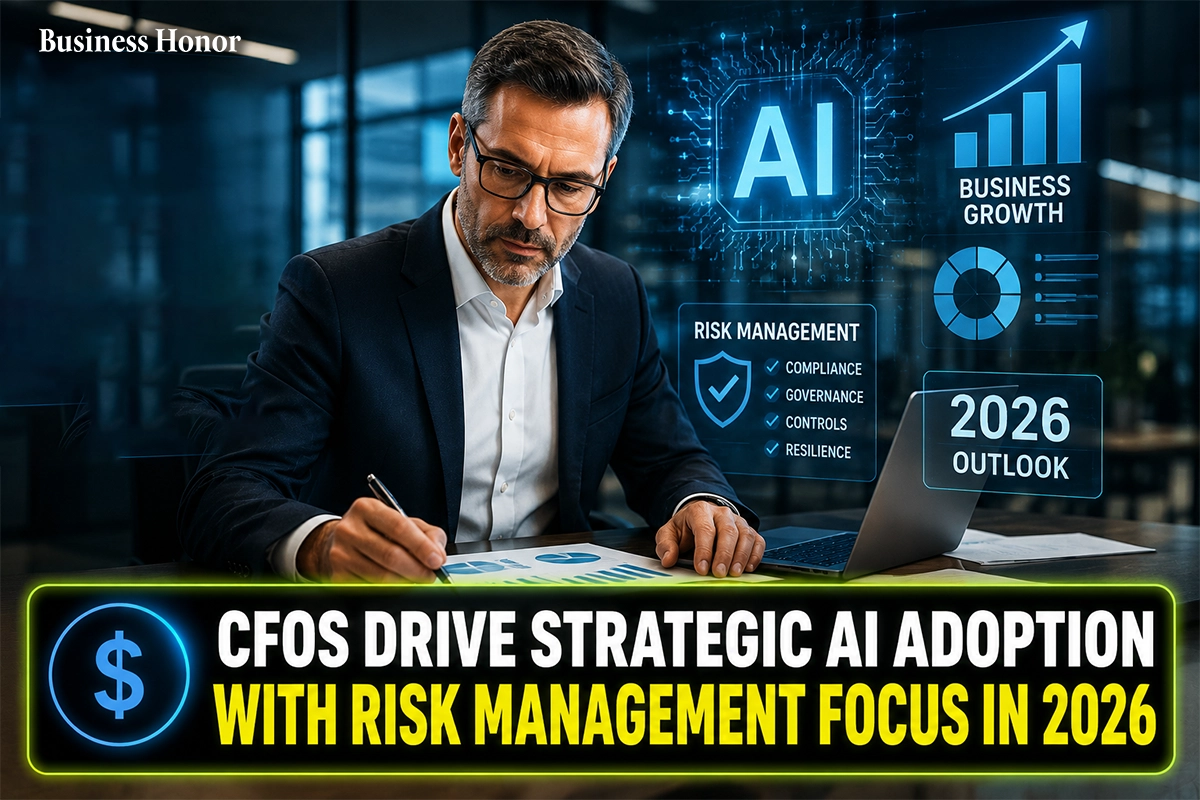
Finance leaders implement rigorous governance frameworks and cost controls to maximize AI adoption returns while minimizing regulatory and operational risks across enterprises.
|
The Chief Financial Officer’s (CFO) approach to AI implementation has fundamentally changed since 2026. CFOs no longer consider AI to be simply a technology experiment but rather a serious, long-term investment. With both financial and operational decisions for all areas of the company relying heavily on the availability and analysis of financial information, CFOs are also central to the overall AI strategy by balancing the pressure for cost savings from waste with the need for deliverable, measurable results from future scaled AI systems. For many organizations, the ongoing financial strain of funding pilot AI programs without closure timelines has led to the creation of an increased level of financial governance and accountability for those pilot programs.
The commitment to expanded spending in the larger world of corporate AI spending patterns is continuing to grow as well. By 2026, companies estimate they will commit 1.7% of annual revenue to AI programs, which is more than double 2025’s estimated percentage. Even though the anticipated increase in spending is evolutionary in nature, many finance departments continue to express hesitance for having the AI programs will produce the desired results for the companies they are working. In addition, the clients they serve creating the CFO’s responsibility to develop capital expenditure-like evaluation frameworks (including multiple phases and stringent risk management measures) for implementation of AI programs.
Governance has become a key component of modern AI adoption for CFOs. CFOs recognize that deploying tools in an uncoordinated manner creates compliance risk and opens the door to unapproved applications referred to as "shadow AI," which are applications that run without organizational oversight. Implementing governance at an early stage allows an organization to navigate regulatory obligations while minimizing the risk of significant violations and damage to the organization's reputation. Increasingly, finance leaders are establishing AI oversight committees to review new implementations, assess vendor contracts, and align with enterprise risk management activities.
Organizations with comprehensive measures in place to track results from AI are able to shift funds from their poorly performing pilots to better-funded strategic initiatives that already have been validated. One of the major concerns for CFOs during times of economic uncertainty is protecting their organization’s budgets. CFOs that quantify definitive returns on AI investments will also have an easier time justifying funding for continued AI investment through enterprise-wide expense management. When CFOs can quantify the actual measurable benefit from their AI investments, (for example, faster forecasting cycles, less reconciliation errors, or improved cash flow), they will be able to protect their continued AI resources while organizations throughout their enterprise will incur reductions.
Risk management has transitioned from completely automating processes to developing human-AI collaboration in managing risk. CFOs are starting to realize that algorithms and AI can fail at making lending, expense categorization, and financial forecasting final decisions based on bias. By combining human oversight with automated methods to manage these risks, CFOs will also be establishing procedural safeguards to manage new types of risks. Additionally, finance executives are focused on the data security safeguards that will protect against unauthorized access or loss of sensitive financial data that is processed by AI systems.
Business Honor is of the view that CFO-led AI adoption strategies represent a fundamental shift in enterprise technology governance and financial performance optimization capabilities.























.webp)

.webp)




.webp)

