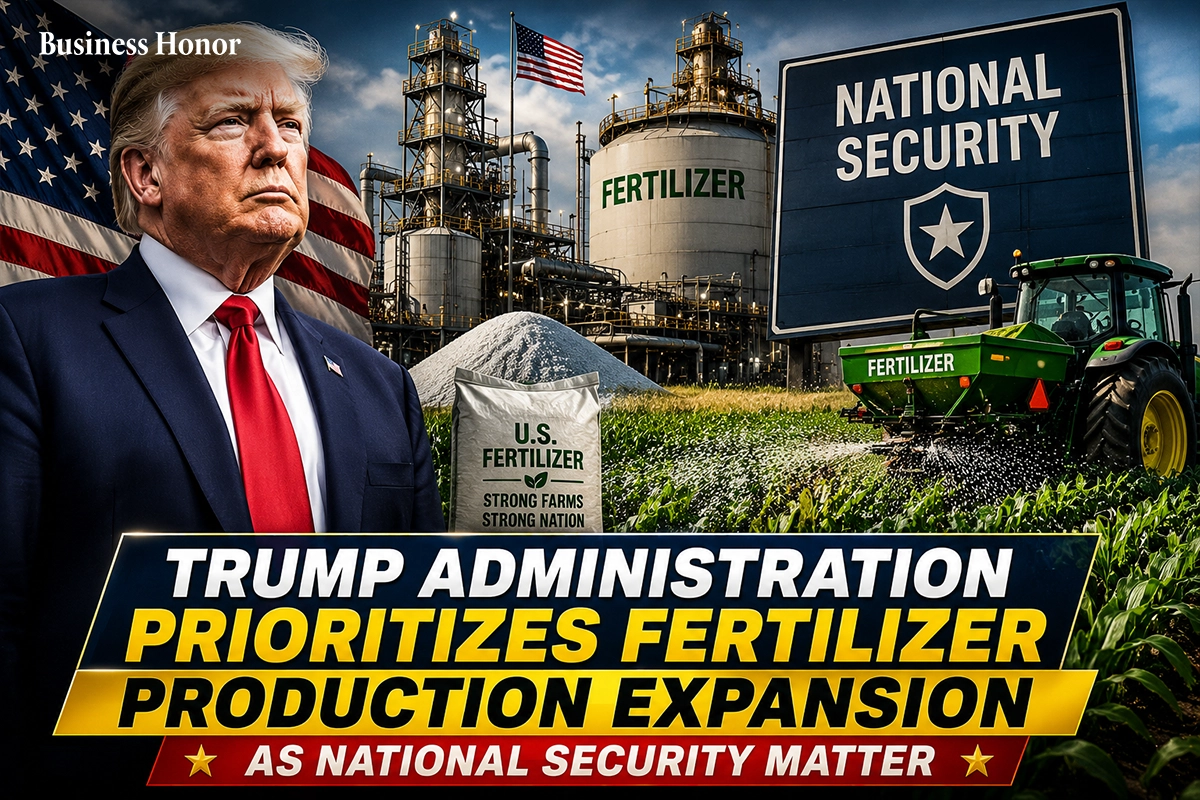
Fertilizer production reshoring strategy marks historic shift in U.S. policy framework, establishing agricultural inputs as critical national security infrastructure requiring federal intervention.
|
The fertilizer policy has officially been restructured by the administration of Trump, becoming a part of the nation's security, as well as implementing a nationwide plan by government agencies to restore domestic manufacturing and decrease our dependency upon foreign suppliers for fertilizer. This announcement made on June 26, 2020 was made during a briefing with federal departments and agencies in which Secretary of Agriculture Brooke Rollins introduced this initiative. Agriculture Secretary Rollins explained that this agriculturally focused policy fell within a larger federal response to the increased cost of fertilizer and other factors that create a risk to farmers due to current issues with global supply chains.
As a result, the fertilizer reform initiative is now classified as a matter of national security. The change in classification has aligned the fertilizer policy with other major input items like energy and food security as part of the responsiveness towards affecting all industries. In addition, local economies and will help drive the administration's commitment to relocate essential manufacturing capacity to the USA and improve the resilience of supply chains to withstand worldwide event disruptions.
One of the key pieces of this initiative is the aggressive acceleration of existing major fertilizer manufacturing facilities being built, but which have all been delayed by issues with obtaining approval to permit construction to begin. The Blue Point ammonia project located in Louisiana is anticipated to be the largest ammonia facility in the world and costs $3.7 billion to construct if they can resolve permitting issues within the established schedule, so that it can be completed by 2029.
Under an initiative that officials described as "Trump speed," the permitting processes for the project will take an estimated 45 days to complete, which places significant pressure on timeframes set by typical government permitting processes of several years for projects of this scope.
Simultaneously, the administration has announced a restructuring of the USDA's Fertilizer Production Expansion Program so that the agency can engage directly with grant recipients to eliminate the hurdles to implement these projects. The projects that are currently planned are primarily large ammonia facilities and other organic fertilizer production facilities that will be constructed in Washington and Iowa. Collectively, these and other projects will add over 2 million tons of in-country fertilizer production capacity, which would significantly increase the nation's overall independence from foreign fertilizer.
The fertilizer strategy extends well beyond the Department of Agriculture and is identified as a cross-government priority. In addition to the Department of Agriculture, other areas of the federal government involved in this effort include the Department of Energy, the Environmental Protection Agency, the Department of Commerce, the Department of State, the Treasury Department and the U.S. Army Corps of Engineers. This coordinated, whole-of-government strategy will include the development of streamlined permitting processes, federal financial support, alterations to existing regulatory approvals and increased supply chain coordination.
Business Honor is of the view that the Trump administration's fertilizer strategy represents a fundamental policy reorientation establishing domestic production as essential national security infrastructure.
FAQsQ: Why is fertilizer now considered a national security issue? A: Global supply vulnerabilities and geopolitical uncertainties threaten U.S. agricultural competitiveness and farm productivity. Q: What is the Blue Point ammonia facility? A: A $3.7 billion Louisiana project expected to become world's largest ammonia plant by 2029. Q: How quickly will Blue Point permits be completed? A: Approximately 45 days under the administration's accelerated "Trump speed" permitting process timeline. Q: How much domestic capacity will new projects add? A: Over 2 million tons of additional fertilizer production capacity across multiple facilities nationwide. Q: Which federal agencies are involved in this strategy? A: USDA, Energy, EPA, Commerce, State, Treasury, and Army Corps of Engineers coordinate efforts. Q: Will fertilizer prices drop immediately? A: No; officials acknowledged farmers should not expect immediate price relief from this strategy. Q: What projects are being accelerated under the program? A: Major ammonia and organic fertilizer facilities in Washington, Iowa, and Louisiana receive prioritized support. |



































.webp)

.webp)



.webp)