SaaS business model transformation reveals competitive advantage now emerges from data governance and operational context rather than standardized software.
|
Despite the growth of the global software market, which is forecasted to be worth about $1.43 trillion by 2026, analysts are observing a fundamental change in the way technology creates business value. Major software-as-a-Service (SaaS) providers, including Shopify, continue to enable millions of businesses across the globe; however, the competitive advantage that most SaaS provided in terms of access has been largely commoditized across all industries. For almost two decades, SaaS has acted as an equalizing force; organizations of any size could have access to standardized solutions for customer relationship management (CRM), enterprise resource planning (ERP), commerce and analytics. By being equally accessible to all businesses today, SaaS has created a paradox; when all companies have the same software; it is no longer a differentiator but merely baseline infrastructure.
The data supports this change. Eighty-eight percent of businesses have added generative artificial intelligence (AI) into their operations in one or more functions; however, few have seen a financial return on this investment yet. According to Gartner, companies that achieve successful AI performance do not simply deploy tools, but heavily invest in data quality, governance and organizational readiness — there is a significant difference between having and creating value through AI.
The new strategy framework is more focused on the context than the actual code. Companies that are successful in a market are using their proprietary data, internal processes, decision-making criteria, and execution paths to create systems. These types of elements cannot be bought in a subscription but must be built, assembled, and continuously improved.
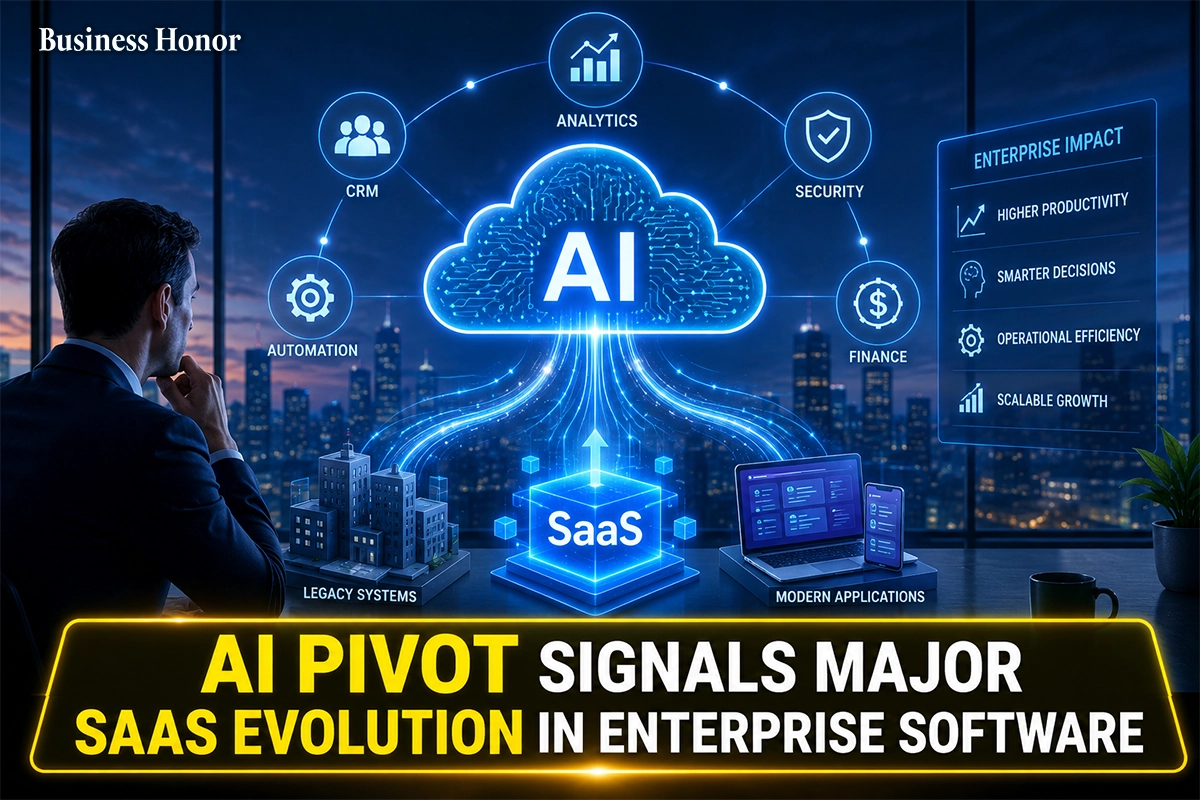
However, enterprise-level SaaS market trends are still relevant. There is one critical category of software that will always be needed: systems that provide recordkeeping and control. Currently, modern platforms are being developed as governed environments, and AI agents will function within the jurisdiction of their environment; they will be governed by the same type of parameters; identity, permission, audit, policy enforcement. The shift in custom software development is significant. Open-source models, agent frameworks, and advanced infrastructure provide a lower barrier to creating custom software. Industry analysts have predicted that by 2028, 90 percent of all enterprise developers are expected to use AI coding tools. However, one important distinction remains: the creation of an application is fundamentally different from running that application at scale.
There is a wealth of evidence indicating that prototype speed does not correlate to production reliability. Some organizations report longer processing times even while they maintain belief in their own increasing speed through AI. Additionally, there continue to be large gaps in governance of AI-related technology. For example, less than one-quarter of IT executives’ state have the confidence to manage AI's security & compliance-related risks effectively.
The clarity of the emerging model can best be seen through ecommerce. Leading retailers such as Walmart, Target, and Mercado Libre have put massive resources into developing their proprietary platforms for price, checkout, and fulfillment systems, directly influencing revenue and margins, simultaneously enabling Shopify to provide a global, standardized commerce infrastructure (over many layers). This pattern presents a reasonable framework: Companies differentially differentiate themselves by controlling the stack layers they directly determine revenue impact, customer experience, or company risk while other areas utilize standardized infrastructure (commodities). This emerging, balanced strategy for making technology decisions has developed into a dominant model worldwide.
Business Honor is of the view that the commodification of SaaS capabilities represents a strategic shift toward differentiation through proprietary data governance and operational excellence rather than software access alone.
FAQs:Q: Is SaaS still important for businesses? A: Yes, SaaS remains foundational infrastructure, but no longer provides competitive advantage through access alone. Q: What creates competitive advantage now instead of software? A: Proprietary data, internal processes, decision logic and how organizations shape their systems operationally. Q: Why can't companies just build their own software? A: Building is easier, but production reliability, governance and operational maturity at scale remain challenging. Q: Which SaaS companies will remain relevant? A: Systems of record and control platforms with strict governance, auditability and policy enforcement capabilities. Q: What is the winning strategy for technology decisions? A: Own revenue-critical stack layers while standardizing commodity infrastructure through established SaaS platforms globally. |




































.webp)

.webp)



.webp)