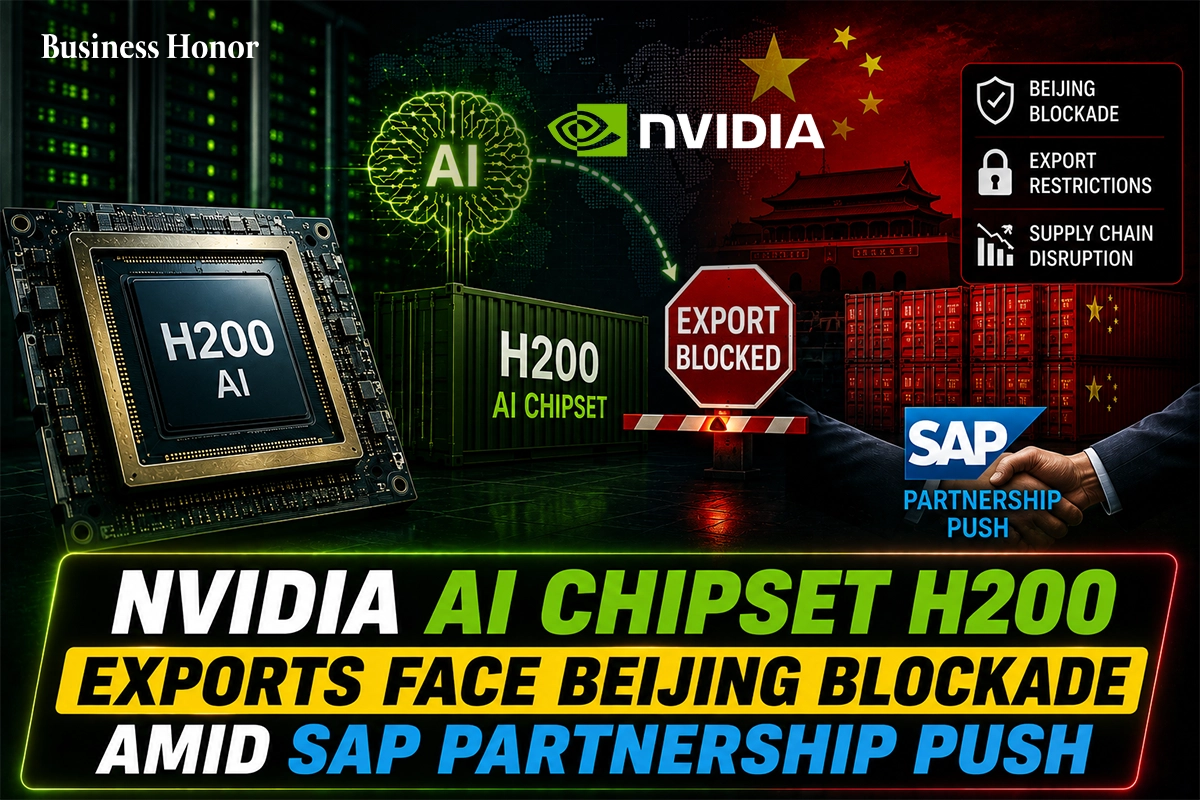
NVIDIA AI chips face China export curbs while SAP partnership signals deeper enterprise software integration strategy
|
NVIDIA and SAP are increasing their strategic collaboration by implementing next-generation AI directly into business operations. SAP plans to implement NVIDIA's OpenShell runtime and NemoClaw agent blueprint in their AI platforms, placing the NVIDIA AI chips technology at the centre of how enterprises will design and implement intelligent agents for their various workflows. The new effort intends to standardize implementation approaches across the enterprise. By combining NVIDIA's runtime infrastructure with SAP's enterprise software ecosystem, both companies will create more robust frameworks around trust, governance, and standards. These frameworks will help companies deal with issues related to AI adoption and the use of autonomous agents in critical business processes while also providing them with reliable oversight.
Industry analysts believe that this will be a critical step in determining NVIDIA's future position in the enterprise software industry. Instead of being merely a hardware provider, NVIDIA will embed its AI within the platforms used by large companies today. This could yield additional revenue streams and build switching costs that will create a competitive advantage for NVIDIA in the enterprise software industry.
The challenges posed by geopolitics coincide with NVIDIA’s expansion into India, an important emerging market for the company. In China, one of NVIDIA’s most significant markets, the company has received approval from the U.S. government to ship H200 advanced chips, which, despite this, the Beijing government continues to block shipments of the chips to multiple Chinese technology companies. The situation reflects the growing political tensions between the U.S. and China regarding the export of AI semiconductors and technology sovereignty.
NVIDIA’s reliance on a narrow supply chain and a concentrated client base exposes potential vulnerabilities through export restrictions. With the growing concentration of advanced AI hardware demand occurring in China, prolonged export restrictions may encourage Chinese companies to ramp up their development of domestic semiconductor substitutes. This scenario leads to both near-term revenue headwinds and longer-term competitive disadvantages for NVIDIA's Asia market position.
As evidenced by CEO Jensen Huang's recent participation in a U.S.-led delegation to China semiconductor restrictions, the company is actively working to deal with the geopolitical complexities surrounding its access to H200 chips. However, the ongoing blockade of H200 chips indicates that diplomatic channels have produced limited success thus far. Persistent cross-border export friction suggests that deeper structural issues exist in U.S.-China technology relations, which will continue irrespective of corporate outreach efforts.
NVIDIA's stock price gives a mixed view of its performance. The company closed at $225.32 on Friday; down 4.7% for the week, up 11.7% for the month, and up 19.3% year-to-date. It returned 66.4% over the past year and nearly 14x over the last five years. Investors' moods change with each announcement for new AI partnerships as well as developments in policies governing AI technology.
In the next several months, the adoption rate of enterprise AI agents and the impact of export policies will be key indicators for those investing in NVIDIA. The news surrounding the NVIDIA/SAP partnership indicates real momentum behind corporations deploying AI; while the issues resulting from the conflict with China highlight some of the regulatory risks that have the potential to change expectations for regional revenues as well as how markets will determine long-term growth opportunities for the AI infrastructure sector.
Business Honor is of the view that NVIDIA's SAP partnership represents a strategic shift toward embedding its AI infrastructure directly into enterprise software platforms for long-term corporate adoption.
FAQs
Q: What is the NVIDIA-SAP partnership about? A: NVIDIA integrates its OpenShell runtime and NemoClaw agent blueprint into SAP's AI platforms for enterprise deployment. Q: Why are H200 chips blocked in China? A: Beijing is restricting shipments to Chinese tech firms despite U.S. government approval over geopolitical AI tensions. Q: How does this partnership benefit enterprises? A: It establishes stronger governance, trust, and standardized deployment frameworks for AI agents in business workflows. Q: What is the market impact on NVIDIA stock? A: Stock gained 4.7% weekly, 11.7% monthly, and 19.3% year-to-date amid partnership and policy developments. Q: Why does this create supply chain risks? A: China export restrictions could accelerate domestic semiconductor development and reduce NVIDIA's revenue concentration in Asia. |

























.webp)

.webp)




.webp)