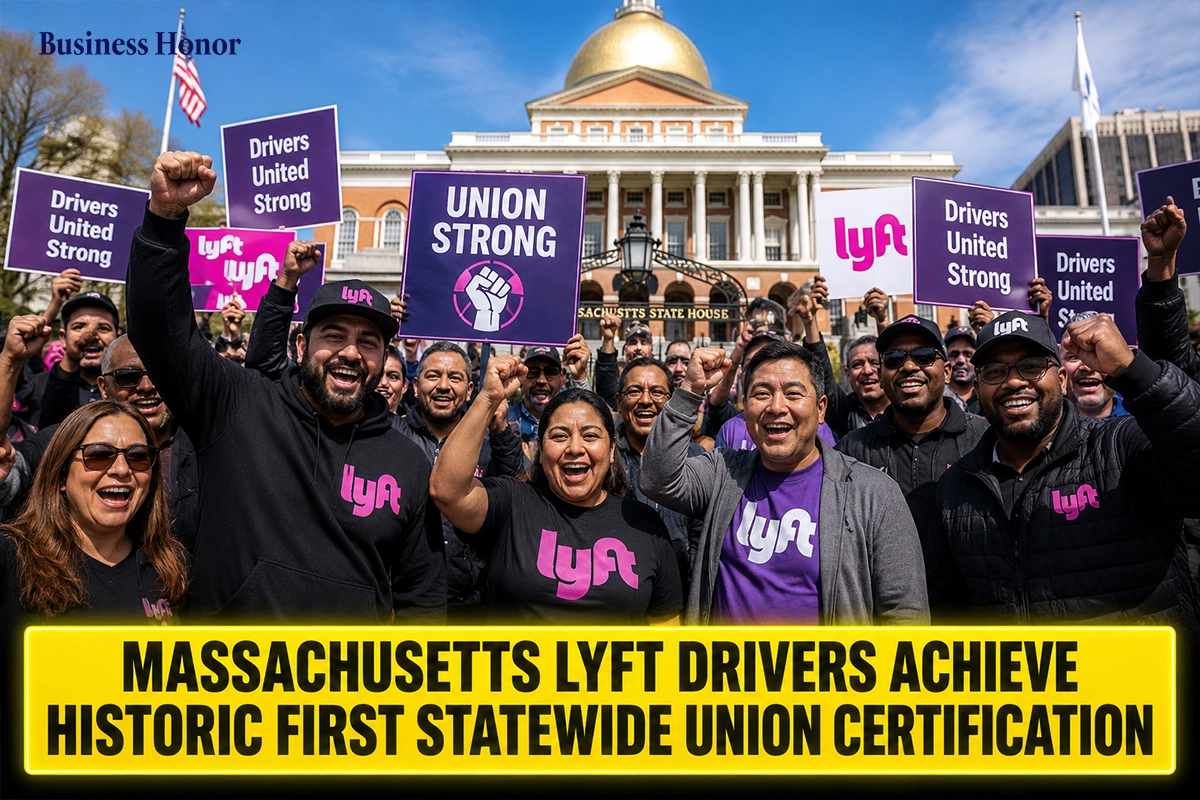
Lyft drivers join Uber counterparts in historic Massachusetts unionization, securing collective bargaining rights while maintaining independent contractor status.
|
A major labor victory occurred in Massachusetts this week as drivers for app-based ride-hailing companies like Uber and Lyft became the first statewide union to be certified in the United States. The certification of the union was made possible by a historic ballot initiative that Massachusetts voters passed in 2024 which created the first legal framework in the United States for ride hailing drivers to collectively bargain and organize as a union while keeping their status as independent contractors. On the steps of the Massachusetts State House, labor organizers and drivers rejoiced in the historic victory with union leaders claiming it is the largest private-sector organizing victory since Ford Motor Company employees won the right to unionize in 1941. The newly certified union will represent about 70,000 drivers across Massachusetts thus providing workers in the app-based economy with a generationally unprecedented collective ability to impact the mechanics of the industries within which they operate.
Driver for Uber, Jean Fredo, echoed the sentiments of other organized drivers saying that this victory is a symbol of hope for Uber and Lyft drivers in the continuing fight to improve their livelihoods through tangible pricing solutions. Fredo stated that when he started driving for Uber more than seven years ago, although he enjoyed the ability to make flexible work schedules, since then rates of pay have decreased while his costs for operating have increased, including fuel and maintenance expenses. He pointed out that drivers are under a lot of constant pressure and worry that they will lose access to their earnings platform with little notice and basically no way to appeal a decision made by someone who deactivated them. "I live with anxiety all the time about losing my app." said Fredo via a translator. "This is not how to live."
Fredo has played a crucial role in the organizing campaign, recruiting hundreds of drivers at places such as the airport and community centers around Boston. He believes that through organizing they can gain better pay, protection from being deactivated without notice, and greater predictability for workers who have borne all of the costs associated with owning a vehicle while their wages increase very little.
The union organizing effort has been occurring in the context of the increasing concern that autonomous vehicle technology will fundamentally change the ride-hailing industry. Today, Massachusetts allows companies to test autonomous vehicles on public roads but requires that there be a licensed human operator in the vehicle while testing. In addition, there are no commercial operations of fully autonomous vehicles allowed in Massachusetts. However, companies especially those like Waymo are operating fully autonomous vehicles in places like San Francisco, Los Angeles, and Phoenix to the public's concern over safety, creating more anxiety than ever before for these drivers about the stability of their jobs.
According to Julie Blust of the App Drivers Union, drivers nationwide communicate regularly regarding changes affecting the industry; for example, the rapid growth of driverless cars in California. Organizers see an increasing need for unionization so drivers can unite and take collective action in response to the ongoing disruptions caused by technology as well as to ensure that their financial interests are protected. Blust emphasized that as more and more driverless vehicles are being implemented, "drivers now have a formal organization they can turn to and that will allow them to speak collectively as one voice within this industry about what’s happening." Labor advocates are hopeful that Massachusetts’ certification will serve as an example for other organizing efforts now gaining momentum in California and Illinois. This victory points to an increasing understanding that workers impacted by gig-economy jobs, again, ought to receive formalized workplace protections and help develop accessible options for employment agreements that address the changes in their industries and jobs caused by advances in technology.
Business Honor is of the view that Massachusetts ride-hailing drivers' union certification represents a transformative shift in gig-economy labor organization and worker protections nationwide.































.webp)
.webp)
.webp)