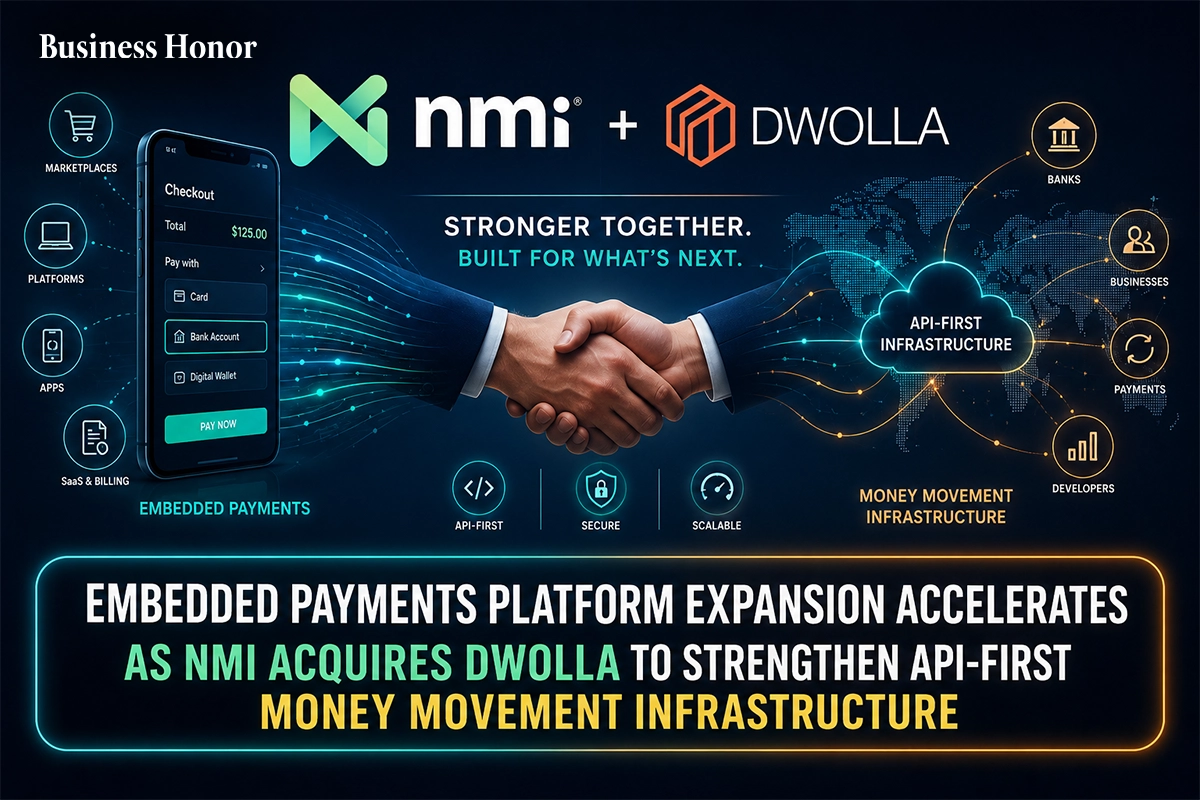
Embedded Payments growth accelerates as PK embedded payments transforms financial infrastructure, with NMI acquiring Dwolla to strengthen API-first account-to-account money movement and real-time payment capabilities across global fintech ecosystems.
|
The exapansion of embedded payments through PK represents a major trend in the infrastructure of the global fintech industry, which is shifting towards a single, API-driven money movement system. With the acquisition of Dwolla by NMI, the embedded payment industry sees an increase in its ability to handle account-to-account transfers, real-time payments, and financial orchestration.
API-First Embedded Payments and Real-Time Money Movement
The incorporation of Dwolla’s technology into NMI’s platform allows for API-first embedded payments functionality, which allows companies to handle onboarding, payment processing, and payouts all within one layer of infrastructure. This is achieved by increasing the capability of A2A payment rails and real-time solutions like FedNow, leading to improvements in speed, visibility, and scalability.
This advancement is necessary due to the growing need for real-time embedded payments infrastructure in industries that require instant payment processing, such as lending, marketplace, and payroll. In addition, the move towards modernizing account-to-account payments decreases reliance on card networks.
Embedded Payments Ecosystem Growth and Fintech Innovation
Considering the growth of global A2A transactions to reach $195 trillion by 2030, PK embedded payments become an integral part of the fintech evolution process. The merger of NMI-Dwolla makes the embedded finance network stronger, empowering developers, ISVs, and SaaS providers to create flexible payment experiences using different rails.
With the emergence of new solutions for managing payments orchestration platforms, enterprises can integrate card payments, bank transfers, and real-time payments in one system, ensuring compliance, reporting, and risk management processes. These innovations open up new possibilities for such industries as healthcare, insurance, property management, and B2B.
While fintech keeps developing, APIs-based payment infrastructure solutions become essential for creating scalable financial services and innovative money movement models, such as stablecoin settlement and agentic payments.
Overall, PK embedded payments is not just an additional payment function but the infrastructure layer that supports modern digital commerce. Business Honor views embedded payments as playing a significant role in the future fintech ecosystem, as unified API-first platforms will define how money will be accepted, moved, and



































.webp)

.webp)



.webp)