
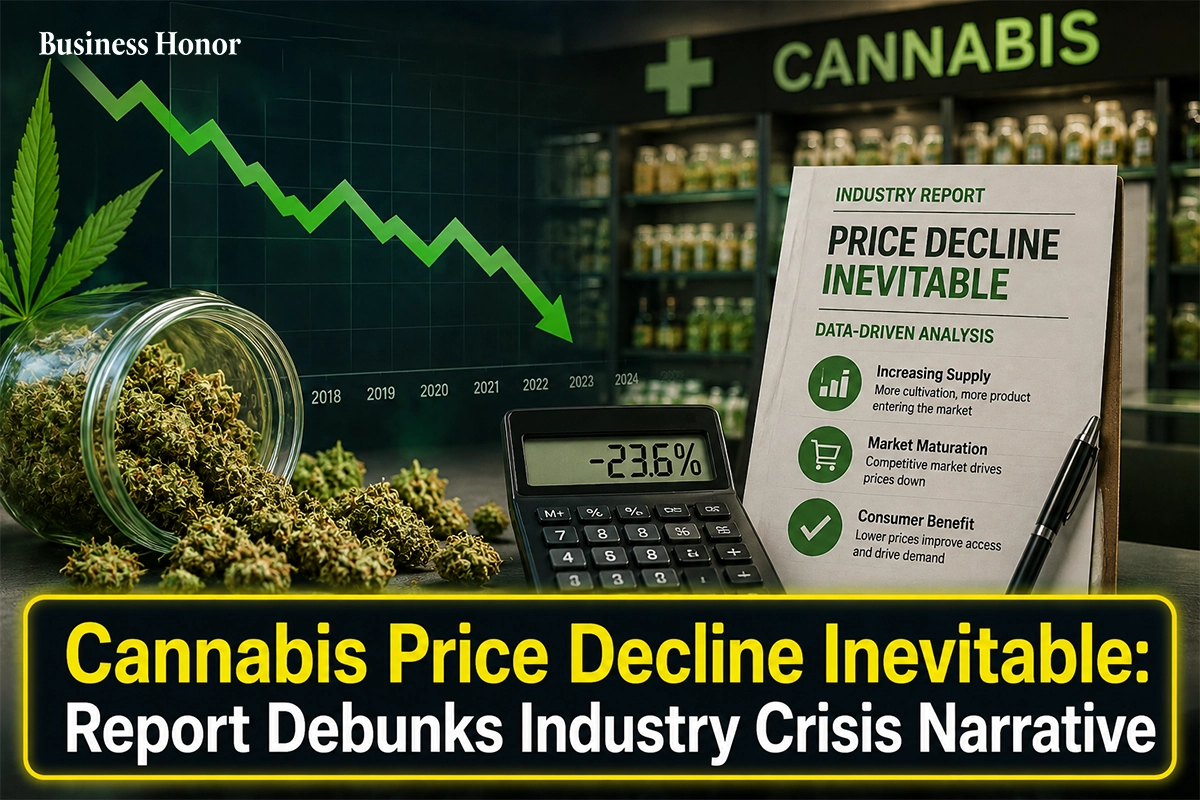
Cannabis price decline represents predictable market maturation phase, not systemic failure, according to Whitney Economics analysis of global legalization patterns.
|
An analysis released earlier this month examines how the cannabis price decline problems that have persisted in the cannabis industry are not resulting from systemic failure but rather from the natural progression of legalizing cannabis. As per the analysis done by Whitney Economics and the Global Cannabis Network Collective, data was analyzed from mature markets in Europe and North America, and they found that the price patterns were similar even across markets with different regulatory environments.
Why Are Cannabis Prices Falling Across Legal Markets
The major finding is that the stakeholders in the cannabis industry need to rethink how to interpret falling prices. In addition, that many of the price declines should not be seen as a crisis that requires intervention; but rather, there is a predictable cycle of cannabis prices fall globally for a new market for three to seven years until the market matures. The initial period of time after legalization generally has limited supply and is going to attract investors and therefore be able to achieve high prices. After a period, once the amount of cannabis produced on the market becomes greater than the amount of cannabis purchased, prices should decline annually by 10%-20% before leveling off around the cost of production.
Did Canada’s Legalization Boom Create an Oversupply Crisis
Canada is the clearest example. In 2018, Canada legalized cannabis for adult recreational use, but as part of that legalization, the number of licensed producers increased significantly, partly due to projection that the U.S. would come to the same conclusion as Canada regarding the legalization of cannabis. By April of 2020, licensed producers collectively had more than 600,000 kilograms of cannabis that had not been sold, representing the extent to which producers had overestimated the demand curve.
The following year proved catastrophic: Health Canada documented the destruction of over 425 million grams of unpackaged dried cannabis—representing 26 percent of total production. Canadian wholesale flower prices subsequently collapsed nearly 50 percent between January 2021 and December 2025. More than 42 cannabis companies filed for insolvency between 2022 and early 2024, leaving lasting scars on the nation's industry.
Is the U.S. Cannabis Industry Repeating Canada’s Mistakes
The United States now mirrors Canada's trajectory. Authorized supply capacity across legal American markets equals approximately 600 percent of legal demand and 225 percent of total demand including illicit consumption. Only 27.3 percent of cannabis operators achieved profitability in 2024, compared to 65 percent of U.S. small businesses across all sectors. The industry carried an estimated $3.8 billion in delinquent payments by 2023. Most troublingly, U.S. legal cannabis revenues contracted in 2025 to between $28.6 billion and $29.6 billion—the first decline in regulated market history.
Can Regulators and Investors Predict the Next Market Correction
Germany represents the most instructive current case study. The country's April 2024 Cannabis Act transformed the landscape by removing cannabis from narcotics legislation and enabling telemedical prescribing. German imports surged from 4,476 kilograms in 2018 to an estimated 201,094 kilograms in 2025—a nearly 45-fold increase. Prices plummeted approximately 25 percent within two and a half years, with pharmacy-level retail prices approaching four euros per gram and wholesale prices near two euros.
The critical insight, according to Whitney Economics founder Beau Whitney, involves anticipation rather than reaction. Successful operators and investors utilize data to forecast market trajectories before margins compress, whereas regulators typically focus exclusively on controlling demand and access while overlooking supply management. This regulatory blind spot, combined with operators building business plans against early-stage pricing rather than inevitable trajectories, creates recurring crises that careful analysis could have prevented.
Business Honor is of the view that cannabis price compression reflects predictable market maturation cycles rather than regulatory or operational failures requiring intervention.
FAQsQ: Why are cannabis prices falling globally? A: Supply capacity now vastly exceeds demand in mature legalized markets across North America and Europe. Q: Is price decline a market failure? A: No. It's a predictable three-to-seven-year maturation cycle that regulators and operators consistently underestimate during legalization. Q: What happened in Canada? A: Producers destroyed 425 million grams in 2021 and wholesale prices collapsed nearly 50 percent by 2025. Q: How bad is the U.S. situation? A: Only 27.3 percent of operators were profitable in 2024; authorized supply equals 600 percent of demand. Q: Why is Germany significant? A: Imports surged 45-fold since 2018, creating oversupply that dropped prices approximately 25 percent in two years. |














.webp)






.webp)

