- Gauri Singh
Voice AI adoption is taking off, but behind the scenes, many systems are struggling. The industry often talks about making conversations sound human, but enterprises need more than that: they need systems that can think, remember, and act consistently. Without proper orchestration, memory management, and fault-tolerant design, even the best AI quickly becomes an expensive problem. This overlooked layer, where cognition meets infrastructure, is where Agustín Suárez has made his mark: “People think AI agents are just about generating responses, but in reality, they’re systems made of multiple layers that have to work together reliably, including memory, logic, and execution,” Suárez explains.
Suárez often explains this by drawing parallels to how the human brain works. For him, the mistake many teams make is treating voice AI as a single, isolated capability, when in reality it’s a chain of interconnected decisions happening in sequence: “Just like humans, voice AI doesn’t operate through a single action, but through a sequence of processes—except in AI, those processes must be deliberately designed and orchestrated,” he explains.
This tech expert points out that human conversation only feels effortless because the complexity is hidden from view: “When you talk to a person, it feels simple, but under the hood, there’s a pipeline,” Suárez says. In that pipeline, sound is first received, then translated into language, interpreted for intent, shaped into a response, and finally executed as an action.
Voice AI, he explains, follows the same fundamental structure: “Voice AI works the same way, it’s just different models interacting instead of parts of the brain,” he adds, emphasizing why orchestration, not just model quality, is what ultimately determines whether a system works reliably.
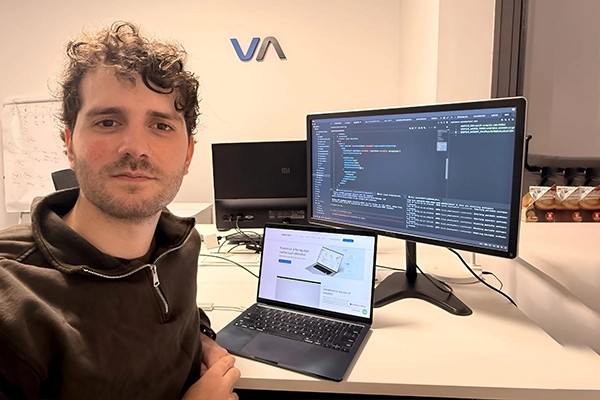
As voice AI expands across enterprise workflows, from collections to customer support, few engineers are influencing its direction like Suárez. This Uruguayan full-stack engineer joined Domu, a Mexico City–based behavioral intelligence platform for high-stakes servicing and account resolution, in October 2025. As the company’s first technical hire and Founding Engineer, Suárez brought an “entrepreneur-founder lens” shaped by years of building under real-world constraints: “I’ve built my own company from scratch, so I understand how founders think—why certain trade-offs are made and why systems have to work in the real world, not just in theory,” he says.
Today he is involved in the startup Zelto.ai, an automated proactive support tool for SaaS products that instantly detects when users get stuck during onboarding or daily use and immediately starts personalized, real-time conversations via SMS, WhatsApp, Slack, or LinkedIn to resolve their issues. This prevents most silent drop-offs—where users quietly churn without asking for help—helping companies reduce onboarding abandonment As CEO, Suárez is working on finding product market fit, sales and product.
While much of the industry focuses on impressive demos, Suárez concentrates on what actually matters: scalable pipelines, high-volume call handling, and cost-saving optimizations: “AI isn’t plug-and-play. You have to redesign the system around it,” he explains. At Domu, this meant rebuilding queue logic, call orchestration, and agent memory from the ground up—work he describes as “deep, hard orchestration,” involving extensive benchmarking, paper reviews, and trial-and-error: “There wasn’t a course for this. I had to go deep into research to understand what the best architecture should be, and then actually make it work,” he explains.
That hands-on mindset allows Suárez to bridge AI and system architecture, helping companies move beyond experiments and into real-world deployments. He often challenges how teams approach AI in the first place: “Most people start with, ‘How do we add AI?’” he says. “I start with the fundamentals. Sometimes the right solution doesn’t involve AI at all—but when it does, it needs to be done properly.”
From Bootstrapped SaaS to AI Frontlines
Suárez isn’t your typical Silicon Valley tech expert. Largely self-taught from the age of 15 in Montevideo, he went on to bootstrap Ventia, a SaaS CRM and sales performance platform focused on LATAM. As co-founder and CTO, he led end-to-end system architecture and execution, managed a 14-person team, and helped grow the company to $360K in ARR by September 2025.
That mindset and skill set were shaped and tested in the most direct way possible—within his own family business. At just 19, Agustín stepped in to address a critical breakdown in sales tracking and management. That experience revealed something bigger: the problem wasn’t unique. Hence, that solution became the foundation for Ventia itself, evolving into a platform that helps companies professionalize and optimize sales operations through technology.
As CTO, Suárez helped turn an internal problem into a scalable platform used by dozens of companies. This holistic approach later guides his AI orchestration work.
Ventia eventually served more than 30 SMBs across Latin America, earning spots in Endeavor ScaleUp and Mana Tech Miami and proving its product–market fit amid a volatile regional economy.
The experience revealed Suárez’s core strengths: a sharp ability to diagnose root problems, design systems grounded in real workflows, and deliver results under pressure. Agustín didn’t believe in forcing rigid systems onto people. Instead, he observed how teams really worked, asked questions, and built tools that matched natural workflows.
That execution-first mindset was also firsthand experience for Gastón Kehyaian, who worked closely with Suárez as a client during his time at Viasono.com.uy, when the company hired Ventia for a complex CRM and data integration project. Kehyaian first came across Suárez through Uruguay’s main innovation hub at Universidad ORT, where Ventia was incubated—an early signal, he says, of the caliber of builders behind the product. What stood out immediately was Suárez’s ability to combine analytical depth with genuine empathy for the client’s real challenges: “He has a rare way of truly understanding the problem you’re trying to solve—not just technically, but commercially. That made his role absolutely fundamental in moving the project forward,” Kehyaian recalls.
Kehyaian also commends Suárez’s technical skills and his calm, clear operation under pressure. The project required integrating multiple data sources into Ventia’s CRM while coordinating with external vendors, including Viasono’s ERP team—an environment where misalignment often slows progress. Suárez became the central point of coordination, translating complexity into execution: “He could grasp the challenge, propose a solution, and keep things moving without ever losing his composure. Even in difficult moments, he was transparent, proactive, and constructive,” Kehyaian shares.
He adds that Suárez’s mix of strong systems thinking, consultative selling insight, and human warmth made collaboration unusually smooth: “He combines excellent technical skills with a great sense of humor—which, in complex projects, makes all the difference.”
This entrepreneurial mindset was shaped long before Ventia existed. Growing up in a small town near Montevideo, Suárez was immersed early in business through his parents, who ran a technology retail company: “My parents are entrepreneurs. When I was a kid, it felt like the only option was to build something of your own. You could see how different life was if you had a business versus working for someone else,” he shares.
That firsthand exposure to how businesses actually operate—rather than just how they work in theory—shaped the way he thinks as a builder. It gave him a strong focus on revenue-generating features, operational efficiency, and designing systems that solve real customer problems, not just technically interesting ones: “If something was manual, I immediately thought about how to automate it. If it was fragile, I wanted to redesign it,” he explains.
This mindset showed up early. By age 12, Suárez was already experimenting with small ventures—organizing paid chess tournaments at school and selling custom photo magnets during lunch breaks: “Those were my first real businesses. I didn’t know the terms yet, but I was learning pricing, demand, and execution,” he recalls.
This constant exposure to logic, patterns, and rapid problem-solving laid the foundation for his later work in analytics, predictive modeling, and AI-adjacent systems. As he puts it: “Those kid ventures taught me full-cycle building before I even knew what an MVP was.” By the time he officially entered the startup world, Suárez wasn’t learning how systems worked—he was refining instincts he had been developing since childhood.
That early training shaped what would become his defining “systems-first” mindset. At Ventia, Suárez’s full-stack skill set—spanning Next.js, Node.js, React Native, AWS, and Redis—powered analytics helped sales teams improve performance by 30%. His work included building internal CRMs, business intelligence pipelines, and data ingestion systems that pulled live information directly from sales teams’ phones into centralized dashboards. These weren’t surface-level dashboards. They were deeply integrated data systems designed to improve forecasting accuracy and sales execution by analyzing real customer behavior.
This sought-after expert personally led the development of these advanced analytics features, often writing custom scripts and tooling himself to “make everything talk to each other,” optimizing data flows and performance tracking so teams could act on real-time insights instead of static reports.
Slashing Bottlenecks and Building Smart Queues
At Domu, Suárez focused on strengthening the foundation. One of his key efforts was restructuring the core PostgreSQL database, reducing overall workload by 80%. He achieved this through thoughtful schema redesigns, optimized indexing, and detailed query-plan analysis—removing inefficiencies that slowed the system. The result was sub-millisecond response times under heavy demand: “It wasn’t fancy. Mostly fundamentals—query plans, indexing, load testing. That’s the stuff that really drives performance,” he shares.
With the foundation in place, he turned to a much larger challenge: handling millions of calls each month. Suárez built a custom, fault-tolerant queue system that remains stable during traffic spikes. Drawing on his experience scaling SaaS infrastructure at Ventia, he made the system fully asynchronous to prevent cascading failures.
But what he created wasn’t just a standard call queue: “We’re not just queuing calls. It’s intelligence; predicting the best moment to call based on behavioral patterns,” he explains. ML-driven timing logic ensured calls happened when users were most likely to engage.
The highlight of his work was Domu’s internal agent builder. Designed as a central command dashboard, the tool lets teams create and manage voice AI agents with persistent memory and modular behaviors, with no coding required.
This dramatically reduced deployment friction and gave non-technical teams real control: “The goal was to let teams move fast without breaking systems,” Suárez shares. Using OpenAI APIs and custom Python pipelines, the platform enables drag-and-drop persona creation, shared memory across interactions, and prompt A/B testing. This approach opened up AI orchestration to teams throughout the company. His bilingual fluency in Spanish and English was also critical in fine-tuning AI behavior for both U.S. and Latin American enterprise customers.
Human-First Orchestration in a Hype-Driven World
Suárez’s approach cuts through the noise surrounding AI. His core principle is simple: think human first. To him, voice agents aren’t complex mysteries. They are carefully designed systems composed of clear steps—speech-to-text, intent detection, response generation, and text—to—speech that work together. As he puts it: “If you understand how humans think and respond, the AI architecture becomes obvious.”
This systems-first way of thinking started early in his career. During his IT and programming training at ESI Buceo, Suárez learned to break complex problems into structured, logical parts. That foundation deepened during his Bachelor’s studies in Computer Systems at Universidad ORT Uruguay, where systems design and structured thinking were core to the curriculum.
Alongside his formal education, he immersed himself in research—studying academic papers, benchmarking different models, and refining workflows through constant trial and error: “I devoured papers and tested everything until it finally felt conversational,” he recalls.
That same experimental mindset shows up in his personal AI projects, including Companion AI, a personalized assistant built to anticipate user needs through contextual awareness and long-term memory. The goal was never a novelty. Instead, Suárez focused on usefulness—creating interactions that feel natural, relevant, and timely in everyday use.
This approach proves its value in real business environments. For global insurer Chubb, Suárez designed voice systems that automate collections while preserving empathy. After a 5-day grace period, AI agents contact customers in natural, human-like language, send polite reminders, and enable instant payments via integrated gateways, all with 24/7 availability.
The results speak for themselves. Call volumes doubled or even tripled, millions in overdue payments were recovered, and human agents were freed to focus on more complex cases: “We reclaimed revenue without adding headcount. That’s the real win,” Suárez says.
Together, these show how Suárez consistently turns AI theory into practical systems—delivering measurable business ROI while keeping humans at the center of the design.
The Orchestration Edge
While voice AI continues to evolve rapidly, Suárez has remained focused on what actually works. He was advocating for multimodal systems long before they entered the mainstream.
Along the way, this tech expert has mentored early-stage startups in building practical MVPs and has spoken on industry panels in cities such as Montevideo and Bogotá. Suárez shares that he regularly works with founders to “close the gap of knowledge” around AI, especially when teams move beyond surface-level understanding and into real implementation: “It’s easy to get the basics, but if you want to go to the next level, you have to read a lot, test a lot, and extract where the real value is,” he shares.
Through leadership programs such as Tribu CTO Mentoring and Emprelatam’s pre-acceleration initiative, he shaped a leadership style focused on building strong teams and flexible, modular systems rather than chasing the latest trend.
For Suárez, real progress in AI comes from orchestration: “That’s where leverage happens,” he shares. By designing modular and auditable workflows, teams can create systems that grow reliably without breaking or producing unpredictable results.
That execution-driven mindset wasn’t theoretical. It was tested daily by the people building alongside him. Federico Barboni, Co-founder and Chief Growth Officer of Ventia, spent more than four years working closely with Suárez and saw firsthand how his systems-first thinking translated into real-world impact.
While Barboni led commercial strategy and operations, Suárez owned technology and product, forming what Barboni describes as a deeply aligned partnership. From the earliest days, he watched Suárez turn messy, fragmented sales environments into coherent, scalable systems: “Agustín doesn’t build features just because they sound good. He starts from how organizations actually work—multiple ERPs, fragmented data, large teams—and then designs systems that truly fit that reality,” Barboni explains.
What stood out most was Suárez’s combination of technical depth, pragmatism, and execution speed. Largely self-taught and relentlessly curious, he held himself to high standards while staying focused on outcomes: “He’s very logical and disciplined about solving the right problem. Often, clients thought they needed one thing, but Agustín would dig deeper, uncover the real pain point, and build what actually created value,” Barboni
That approach proved decisive as Ventia expanded beyond Uruguay. During the company’s move into Peru, Suárez rapidly built an MVP outside the roadmap to support new enterprise clients—without compromising system stability. His long-term vision, modular thinking, and ability to lead technical teams under pressure allowed Ventia to scale reliably: “Thanks to Agustín’s work, we were able to compete with global players and expand into multiple markets with a product that delivered real, measurable business impact,” Barboni adds.
This mindset is increasingly relevant as enterprises move away from fragile call centers and toward more controllable AI agents. Suárez’s work at Domu reflects this shift, showing that true efficiency comes from deep engineering, not unlimited funding. His journey—from a bootstrapped SaaS founder to an AI systems architect managing millions of real-time interactions—tells the story he calls an underdog story. More importantly, it proves his core belief: where you start doesn’t define your success; persistence and execution do.
About Author: Gauri Singh is a content contributor with experience writing business and technology-focused articles for professional audiences. Her work covers leadership profiles, operational strategy, and emerging trends across industries. Gauri has contributed to long-form editorial content designed to present complex topics in a clear, structured, and accessible way. She works closely with editorial teams to ensure accuracy, clarity, and alignment with publication standards.








































.webp)
.webp)

.webp)