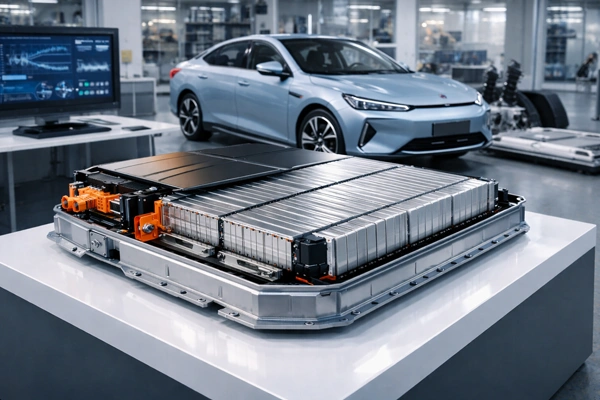
New battery achieves energy density above 700 Wh/kg, enhancing cold-weather performance and driving range for electric vehicles.
Chinese researchers have created a revolutionary battery for electric cars (EVs) that can go more than 1000 km (620 mi) on a single charge and has a super high energy density of more than 700 W/kg. A group led by Academician Chen Jun at the Chinese Academy of Sciences has established a new electrolyte system that replaces traditional oxygen atoms with fluorine atoms, resulting in improved performance for the battery. Lab tests show that this type of battery has a high energy density of approximately 700 W/kg. The battery can even withstand low temperatures as low as -50 C (-58 F) while still having a high energy density of almost 400 W/kg.
According to Chen, two of the main obstacles preventing more widespread adoption of electric automobiles are improving energy density and the performance of batteries under cold conditions. By using fluorinated hydrocarbons along with lithium-fluorine compounds, the researchers increased the conductivity and stability of ions, allowing for ultra-high energy density batteries.
There are several uses for high-energy density batteries; they can be used in addition to the electric vehicle market. Chen also stated intelligent robotics, operating at the Poles, the aerospace industry and the aviation industry would see great benefit from this technology. This latest advance builds on other recent accomplishments in China's battery technology. Chen's research team developed and installed the first - in the industry - lithium-rich manganese hybrid solid/liquid battery into an electric vehicle. The vehicle was in collaboration with FAW Group's Hongqi brand. The ongoing advancements point to China's goal of leading the way on the development of next generation battery technology.































.webp)

.webp)




.webp)