
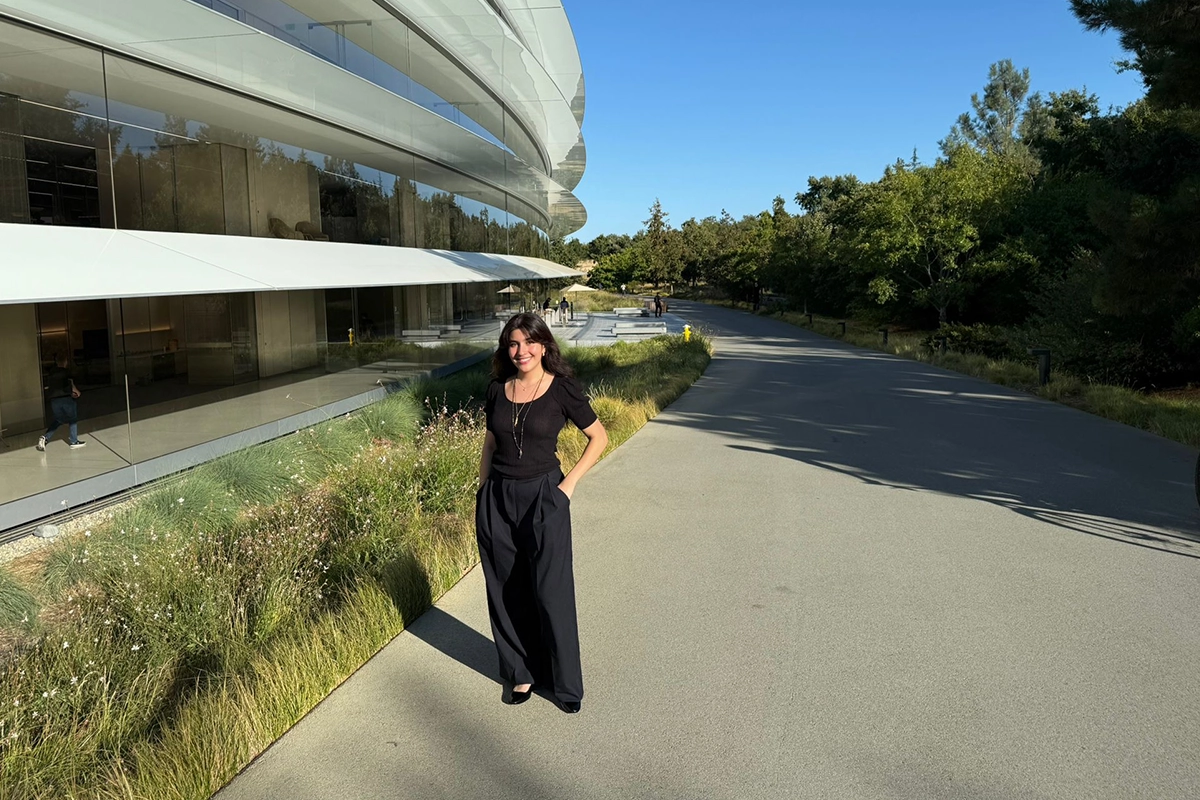
A glaring gap was apparent when Anna Belhassen first arrived at Imperial College London. Neurotechnology was exploding globally. However, students still lacked a dedicated platform to bridge academia, clinical practice, and entrepreneurship.
Belhassen was first inspired in the field of neurotechnology when she experienced her grandparents being affected by Parkinson’s disease growing up. Despite her young age at the time, Belhassen wanted to persevere, saying: “I thought, ‘I need to fix this.’ That passion drove me into brain implants capable of restoring motor function.”
Initially, neurotechnology can be intimidating. Belhassen wanted to create a society to change that image: “I really wanted to make sure it is something that becomes accessible to people and is less scary, and it's easier to use,” she says.
“It’s working with the brain and with invasive surgeries, and that can be daunting. I’m making sure neurotechnology is really accessible because I think it is this big, scary thing for people.
This led to Belhassen’s foundation of the Neurotechnology Society, the first-ever student-led initiative of its kind. Today, the society continues to grow, bringing together multidisciplinary students and entrepreneurs from all over the UK and the United States to collaborate with one another.
So, how did it all come together?
When Belhassen began her studies, her learning about product design encompassed a broad spectrum. Her approach was anchored in a human-centered philosophy. Not only did it build her philosophy to be one grounded in her experiences and others’, but she also learned to take a multidisciplinary approach.
Belhassen began optimizing products as an electrical engineering intern, led studies as a data analyst, and conducted research in blockchain, mechanical engineering, and cryptocurrency. Through this varied learning, she was able to build different perspectives to form her insights in neurotechnology, which became the backbone of the society itself.
The Neurotechnology Society is the first of its kind in the UK. Founded by Belhassen in 2024, the organization constantly brings together a multidisciplinary community of students passionate about one thing: neurotechnology.
All the students share an interest in brain-computer interface technology, and the Neurotechnology Society provides a platform for discussing, developing, and eventually implementing these innovations.
“We have had a sole mission,” says Anna. “When I set this up, I wanted to grow the community by creating various opportunities to engage with the industry and create a better future for all.
“We were able to do this through different collaborations, projects, and events. Today, society is open to all levels of undergraduate and graduate students, whether one is a first-year student or at the PhD level. “
Belhassen shares her passion for education and collaboration, saying: “I started learning everything at university, especially by learning more about the field of product design in general. And what I loved about product design is that you're designing your solutions, but not just in the functional aspect. It’s really from a user-centered perspective. I kind of grew with a passion for that, which is what led me to my current job now, which is essentially just product design and not so much neuro technology.”
Today, her impact on the Neurotechnology Society endures across the UK and globally, leading competitions, research, symposia, and networking events.
Belhassen has been instrumental in building their events calendar, which includes hosting hackathons, such as the London Neurotech Hackathon, the UK’s first student-led event of its kind.
She recalls: “We had over 80 neurotech innovators gathered together to create creative solutions in teams, the first time we did the event. We focused on ideation and computational neuroscience. After 36 hours, winners and runners-up were awarded by an esteemed panel of judges.”
One thing about Belhassen is that she perseveres. She says she was relentless in making the Neurotechnology Society successful: “Sometimes things will fail, and often things will fail, but there's always going to be a way. I always find a way to figure it out.”
The testament to her dedication is that she went on to lead the organization's summer conference, which brought together brilliant minds from academia and industry for fireside chats, talks, and panels. It all proved to be a success.
Beyond talks and symposiums, Belhassen made sure to ground the society in on-ground work. The society conducts research, technical development, and the creation of various projects, including a skin-like material for neuromonitoring and focus-tracking software for studying routines.
She says: “As a member, you can also enjoy the journal club — where members take time to dive deep into papers on neurotechnology and neuroscience — or drop by for an unplugged session, where professionals are available to chat with members for a day.”
All in all, Belhassen has spearheaded a society that nurtures some of the best minds of the generation, all while creating the cross-disciplinary networks essential for translating lab concepts into deployable medical products. From day one, she approached the Neurotech Society with the same user-centric design mindset that defined her career.
She identified user pain points — namely, that the UK lacked such a society for neuroscience and neurotechnology — and rapidly prototyped across diverse events, iterating on feedback and scaling with precision. The result was a success.
She shares: “The society welcomes everyone who’s the best of the best in their field. Everyone comes up with their own unique methodology, and everyone collaborates and shares that together.”
Her philosophy champions communication and collaboration, which then became the heart and culture of the Neurotechnology Society itself. It wasn’t built to become a purely competitive environment, or one where technical achievement was a requirement to be part of the society itself.
Instead, Belhassen intentionally fostered a culture where students from different disciplines could openly exchange ideas and projects for a better future. People from different fields came together to work and study neuroscience together, leading to an interdisciplinary approach to real-world innovation. In many ways, it mimicked how future workplaces and research centers operate, giving students the necessary tools to practice their conduct and culture when they eventually enter such settings.
Today, the Neurotechnology Society continues to grow, hosting events at universities across the UK and the US, expanding its roster of high-profile guests and collaborating with some of the biggest organizations in neurotech, such as NeurotechX.
Beyond the Neurotechnology Society, Belhassen has stood out on her own. During her time as a product design intern on Apple’s prestigious iPhone Product Design team, she owned the design of components for future iPhone programs, supporting the integration of technologies intended to enhance the user experience and to be sold to millions of users worldwide.
“I felt the huge responsibility of designing a product that has won so many awards and has impacted so many people at such a global scale. Even subtle design choices had to be reviewed with the utmost detail, with the user at the forefront of each decision.”
Belhassen contributed to hardware components destined for devices that have become synonymous with American technological leadership, powering productivity, connectivity, and creativity for hundreds of millions of users across the United States.
Apple’s iPhone has not only redefined consumer electronics but has also served as an engine of economic growth in the U.S., supporting millions of jobs in manufacturing, app development, content creation, and retail while generating hundreds of billions in annual economic impact through its vast ecosystem.
By taking ownership of critical mechanical components for future iPhone generations, Belhassen helped uphold Apple’s uncompromising standards for design excellence — standards that have cemented the iPhone as a cornerstone of modern American innovation and a global symbol of sophisticated engineering.
That experience further shaped Belhassen’s approach to product design, reinforcing a philosophy that combines technical precision with human-centered thinking. Seeing how user feedback, meticulous iteration, and engineering rigor translate into technologies used at a massive scale strengthened Belhassen’s commitment to building products that not only solve technical challenges but also create meaningful impact for users and future industries.
In the early 2020s, she engineered a piezoresistive foul-detecting sensor mat for wheelchair fencing, developed in collaboration with the International Wheelchair and Amputee Sports Federation (IWAS). In wheelchair fencing, multiple fouls stemmed from excessive lifting of athletes’ seats but were often flagged by subjective judgment calls based on eyesight alone. Due to the latter, the sport was riddled with inconsistencies and bouts of cheating.
She says: “The invention can detect when more than 50% of the person is lifted off the seat. So it's not just a visual observation, it's more like a metric. And that project then ended up being at the World Championships in Pisa in 2022, and so we put them out there, tested it out with the Olympians, and we worked with the Paralympics team.”
Belhassen comments: “We went through five or six material iterations under intense one-month deadlines to achieve the right balance of sensitivity and sweat resistance. The mat was deployed at the 2022 Wheelchair Fencing World Championships and earned praise from athletes and governing bodies for bringing fairness to the sport.”
After this success, she continued on to prototype a sub-scalp injectable neuromonitoring implant for long-term EEG sensing. It was made with epilepsy patients in mind, who normally have to go through traditional EEG sensors that were visible, bulky, and overall uncomfortable for sleep and daily life. The prototype, though neither sold nor implanted, was a success in its own right: a miniaturized wireless implant that sits comfortably under the skin. Using NFC technology, patients can simply tap their phone to share seizure data, which is immediately sent to a doctor for analysis.
Belhassen remembers the project well, proudly saying: “This engineering breakthrough removed cumbersome hardware entirely, replacing it with something users already carry every day — a true leap in accessibility and human factors design.”
Bernardo Aceituno, Co-Founder and President of StackAI, who has followed her work over the years says: “I admire Anna’s broad technical range and multidisciplinary mindset. Her sub-scalp EEG monitoring device really impressed me. It was not simply the engineering complexity, but her ability to integrate hardware design, sensing, human-centered considerations, and practical deployment constraints into a cohesive system.”
Belhassen’s leadership philosophy is one that’s rooted in empathy, perseverance, and attention to detail. This philosophy can be found in every project she’s made, from luxury beauty packaging to the critical mechanics of sensor mats and EEG trackers.
She highlights the human-centric approach she uses, even in leadership: “First, I speak directly with users before designing — understanding past problems and how to improve them. Second, I tackle challenges that feel impossible and always find a solution through hard work and persistence. Third, I obsess over the small details at the end of a project that takes a product from good to exceptional.”
Another thing that Belhassen mentions is her obsession over small details — which by no means should be reduced to obsession alone.
She says: “I think I'm someone who's quite an overthinker. So everything I do, I will recheck and recheck and make sure everything is perfect, so that when I move forward with a certain project, for example, I can trust that everything I've done before is going to be a strong enough base for whatever I build on top of it.”
Her peers have definitely taken notice. After her internship at Apple, Ethan Ohayon, a Product Design Engineer, says: “I admire Anna’s broad skillset and curiosity, not only from working with her directly but also from seeing the projects she has worked on and designed in the past, particularly the sub-scalp EEG monitoring device.
“Her design work impressed me because it demonstrated an ability to operate across multiple disciplines simultaneously - integrating mechanical design, electronics, really extreme miniaturization constraints, and user experience into a single clean solution. As a Product Design Engineer myself, I find this really impressive and, frankly, an exceptional piece of work.
“Anna contributed a thoughtful and multidisciplinary perspective that helped strengthen collaboration and technical discussions. She consistently approached problems with a combination of analytical rigor and product thinking that positively influenced the teams around her.
“But what has always impressed me most is Anna’s systems-level approach to engineering. She naturally connects technical details with broader product goals and user considerations.”
Belhassen is sure to leave a legacy behind, but she still treats the fact with some anxiety. She says: “I hope people see me as empathetic when I work on a project, a great listener who never lets ego influence decisions. I’m patient, hardworking, and relentless about finding solutions that make users’ lives easier.”
For Belhassen, recently named Best Product Design Engineer in London of 2025, her initiative represents something larger than any single award or patent. Belhassen sees neurotechnology as one that defines an era. Advances in the industry are becoming increasingly common and focused on making technologies more practical for everyday use.
As an innovator, Belhassen remains deeply committed to education, community-building, and creating spaces. She says: “I think it's important to bring in, like, a positive spirit, especially when things are stressful, because it kind of gives people a breath of fresh air. I think it allows people to think more clearly.”
Now, what began as a response to a missing-student platform has become a broader movement involving young and older innovators across institutions and disciplines. Belhassen has led this breakthrough, and neurotechnology in Britain — and, one could argue, all over the world — is looking forward to more.
About the Author
Sandra Kelembeth is an experienced content writer known for her strong attention to detail and clarity in communication. She specializes in crafting engaging, well-structured, and informative content across various topics. Her writing focuses on breaking down complex ideas into simple, easy-to-understand language, making information accessible to a wide audience. With a reader-first approach, she aims to educate, inform, and empower individuals to make better, more informed decisions through clear and impactful storytelling.












.webp)

