
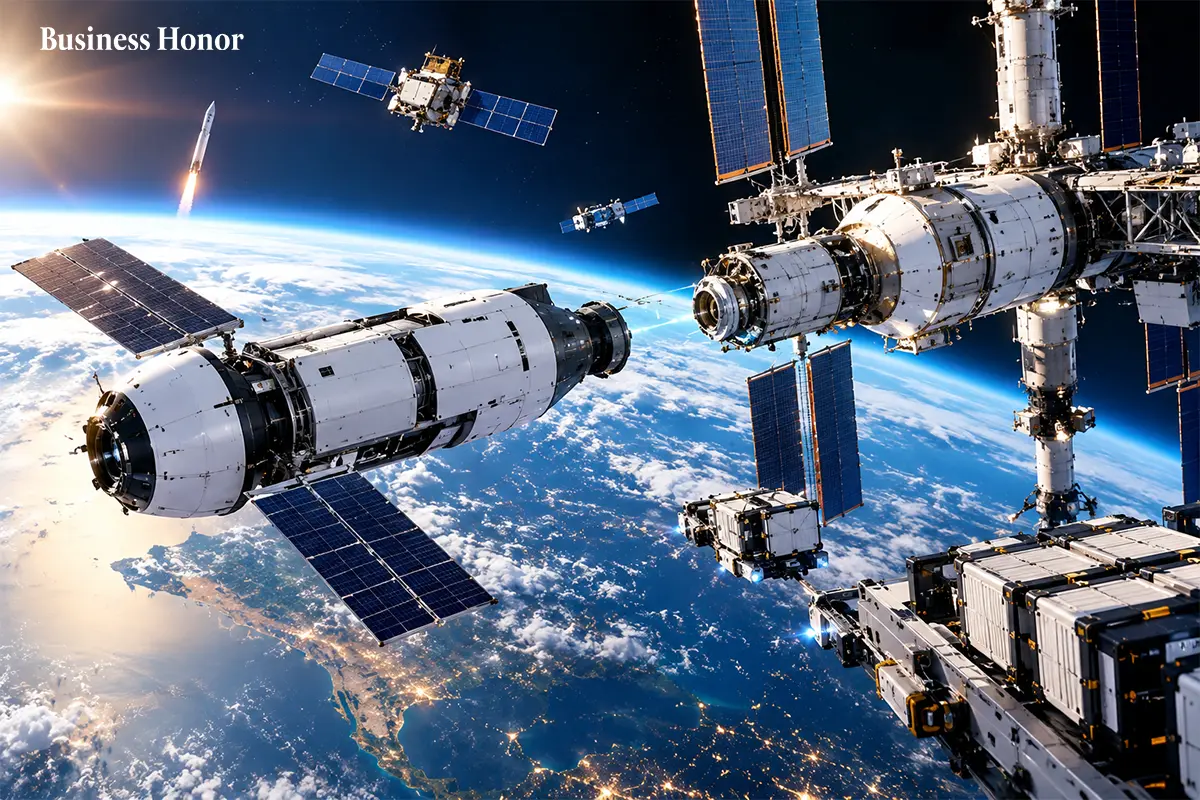
The top private space companies are entering a decisive phase in 2027. Launch capabilities for commercial use are transitioning from an era of experimentation into one where the operation occurs regularly and frequently. Rather than merely supporting government activities, commercial entities are now constructing self-contained economic ecosystems within low-Earth orbit, the moon, and deep space.
Financial figures compiled indicate that investments into space ventures recently crossed the $23 billion threshold. The investors are targeting organizations which have hardware already tested, proven manufacturing capability, and solid commercial contracts.
The Macro Shift in Commercial Orbital Infrastructure
The broader aerospace market is undergoing a clear structural shift. Government monopolies on rockets and payload delivery have opened up to open market competition.
The change has been accelerated by policies such as that of the United States Commercial Space Launch Act.
Instead of using the one-time use rockets owned by the government, satellite companies, research facilities, and military groups have started purchasing specialized transportation services.
Three distinct trends drive this market:
-
Reusable Launch Systems: Reducing the cost per kilogram enables launching huge satellite constellations as well as large amounts of cargo.
-
Post-ISS Space Logistics: As the International Space Station is set for decommissioning, private companies are developing modular space stations as well as automated laboratories.
-
Lunar Supply Lines: Programs like NASA's Artemis Program are turning lunar transport into a multi-billion-dollar recurring business.
An analysis in Harvard Business Review pointed out that commercial space has evolved from a risky gamble into a core infrastructure market. Can traditional space operations stay competitive without moving to fully reusable rockets?
10 Top Private space exploration companies to Watch in 2027
- SpaceX
SpaceX remains the central pillar of commercial space operations. Most of its revenue comes from frequent Falcon 9 launches and its growing Starlink internet constellation.
For 2027, all eyes are on scaling Starship, its massive reusable launch system. Starship's large payload capacity aims to drive down transport costs, providing the heavy lifting needed for NASA’s lunar landers and massive industrial payloads.
- Blue Origin
Founded by Jeff Bezos, Blue Origin focuses on heavy orbital launch, crewed missions, and lunar hardware.
Blue Origin enters 2027 with the most to prove. A New Glenn rocket exploded during a pre-launch test in late May and badly damaged its only launch site. The stakes are high because NASA holds a $3.4 billion contract with the company for its Blue Moon lander.
NASA Administrator Jared Isaacman still backs flying the Mark 1 lander on New Glenn, saying, "We have time." A rebuilt pad and a clean return to flight will decide whether that holds.
- Rocket Lab
Rocket Lab uses a dual model that combines launch services with satellite manufacturing. Its Electron rocket provides dedicated access to orbit for small satellite operators.
Neutron, a medium-lift rocket developed by the company for the purposes of satellite constellations and deep space exploration, increases the operational capacity of the company. The company develops satellites and has launch capabilities using its own rockets.
- Stoke Space
Stoke Space is developing Nova, a medium rocket built for total reusability across both its first and second stages.
While recovering the main booster is common today among space startups to watch in 2027, most companies discard the second stage in orbit. Stoke Space designs its upper stage engine to survive re-entry and fly again, aiming to eliminate replacement costs and shorten turnaround times between flights.
CEO Andy Lapsa told that the space economy scales "exactly as fast as rockets get off the ground." The target has already slipped slightly, and a first flight must still prove full reuse.
- Impulse Space
Impulse Space handles last-mile delivery once a rocket drops off a satellite in orbit. Its spacecraft move payloads to their final operational positions.
Its high-energy kick stages, including the Helios platform, handle orbit changes, trajectory adjustments, and repositioning. As satellite networks grow larger, this type of in-space towing is becoming an essential part of orbital logistics.
“We’ve proven that we can build fast and fly successfully. Now, the market is demanding more,” said Mueller, CEO and founder.
- Apex
Apex builds standardized, mass-produced satellite bases that eliminate the long lead times of custom engineering.
By building factory-assembled spacecraft platforms, Apex lets constellation operators and government teams attach their payloads and launch quickly. In 2027, the key test for Apex will be scaling factory output without compromising hardware quality.
CEO Ian Cinnamon says, "Over time, we'll get to 100% vertical integration." Factory output, not fundraising, is the test.
- Varda Space Industries
Varda Space Industries focuses on space manufacturing. It uses the weightless environment of low-Earth orbit to make specialized pharmaceuticals and advanced materials that are nearly impossible to produce on Earth.
Varda’s automated spacecraft process high-value compounds in orbit and send them back to Earth inside return capsules. The company's business model hinges on repeatable re-entry flights and proving clear financial returns for commercial clients.
- Agnikul Cosmos
Based in Chennai, India, Agnikul Cosmos specializes in small satellite launches using custom 3D-printed rocket engines.
After initial suborbital tests for its Agnibaan rocket, Agnikul is building toward full commercial launches. The company works within India's updated space policies, overseen by IN-SPACe, to offer low-cost, mobile launch options for global clients.
- Skyroot Aerospace
Headquartered in Hyderabad, Skyroot Aerospace is another major builder in India’s commercial launch market. Its Vikram rocket series offers flexible options tailored for small satellite payloads.
Skyroot is moving from test flights into regular commercial operations. Securing repeat corporate contracts will decide how well it holds up against established small-launch competitors.
- Pixxel
Pixxel deploys a constellation of satellites based on hyperspectral imaging technology. Conventional cameras in satellites only provide visual imagery, whereas hyperspectral imagery takes images through hundreds of narrow spectral bands and thereby provides information about chemicals and materials.
Founder Awais Ahmed set out to build a "health monitor for the planet." The test is whether customers pay for what it sees.
The proof of success will be determined by whether the customers pay for its services.
The company offers its detailed environmental data to agriculture, mining, energy, and military industries. It uses the data subscription business model instead of building rockets.
Strategic Analysis: Moving into Commercial Execution
Business Honor observes that the commercial space sector is now moving beyond just technical demonstrations and into unit economics. Rocket launches can take all the attention, but in terms of creating long-term value, it’s all about timing, logistics, and customer loyalty.
How will space companies protect their profit margins as launch capacity becomes easier to buy?
Investors are putting money into companies with recurring service models. Teams offering specialized space software, in-orbit towing, and standardized satellite bases are protecting themselves against falling launch prices.
What Will Define Success in 2027?
-
Total Vehicle Reusability: The reusability of the second stage will decide whether the turnaround time is measured in days rather than months.
-
Diverse Revenue Streams: Launch firms are diversifying into satellite manufacturing and in-orbit services to maintain profitability.
-
Execution on Government Contracts: NASA’s Artemis program and military supply contracts remain essential sources of non-dilutive capital.
Industry Outlook & Final Perspective
Private rocket companies in 2027 are laying the groundwork for routine orbital commerce. With the hardware manufacturing process being standardized and launch costs falling, the key will not be just reaching space but what those companies will do when they get there.
The firms that focus on execution, build long-term contracts with their customers, and keep their capital costs low thanks to reusable hardware will lead the way in expanding the space economy.
FAQ:
What defines the top private space companies in 2027?
Leading companies are judged on reusable rocket tests, contract backlogs, manufacturing efficiency, and consistent launch schedules.
Why are private space exploration companies shifting focus toward in-orbit services?
Reaching orbit is now routine, so real value is moving to secondary services like in-space towing, satellite repairs, and orbital manufacturing.
How do space startups to watch in 2027 differentiate from legacy aerospace contractors?
New space startups focus on rapid software iteration, off-the-shelf components, in-house manufacturing, and fully reusable designs to cut capital costs.
How are private rocket companies reducing overall launch expenses?
Reusing boosters and upper stages cuts replacement hardware costs, allowing teams to fly more often at lower rates per kilogram.
What role do global government policies play in commercial space growth?
Laws like the U.S. Commercial Space Launch Act give companies legal clarity to license hardware, secure signal frequencies, and win public research contracts.










































.webp)



.webp)



Comments
0 Comments