
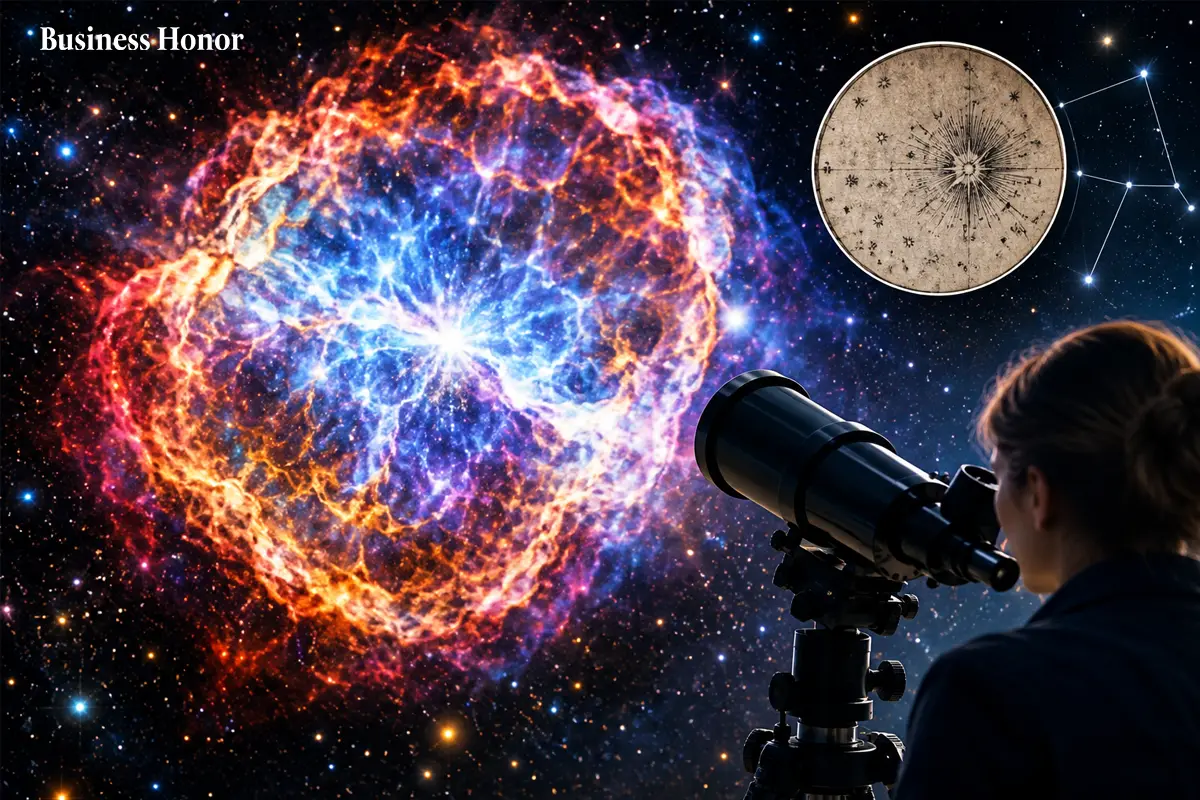
A mysterious new star observed in 1604 was later identified as a supernova, giving astronomers a rare look at the violent death of a star.
|
There was a strange object in the sky in October 1604. Scientists at the time were surprised because they believed the heavens were largely stable. More than 400 years later, astronomers found out that the object was not a newly formed star. It was the remains of a dying star, known as SN 1604 or Kepler's Supernova.
According to Moneycontrol, SN 1604 was a powerful stellar explosion that appeared as a bright new object in the sky in 1604.
Kepler Studied the Mysterious New Star
The object appeared in the constellation Ophiuchus, near Jupiter, Mars, and Saturn. It became extremely bright, reaching a magnitude of -2.5 and outshining Jupiter. For nearly three weeks, people could even see it during the daytime.
Kepler closely followed the object and later published his observations in Prague in 1606. His work was titled De Stella Nova Pede Serpentarii, or “On the New Star in Ophiuchus' Foot.” The event later became known as Kepler's Supernova.
Kepler did not have a telescope when he studied the object. The instrument had not yet been invented, so he and other astronomers depended on their eyesight and the instruments available at the time.
What Was the New Star?
Modern astronomy identifies SN 1604 as a Type Ia supernova. It was a huge thermonuclear explosion involving a white dwarf. A white dwarf is the dense leftover core of a star that has exhausted its nuclear fuel.
A white dwarf can pull material from a nearby companion star. If enough material builds up, it can trigger a massive thermonuclear explosion.
So, the object seen in 1604 was not a star being born. It was the violent end of a star.
The Explosion Happened Thousands of Years Earlier
SN 1604 is estimated to be about 20,000 light-years from Earth. The light that Kepler saw had therefore been travelling across space for thousands of years before reaching Earth.
The explosion left behind a growing cloud of debris. NASA's Chandra X-ray Observatory, Hubble Space Telescope, and Spitzer Space Telescope have all been used to study these remains.
Chandra has also detected material moving at more than 20 million miles per hour in parts of the remnant.
Why This Matters
Kepler's Supernova gives scientists a rare connection between early observations and modern astronomy. Kepler could only watch the light in the sky, while today's telescopes can examine what the explosion left behind.
Business Honor observes that Kepler's Supernova shows how centuries-old observations can still help scientists understand stellar explosions and the final stages of a star's life.
FAQs
What was the new star seen in 1604?
It was SN 1604, a Type Ia supernova now known as Kepler's Supernova.
Who observed SN 1604?
Italian astronomer Lodovico delle Colombe made an early recorded observation, while Johannes Kepler later studied the object extensively.
Was Kepler's Supernova actually a newly formed star?
No. It was the explosive death of a star involving a white dwarf.
How far away is SN 1604?
It is estimated to be about 20,000 light-years from Earth.
Can astronomers still see the remains?
Yes. The expanding supernova remnant continues to be studied using modern space observatories.





































.webp)

.webp)



.webp)



Comments
0 Comments