
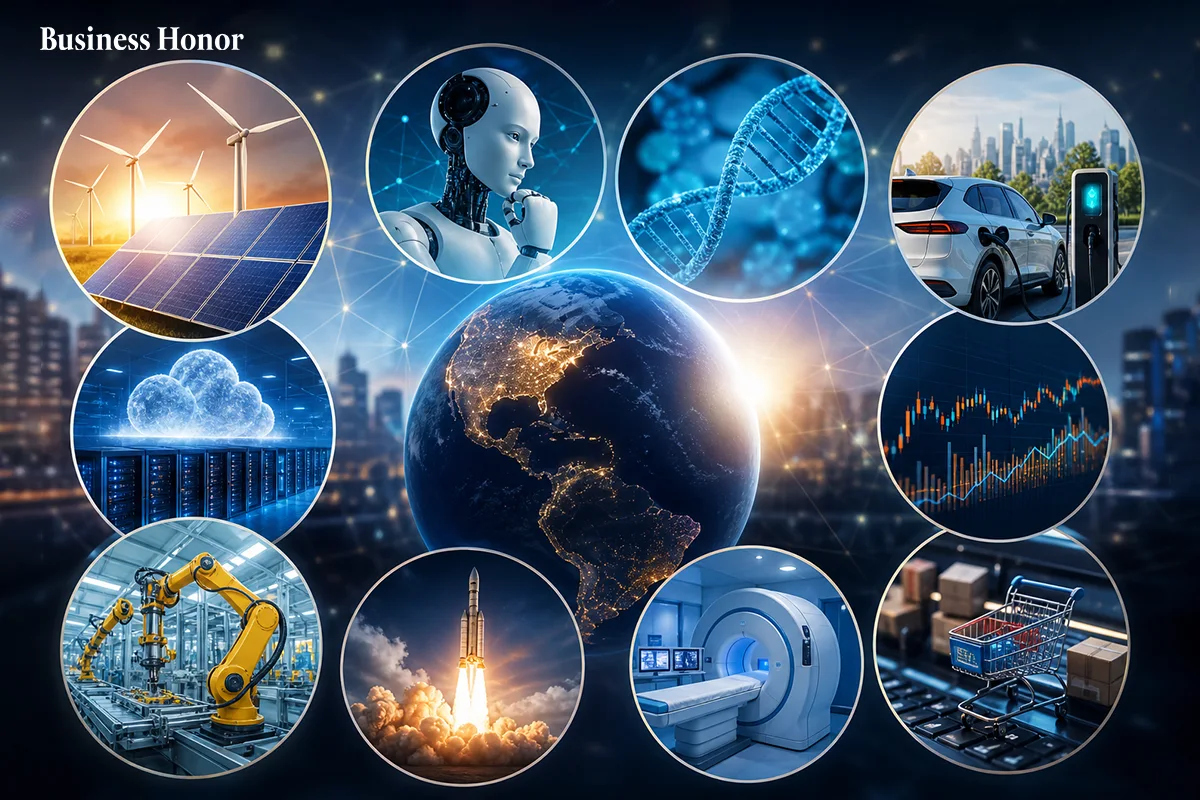
Businesses are putting more money into artificial intelligence, digital infrastructure, energy, manufacturing, and supply chains in 2026. Corporate investment trends in 2026 are increasingly focused on areas connected to technology, infrastructure, and long-term business requirements. UN Trade and Development said strategic sectors made up 44% of greenfield investment value in 2025, compared with 16% in 2020. Data centers, semiconductors, critical minerals, and energy-transition technologies were among these areas.
Business Honor examines the 10 industries attracting major corporate investment in 2026, from AI and semiconductors to energy, cybersecurity, healthcare, and logistics.
- Artificial Intelligence
AI is taking up a larger share of technology budgets. Companies are spending on AI models, software, computing systems, and AI agents. Corporate investment in artificial intelligence is also extending into the infrastructure required to support these technologies.
The spending does not stop with software. Companies also need servers, chips, data centers, and electricity. PwC estimates that investment needed for AI infrastructure could reach $31.6 trillion by 2050. It also estimates data-center capital spending at about $800 billion a year in 2026.
- Semiconductors
Chips are used in phones, cars, computers, industrial machinery, AI systems, and data centers. This wide use has made semiconductor manufacturing an important area for new projects.
Governments and businesses are also trying to build more dependable chip supply chains. UN Trade and Development lists semiconductors among the strategic industries linked to higher greenfield investment.
An EY-IESA study published in September 2026 estimated India's semiconductor market at $64 billion in 2026. The study expects it could reach $200 billion by 2035.
- Data Centers and Cloud Infrastructure
AI requires large amounts of computing capacity. That has increased the need for new data centers and high-performance computing facilities.
Building a data center is expensive. Companies have to pay for servers, GPUs, cooling equipment, network connections, and power. The costs do not end after construction, either. Equipment needs to be replaced and upgraded as computing technology changes.
The availability of electricity and network connections can also determine where these facilities are built.
- Renewable Energy and Power Infrastructure
Electricity has become a bigger concern for companies operating large data centers and other energy-intensive facilities. This has put power generation and electricity grids into the investment discussion.
Renewable energy remains an important part of the energy transition. However, projects can face problems with financing, approvals, and regulation. UN Trade and Development includes energy-transition technologies and services among strategic investment areas.
- Cybersecurity
Companies are using more cloud services, connected systems, and AI tools. Protecting those systems requires continued spending on cybersecurity.
Businesses are investing in identity protection, threat detection, cloud security, data protection, and security operations. The expansion of AI infrastructure adds another layer of security requirements.
PwC has also identified security as one factor that may influence decisions about future AI infrastructure.
- Robotics and Industrial Automation
Manufacturers are turning to robots and automated equipment to improve factory operations and deal with labor shortages.
The market covers industrial robots, autonomous machines, machine-vision equipment, and AI-based manufacturing systems. Automotive, electronics, semiconductor, and logistics companies are among those using these technologies.
- Healthcare and Biotechnology
Healthcare continues to draw corporate money. Pharmaceuticals, biotechnology, medical devices, diagnostics, and digital health are all receiving investment.
New treatments, aging populations, digital healthcare services, and advances in biological research are some of the factors behind this spending.
Private-equity firms are active in the sector as well. EQT lists healthcare among the areas in which it has invested in India.
- Aerospace and Defense
Aerospace and defense companies are seeing investment across aircraft, satellites, autonomous systems, electronics, and manufacturing.
Changing security requirements and military modernization are contributing to this spending. Some of the technologies used in the industry are also shared with the AI, robotics, semiconductor, and advanced-materials sectors.
- Critical Minerals and Advanced Materials
Electric vehicles, batteries, renewable-energy equipment, and semiconductor production all require specific minerals and materials.
That has brought more attention to the supply of critical minerals. UN Trade and Development identifies critical minerals as a strategic investment area. Companies are also looking for more dependable sources of important raw materials to avoid production problems caused by supply disruptions.
- Logistics and Supply-Chain Infrastructure
Companies are spending on logistics as they make changes to their supply chains.
Warehouses, ports, transportation systems, automation, and digital logistics platforms are receiving investment. Businesses are also using AI and data analysis to plan inventory, estimate demand, and manage transportation.
What These Industries Have in Common
Many of these sectors depend on one another.
AI needs chips and data centers. Data centers need electricity and cooling. Chip factories need specialized materials and transportation. Robots need chips, software, and industrial equipment.
This means spending in one area can create additional demand elsewhere. PwC's 2026 analysis describes AI infrastructure as a long-term investment cycle, partly because computing equipment will need regular upgrades.
Why 2026 Is Different
Global investment increased in 2025, although the growth was uneven. UN Trade and Development reported a 6% rise in global foreign direct investment to $1.6 trillion. It also said much of the increase was concentrated in a small number of economies and large projects.
Companies are also dealing with geopolitical tensions, uncertain trade policies, higher financing costs, and economic fragmentation.
These issues affect where businesses put their money. A company looking at a new project now has to consider more than market demand. Electricity, computing capacity, raw materials, manufacturing facilities, and supply routes can all affect the decision.
The Investment Outlook
The high growth industries 2026 include several areas connected to technology and infrastructure. AI, semiconductors, and data centers are receiving substantial spending. Energy, cybersecurity, healthcare, defense, robotics, critical minerals, and logistics are also part of the wider picture.
These sectors are among the future growth industries being shaped by changes in technology, manufacturing, energy use, and global supply chains.
However, spending will vary between companies and countries. Interest rates, regulations, technology, energy availability, and geopolitical conditions will continue to affect individual projects.
The broader picture is straightforward: in 2026, companies are putting capital into the systems and resources they need to build, operate, and expand their businesses.












.webp)

.webp)




.webp)


Comments
0 Comments