
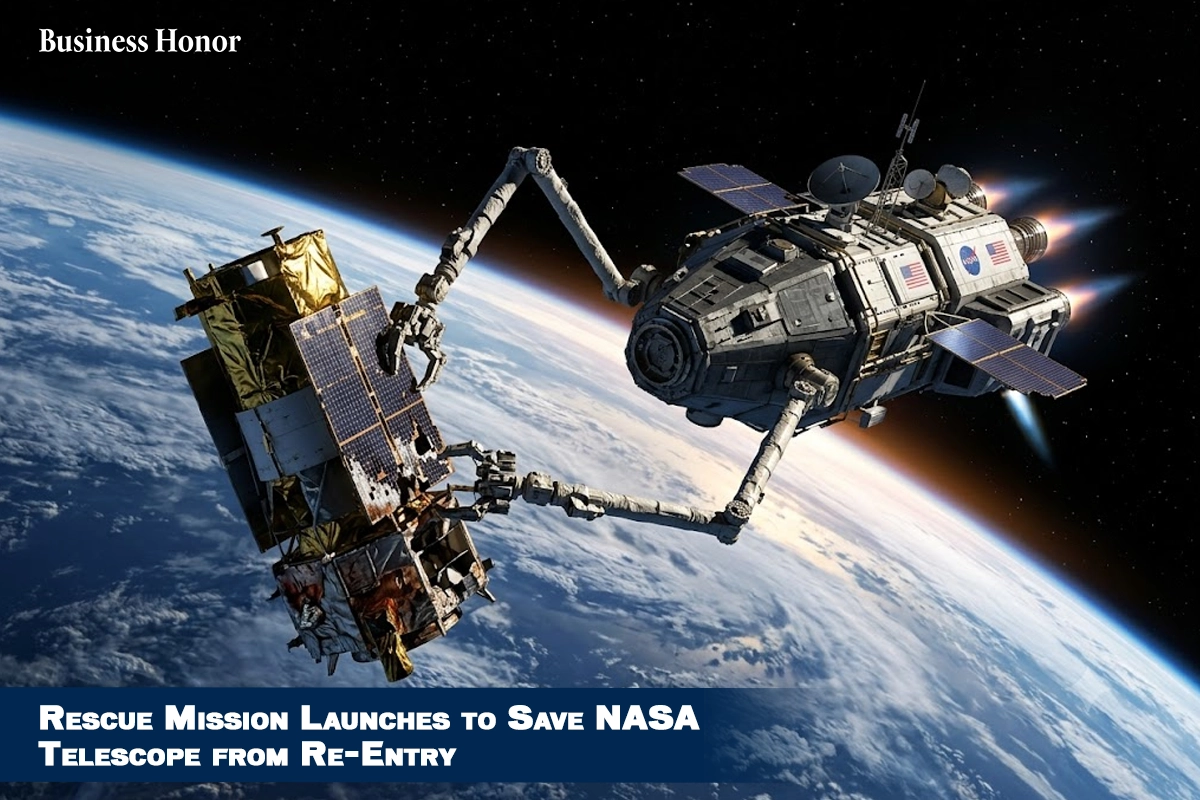
A pioneering rescue mission has launched to save a NASA telescope from falling back to Earth, marking a major milestone in satellite servicing and space sustainability.
|
A groundbreaking rescue mission is underway to save a NASA telescope from burning up in Earth's atmosphere, marking one of the most ambitious satellite servicing operations ever attempted. The mission is drawing global attention as NASA's satellite rescue mission and space debris mitigation technology become major topics across the aerospace industry.
Northrop Grumman has launched Katalyst Space Technologies' Link spacecraft into orbit via a Pegasus rocket from the Marshall Islands. The mission is set to attempt the docking with the aging NASA Swift Observatory satellite, which has been gradually descending as a result of increased drag on account of the heightened activity of the solar. A success might revolutionize NASA's telescope maintenance services and prolong the life of aged satellites.
The Swift Observatory, which was put into orbit in 2004, has contributed greatly to the monitoring of gamma-ray bursts and other cosmic events. Unfortunately, solar activity has hastened the process of orbital decay of the craft, making it vulnerable to re-entry into Earth's atmosphere already this October. NASA has invested some US$30 million into the project that will result in Link capturing Swift and slowly elevating its altitude by some 240 kilometers. The thrusters were specially built for a gradual boosting procedure, causing minimal stress to the observatory and returning it to a stable position.
Project managers believe that the robotic spacecraft will arrive at Swift in one month. All scientific research has been paused in order to save the remaining lifespan of the orbiting telescope until the process of servicing is complete. This mission is a significant step towards sustainability in the space industry. Once the technology proves to be effective, it can be used to serve other spacecraft in need, including the Hubble Space Telescope, which loses its altitude due to air friction in the atmosphere.
Katalyst Space Technologies noted that the mission is high risk, but it might transform the industry as we know it, providing a way to prolong the lifespan of satellites without wasting billions of dollars on new equipment. Business Honor believes innovative satellite servicing missions can transform space sustainability by extending spacecraft lifespans, reducing orbital debris and maximizing scientific investments for future exploration.













.webp)

.webp)




.webp)


Comments
0 Comments