
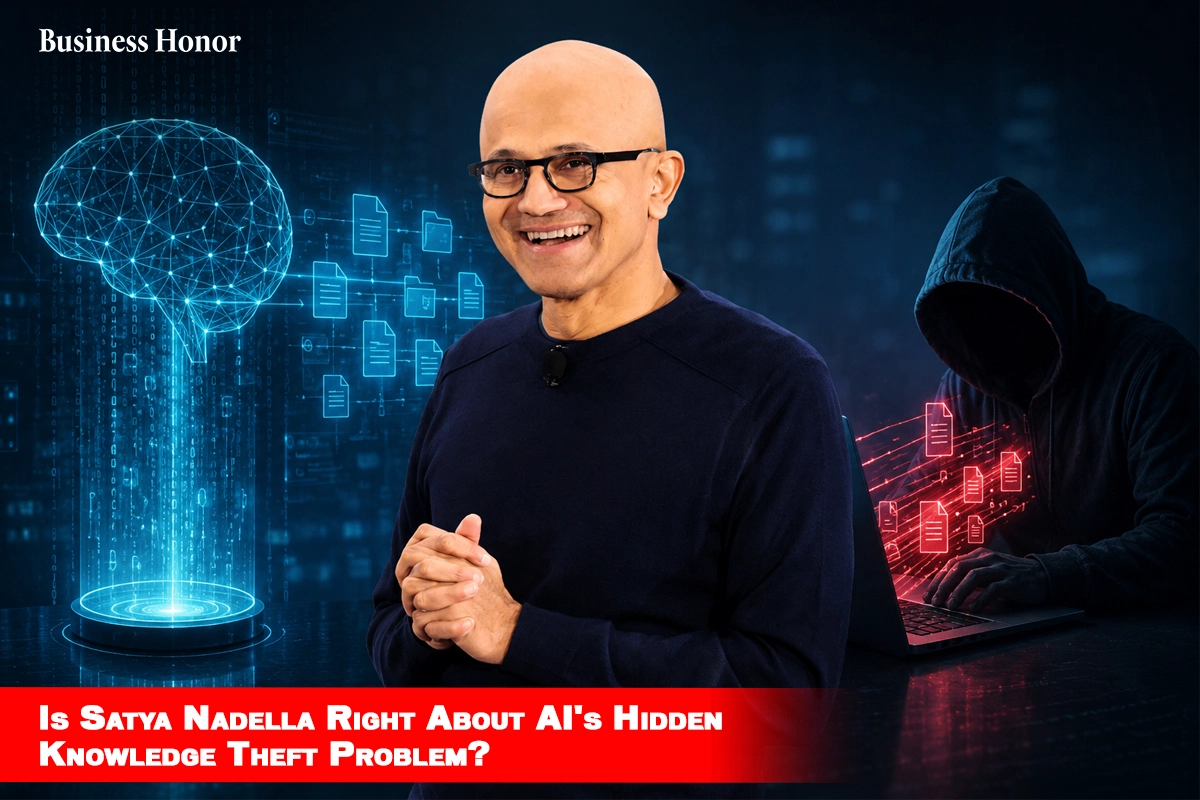
Microsoft CEO Satya Nadella warns enterprises face unprecedented risks in artificial intelligence adoption today globally.
|
Satya Nadella, Microsoft's Chairman and CEO, has articulated a critical paradox facing modern enterprises in the artificial intelligence age—one that fundamentally inverts economist Kenneth Arrow's classic information problem. Unlike Arrow's traditional paradox where sellers risk revealing knowledge to buyers, Nadella describes an opposite dynamic emerging today. In acquiring Microsoft AI, companies must expose their most valuable proprietary knowledge—the very assets that differentiate them from competitors. "In the AI age, the buyer risks giving away knowledge, just in order to use what they bought," Nadella explained on X. "You essentially pay for intelligence twice, once with money, and again with something even more valuable: the proprietary knowledge you must reveal to make that intelligence useful."
This phenomenon grows more pronounced as organizations seek better model performance. Enhanced capabilities demand deeper insight into a company's operations, data patterns, and internal processes. Each additional layer of customization and optimization requires revealing more institutional secrets to the model provider—creating an asymmetry that systematically disadvantages knowledge creators. The challenge extends beyond initial data exposure. Model providers continuously learn from what Nadella terms "exhaust"—encompassing user prompts, agent tools, corrections, and evaluations. Every mistake corrected, every prompt refined, and every operational adjustment becomes embedded institutional knowledge. This learning flows predominantly in one direction: from customer to vendor.
|
"Every correction is distilled into institutional know-how," Nadella stated. "It's the kind of knowledge a competitor could never buy, and the kind that leaks almost imperceptibly: trace by trace, correction by correction.” |
The current ecosystem compounds this imbalance. Model providers leverage fair use rights to train on public data while simultaneously imposing restrictive terms on customer distillation and reserving rights to learn from customer usage. This one-directional learning concentrates economic value toward infrastructure owners rather than the organizations generating knowledge.
His perspective aligns with demands from sophisticated technical customers. Quoting Palantir CEO Alex Karp, Nadella emphasized that enterprises increasingly seek "absolute autonomy over their proprietary systems." Organizations want control over their compute infrastructure, models, data stacks, and competitive advantages—essentially owning the means of production rather than depending on external vendors. Resolving the reverse information paradox requires distributing learning infrastructure across enterprises, enabling each organization to control its own learning loop. This structural change would ensure that knowledge created through customer engagement returns to knowledge creators, fundamentally reshaping how value distributes across the AI ecosystem and protecting competitive advantages in an intelligence-driven economy.
Business Honor is of the view that Satya Nadella's "reverse information paradox" framework represents a transformative strategic shift in how enterprises must approach artificial intelligence adoption and competitive positioning.












.webp)
.webp)

.webp)


Comments
0 Comments