
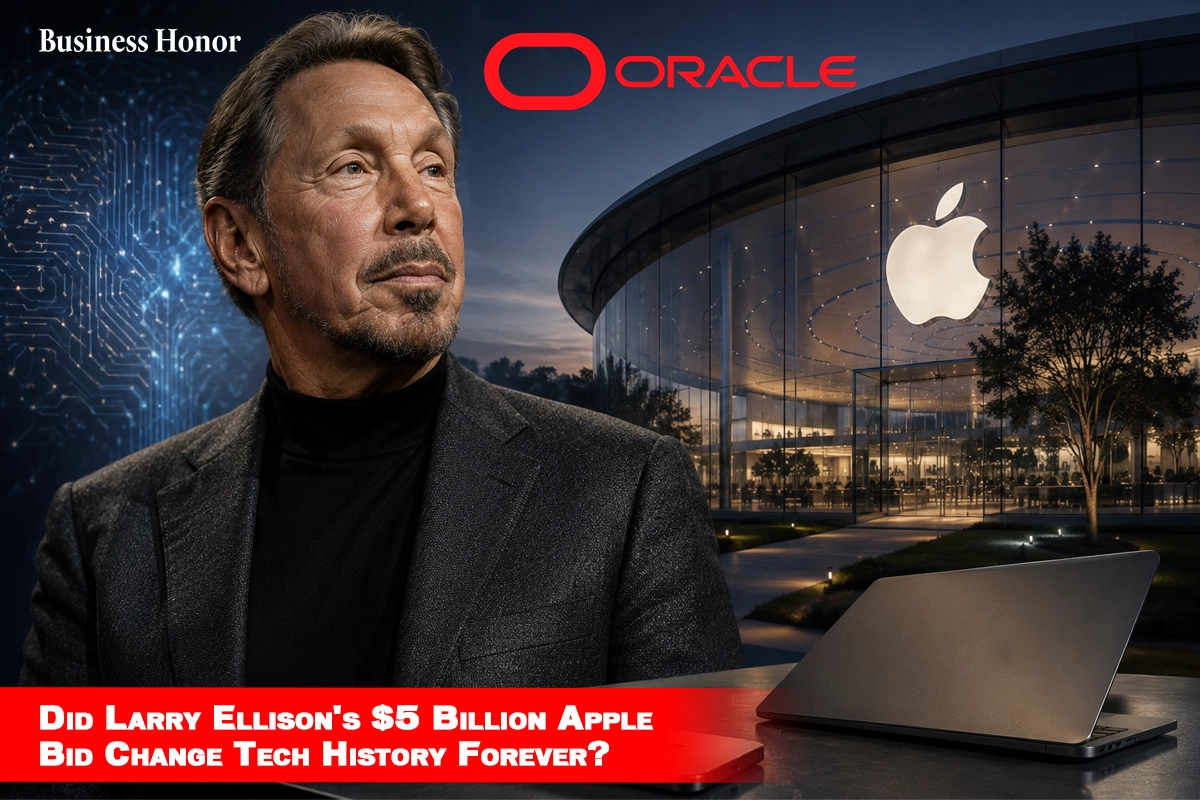
Larry Ellison's rejected $5 billion Apple takeover reveals Jobs' principled vision over wealth and control strategy.
|
During a commencement event in 2016, Oracle co-founder Larry Ellison revealed that it was possible for him to buy Apple in the mid-1990s as he had planned to acquire Apple during that time. In his address at USC in the same year, Ellison narrated the tale of how he planned. He intended to acquire a company, valued at $5 million and in financial crisis. The company was firing its employees, losing money, and stock crashing low prices.
Ellison's proposition was straightforward: acquire Apple and immediately install his close friend Steve Jobs as CEO. Both men possessed sufficient personal credit to secure the necessary financing. "I had already arranged to borrow all of the money," Ellison explained. "All Steve had to do was say yes."
Jobs, then leading NeXT Computer following his 1985 ouster from Apple, saw a fundamentally different path forward. Rather than engineer a hostile corporate takeover, Jobs envisioned Apple acquiring NeXT, bringing him onto the board, and allowing the company's directors to independently reach the inevitable conclusion that he should lead the organization. When Ellison pressed back with practical objections — questioning, how they would generate returns without owning Apple—Jobs delivered the response that would become legendary in business circles. "You don't need any more money," Jobs told him. "I'm not doing this for the money. I don't want to get paid."
According to Walter Isaacson's authoritative biography of Jobs, the entrepreneur further explained that returning to Apple without either party owning a controlling stake would grant him the moral high ground necessary to rally employees and restore industry confidence. Ellison's characteristically blunt response labeled the moral positioning "the most expensive real estate on earth."
Jobs ultimately prevailed in his strategic vision. Apple acquired NeXT in December 1996 for $429 million, bringing Jobs aboard as an advisor. Within months, he assumed the interim CEO position in September 1997. The subsequent transformation proved spectacular: the iMac launch, the Microsoft partnership agreement, and eventually the revolutionary iPhone rebuilt Apple into the world's most valuable corporation, now valued beyond $3.7 trillion.
While Ellison never secured his desired takeover, he obtained the outcome that truly mattered—Jobs' return to Apple's leadership. Ellison joined Apple's board that same year and remained until 2002, when schedule conflicts necessitated his departure. The episode illustrates how Jobs' principled commitment to legitimacy ultimately proved far more valuable than any equity stake.
Business Honor is of the view that Steve Jobs' rejection of Larry Ellison's acquisition proposal represents a transformational moment in Apple's strategic independence and leadership legitimacy.


































.webp)

.webp)



.webp)



Comments
0 Comments