
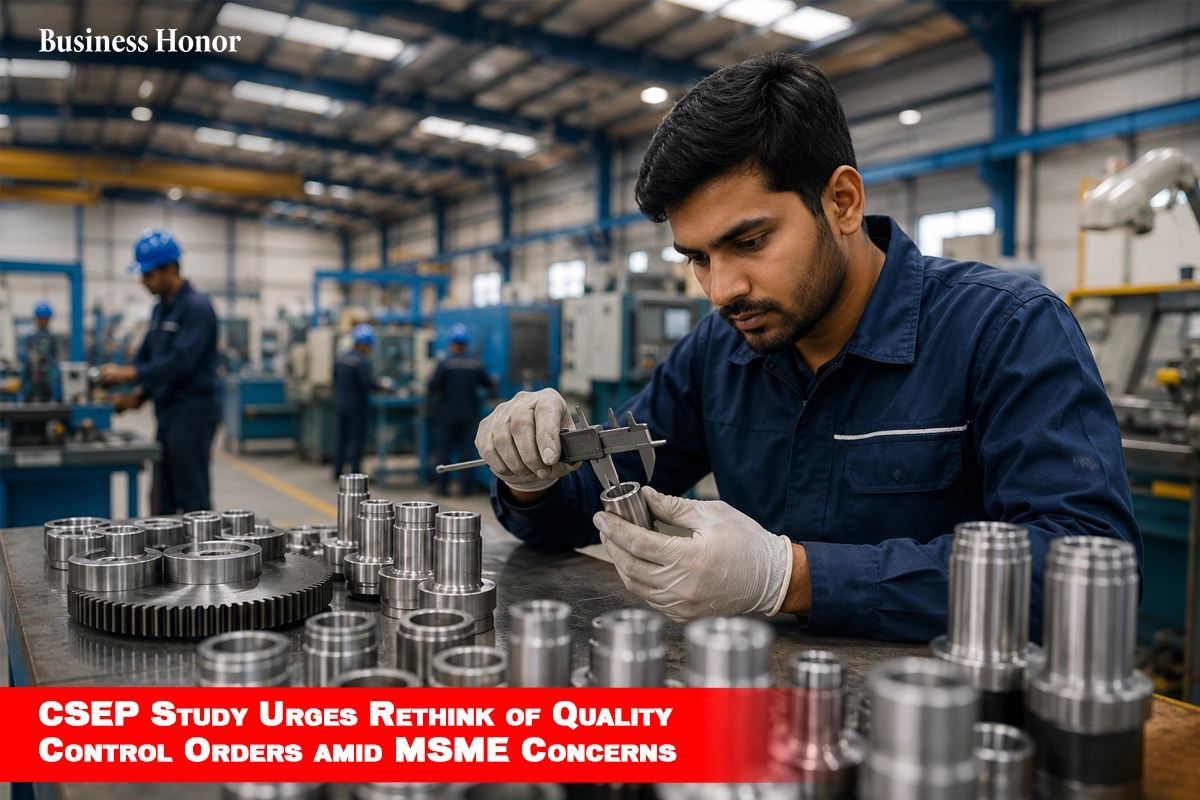
A new CSEP report says expanding Quality Control Orders has increased compliance costs, disrupted supply chains, and reduced value addition for Indian manufacturers.
|
A new study by the Centre for Social and Economic Progress (CSEP) has advised the government to reconsider its increasing dependence on the Quality Control Orders (QCOs), warning that the policy is creating manufacturing supply chain challenges in India while placing significant pressure on micro, small, and medium enterprises (MSMEs).
The report, titled Quality Control Orders in India's Chemical Sector, finds that the impact of Quality Control Orders on MSMEs has become increasingly evident as compliance costs rise and supply chains become more complex. The Quality Control Orders are meant to enhance the quality of products through BIS certification; however, this rapid expansion has made industries less competitive.
With data from the Annual Survey of Industries in the period FY2015-FY2024, CSEP observed that chemical-related QCOs shot up from zero to 52 between 2018 and 2024. More than 57% of companies using chemicals as inputs and more than 66% of manufacturing firms were affected either as raw material suppliers or as finished goods.
It was observed that while firms having QCOs on the input side had their production value grow by 9.6%, their gross value added (GVA) had decreased by 37%, indicating an increase in the cost of production. Small-scale manufacturers were impacted the most, as their profitability was reduced by 48% due to input-side QCOs and by 59% due to output-side QCOs.
Representatives from the industry sector were also critical. Samsung India pointed out that items like refrigerators needed multiple compliance certifications not only for the finished product but also for its individual components.
Ex-Chairman of the Planning Commission Montek Singh Ahluwalia appreciated the decision of the government to withdraw certain QCOs, describing it as an indicator of an appropriate policy response. It was strongly recommended that any regulation related to manufacturing be subject to wide industry consultation.
The study suggests that an evidence-based approach to establishing quality standards is needed, in addition to the review of current QCOs on a regular basis and the development of a certification structure, among other things. Business Honor believes balanced quality regulations should strengthen manufacturing competitiveness while minimizing compliance burdens, enabling MSMEs to innovate, grow, and integrate efficiently into global supply chains.











.webp)



.webp)

.webp)




.webp)


Comments
0 Comments