
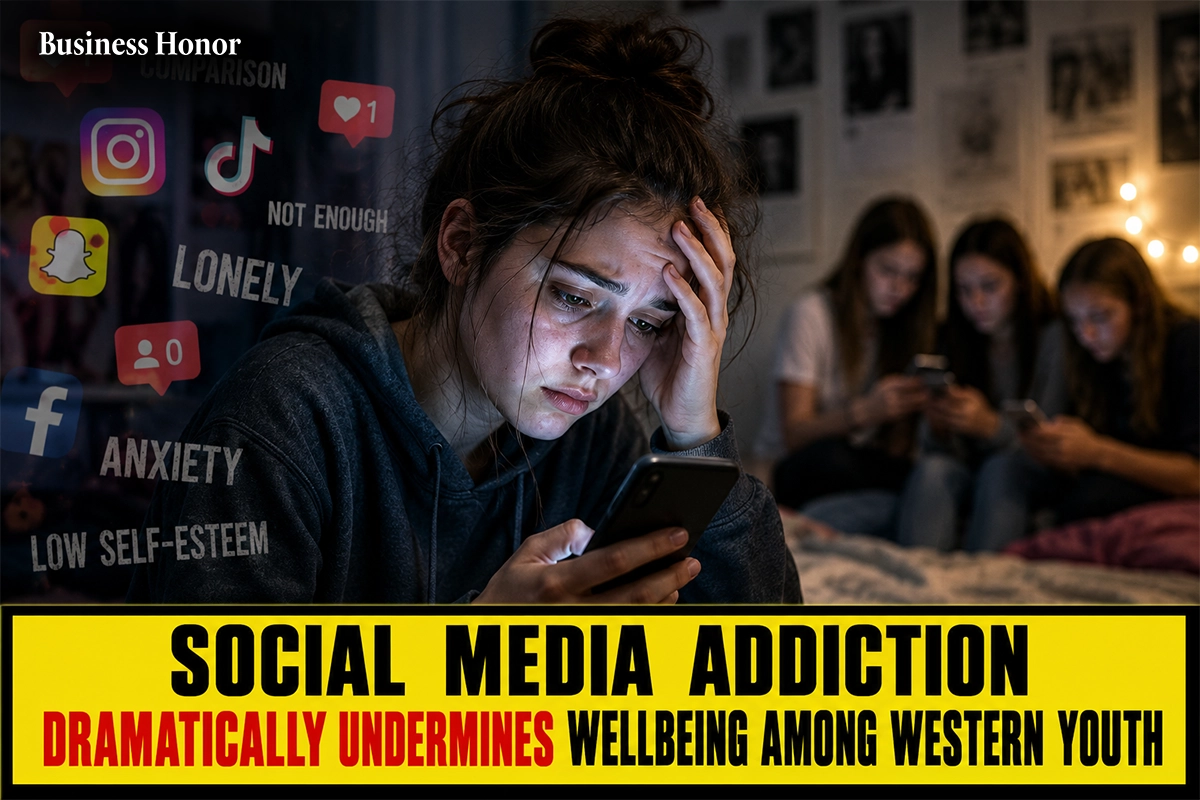
Research confirms social media addiction correlates directly with severe mental health decline, particularly affecting young Americans under twenty-five years old significantly.
|
Researching how our happiness level can decrease through the use of social networks and therefore. social media addiction is the focus of the latest report from the Wellbeing Research Centre at the University of Oxford. This is important because younger generations are faced with a very different online environment than their parents. With social networks designed for maximum engagement, it is no surprise that the amount of time spent on these platforms correlates with the level of loss of wellbeing.
How social media is affecting young people’s wellbeing
According to researcher Michael Plant, “Using social media for one hour every day is a positive way to maintain connections. However, as the report shows, the more time spent using social media, the higher the rate of loss of wellbeing will be.” The United States has seen significant declines in their wellbeing measures for those aged 25 and younger over the past decade—just as this age group is increasingly adopting social media as part of their daily lives. A comparable decline is seen across Canada, Australia, and the UK, highlighting that these trends are linked across English-speaking Western nations. Interestingly, this decline in wellbeing occurs even though people 25 and younger are less likely than their parents to take risks.
Plant notes that young people today are not involved in smoking, drug use, and sexual activity to the same extent as his generation but rather are engaged with online social media. This reflects an additional challenge for young people and a difference from previous generations.
Why social media are platforms being criticized
One factor contributing to this issue is social media platforms' design features that encourage high engagement levels. Plant argues that social media organizations do not have any incentives to reduce addictive elements used on their platforms voluntarily. The way algorithmic systems operate gives preference to the total amount of time spent by users instead of the user's wellbeing; this produces a fundamental mismatch in social media platforms. User engagement for social media companies is increasing, while young people's mental health is declining (i.e., high level of engagement corresponds to a low level of mental health).
What creators experience on social media platforms
Sydney Grows is a fitness content creator on TikTok and has been using TikTok intermittently since 2021. Grows represents the complexity associated with being a participant on social media. Grows elaborates on creating a successful career in providing authentic gym-related content and sports but that there are often emotional challenges that may influence Grows as well. "I usually ignore the negative comments as I've had four years of building up my ability to deal with them," Grows states.
Despite staff having learned coping mechanisms, many feel the stress from this type of experience with social media is real (and considerable). Grows explains, "You might receive a lot of positive feedback but it won’t seem significant to you, as opposed to one piece of negative feedback, which seems directed to you." Social media has been built on the premise of amplifying any negative occurrences of interaction, more so than anything positive.
Can social media be used in a healthier way?
Michael Plant believes that adults should be held accountable as adults; if we want to limit our exposure to harmful things online, we must hold ourselves accountable for making those decisions. His recommendation is to develop an intentional awareness of when you are comparing yourself to others and when any corresponding negative feeling arises, and then making a conscious effort to engage in a positive way with the people you encounter through social media. Plant concludes by saying that "The goal overall is to put the ‘social’ back into social media," and that, with intentional choices regarding how, when, and where they interact with one another on these platforms, users can achieve the connection(s) they originally sought through the use of social media.
Business Honor is of the view that excessive social media consumption represents a critical wellbeing crisis requiring immediate individual responsibility and intentional behavioral change strategies.
FAQsQ: Does one hour of social media daily harm wellbeing? A: No, one hour daily appears optimal for connection without negative mental health impacts. Q: Which countries show the worst wellbeing declines from social media? A: United States, Canada, Australia, and United Kingdom demonstrate the most dramatic drops. Q: Why do Western nations experience greater social media impacts than other regions? A: Researchers cannot yet explain the disparity, though the correlation remains statistically significant. Q: Are young people smoking less because of social media use instead? A: Yes, today's youth avoid smoking and drugs but heavily engage with social platforms. Q: How do social media platforms deliberately keep users scrolling longer? A: Platforms use algorithmic design specifically engineered to maximize user engagement and addiction potential. Q: Can negative comments on social media outweigh positive feedback psychologically? A: Yes, single negative comments often hurt more emotionally than hundreds positive ones combined. Q: Will governments restrict social media use for adults anytime soon? A: No, experts believe individual responsibility remains the only realistic protection available currently. Q: What does "putting the social back into social media" actually mean? A: It means using platforms for genuine human connection rather than endless comparison scrolling. |














.webp)

.webp)



.webp)

