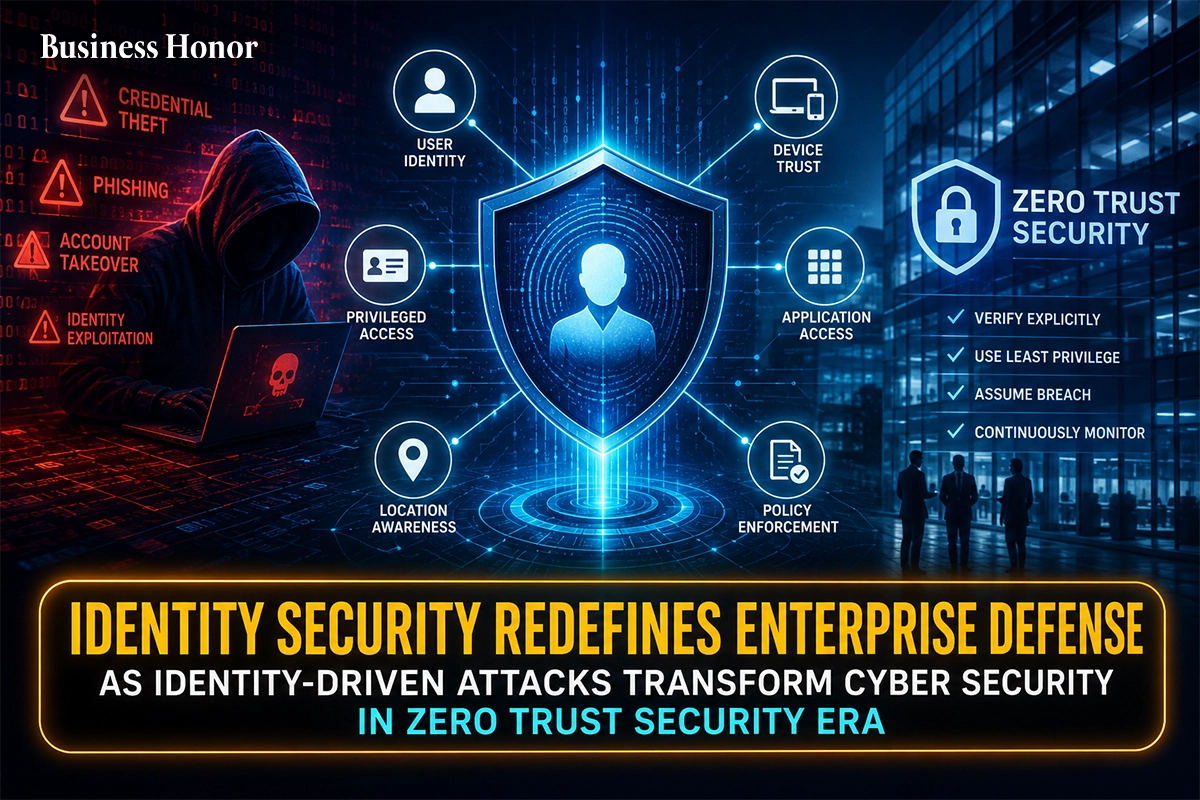
Identity Security is becoming the core of enterprise defense as identity-driven attacks redefine modern cyber security risk, accelerating adoption of zero trust security frameworks across cloud-first organizations worldwide.
|
The fast-changing nature of identity security represents a clear departure from the classic perimeter defense paradigm. Today, in cloud environments, attackers do not use software flaws as attack vectors; instead, they directly attack authentication systems, focusing on identity as the primary control mechanism for enterprise security policies. This change is further amplified by the emergence of the zero-trust security model, which does not trust anyone and requires continuous verification of all access requests.
Identity Security Risks in Modern Attack Landscapes
One of the key reasons behind this shift is the emergence of MFA-bypass token-hijacking attacks, in which attackers take control of sessions or tokens without raising any security alarms. In this way, attackers can perform lateral movement within the system while disguised as legitimate users.
In parallel, the growth of SaaS phishing adversary-in-the-middle attacks is becoming increasingly common in cloud environments. In such an attack, attackers intercept live login sessions to obtain the credentials and MFA answers to pass them to the legitimate application. Thus, the development of phishing attacks makes password security increasingly obsolete.
Non-human identity security has become another rising issue. Modern companies are using APIs, service accounts, and workloads extensively. Consequently, there is a need for enhanced machine identity security management. Without such, these identities typically become over-privileged and vulnerable to prolonged exploitation inside cloud systems.
Zero Trust Security and the Future of Identity Protection
Consequently, passkey authentication is being embraced by organizations at an incredible pace through the use of cryptography that is immune to phishing and credential theft. It also aligns with the general concept of zero-trust security architecture through the enforcement of continuous verification.
The combination of cloud computing complexity, AI-based attacks, and identity sprawl has changed the cybersecurity landscape. In this regard, identity security should include continuous monitoring, least privilege access, and identity threat detection since identity has become the new control plane.
Identity security is no longer a complementary aspect of cybersecurity but a crucial component of cybersecurity infrastructure. Identity security will be a critical requirement for organizations implementing zero-trust security, as it ensures that silent and persistent attacks can occur in the absence of perimeters. Business Honor views identity security as the foundation of zero trust security and believes organizations that fail to strengthen identity controls will face increasing exposure to modern cyber threats and persistent cloud-based attacks.






































.webp)

.webp)



.webp)