
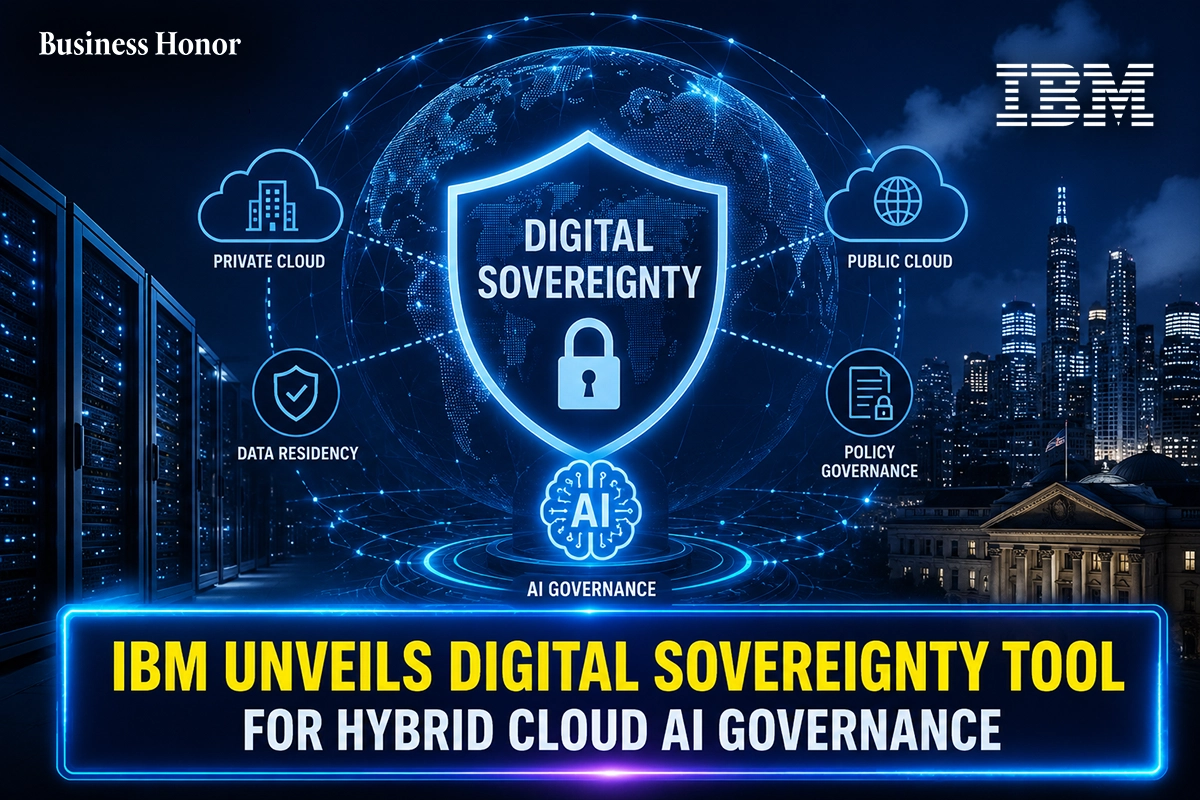
Digital sovereignty emerges as critical priority as enterprises accelerate AI deployments across multiple jurisdictions and cloud providers worldwide.
|
IBM has launched a complete technology solution for cloud sovereignty to meet the increasing enterprise concerns about governing AI within hybrid and multi-cloud environments. The new "Cloud Sovereignty Risk Profile" will provide organizations with critical insight into where their workloads are operating, how their data stays protected, and whether or not their operational controls comply with an increasingly complicated regulatory landscape.
This launch is in response to increasing requests by governments and changing regulations globally as organizations move to deploy AI across multiple jurisdictions, and cloud provider environments. According to research by IBM’s Institute for Business Value and the Dubai Future Foundation, 93% of all executives believe that digital sovereignty must be part of a company’s overall strategy; however, less than 33% of organizations have any knowledge of where their AI workloads run, and 18 percent of enterprises maintain an updated inventory of their AI systems. IBM’s offering addresses this visibility issue by enabling continuous monitoring of enterprise cloud workloads and providing audit-ready evidence that the organization's operational controls are consistently effective as intended. The Sovereignty Risk Profile builds upon IBM's existing Security and Compliance Center Workload Protection Platform, allowing organizations to effectively manage compliance and security across all of their distributed cloud environments.
According to IBM, there are four foundational principles that support the ability of technology companies to provide true sovereign digital experiences. The first principle is proven ability—the capability to demonstrate compliance with regulations by identifying and assessing risks related to data residency, encryption, resiliency, and operational independence. The second principle concerns preventing access to data by government entities, which is accomplished by ensuring enterprise ownership of the encryption keys used in the cloud. IBM highlights its Key Management technology as a means of achieving this goal with systems certified under the Federal Information Processing Standards (FIPS) 140-3 Level 4, thus providing customers complete control over their encrypted data. The third principle is privacy, which refers to an enterprise's ability to deploy applications across multiple locations while still adhering to local laws regarding privacy. IBM Cloud offers dedicated multi-region service, dedicated single-tenant service, and partnerships with localized service providers so that data can be processed within a specific geographic area under the control of the local jurisdiction.
The final principle is portability, which entails that customers have access to the same applications regardless of the infrastructure upon which they run (public cloud, private cloud, and on-premise). IBM Cloud makes heavy use of open-source technology (e.g. Red Hat OpenShift, Kubernetes) and open standards for interchangeable systems, so customers can move data across different types of infrastructure without relying on any specific vendor. IBM Cloud General Manager Alan Peacock emphasized the urgency of this challenge in a recent statement: "Leaders are under pressure to show where data lives, how systems behave, and who ultimately has authority over critical workloads. Yet the visibility required to answer these questions remains elusive." This announcement follows IBM's earlier introduction of Sovereign Core, a software platform enabling organizations to construct AI-ready sovereign cloud environments while maintaining operational control.
Business Honor is of the view that IBM's Cloud Sovereignty Risk Profile represents a strategic advancement in enterprise operational control and regulatory compliance capabilities.
FAQsQ: What is IBM's Cloud Sovereignty Risk Profile? A: A tool providing visibility into workload locations, data protection, and regulatory compliance across hybrid cloud environments. Q: Why do enterprises need digital sovereignty solutions? A: Governments intensify AI oversight as organizations deploy systems across multiple jurisdictions requiring strict data governance compliance. Q: How many executives prioritize digital sovereignty in strategy? A: 93% of executives now recognize that digital sovereignty must be embedded into corporate business strategy globally. Q: What percentage of organizations know their AI locations? A: Fewer than one-third of organizations know where AI workloads run; only 18% maintain current AI inventories. Q: What is Keep Your Own Key technology? A: IBM's encryption solution enabling customers exclusive control over cryptographic keys using FIPS 140-3 Level 4 certified hardware. Q: How does portability prevent vendor lock-in? A: IBM Cloud uses open-source technologies like Kubernetes and OpenShift allowing workload migration between cloud providers freely. Q: What are the four pillars of IBM's sovereignty strategy? A: Provability, prevention, privacy, and portability ensure compliance, encryption control, jurisdictional flexibility, and interoperability across environments. |











.webp)

.webp)





.webp)

