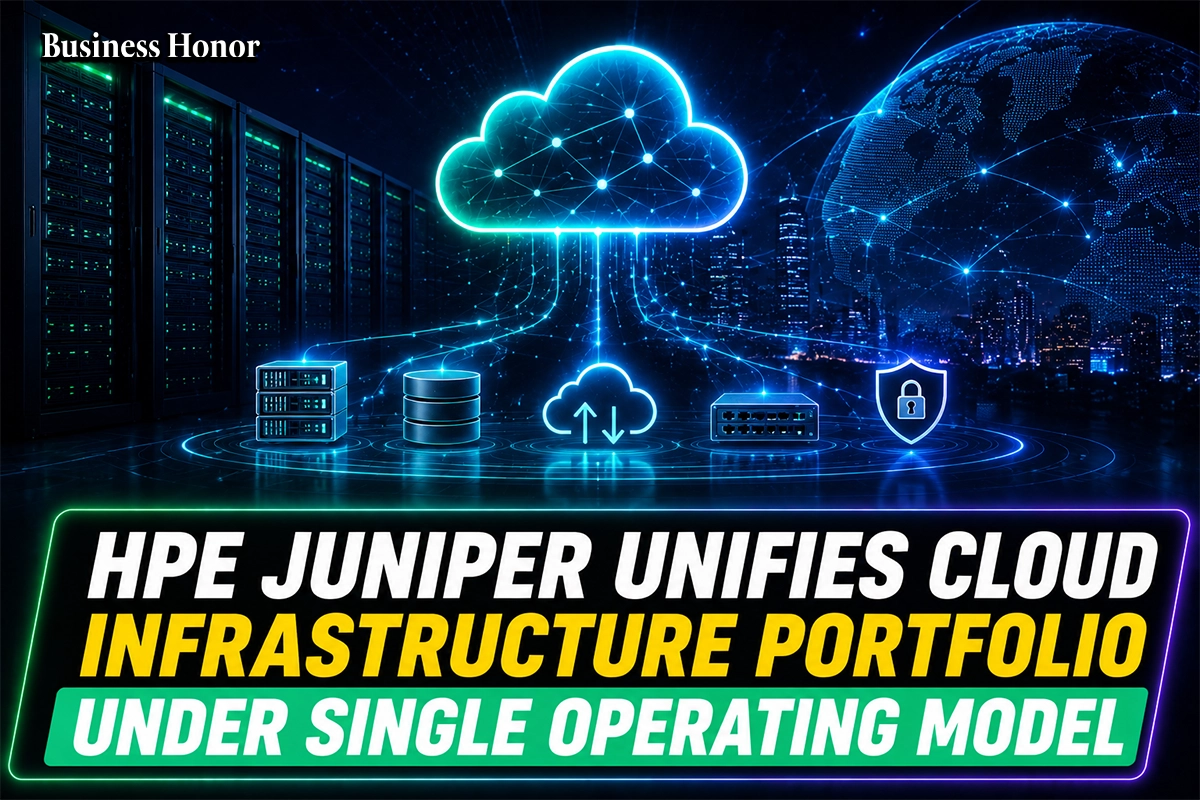
HPE consolidates fragmented private cloud infrastructure offerings into unified platform to simplify hybrid cloud and artificial intelligence deployment strategies globally.
|
Hewlett Packard Enterprise recently announced it would consolidate its entire private cloud and storage portfolio under a single unified operating model in response to complaints from many customers who have had difficulty managing the complexity of multi-vendor infrastructures when deploying private cloud solutions. The transition comes at a critical time as organizations across the globe are dealing with continually changing workforce economics along with never allowing artificial intelligence (AI) to grow exponentially within their business and as a result requiring operational knowledge to scale AI implementations across their organization.
Previously independent product lines such as the Private Cloud Business Edition, Private Cloud Enterprise, and SimpliVity will be merged into one product line with three different options. The PC 1000 will be a hyper-converged cloud infrastructure solution intended for use within smaller deployments; the PC 3000 will offer disaggregated system architectures for large enterprise data centers; and the PC 7000 will provide organizations with a "managed-as-a-service" alternative that allows them to focus on core capabilities without any additional administration responsibilities.
Another key component within this strategy will be HPE Morpheus, which will serve as a multi-hypervisor control plane solution by providing customers with a single interface to manage virtual machines, Kubernetes containers, and new AI workloads independent of where those virtual instances are deployed (data centers, colocation, or edge locations). This comprehensive, end-to-end approach resolves one of the greatest challenges faced by customers: building multiple, disjointed infrastructures on top of their current virtual, container and new AI environments — each requiring different skill sets and management tools.
Analysts are saying that timing will be very important with regard to HPE's announcement. The acquisition of VMware by Broadcom and the increase in hypervisor licensing costs have drastically changed the technology landscape and have led many companies to move workloads from public clouds back to their own datacenters. At the same time, the AI architectural requirements—specifically having massive workloads using GPUs and being distributed—have illustrated the limitations of legacy infrastructure designed for the previous generation of computing, which is primarily VM-based.
HPE is providing a practical means for organizations looking for an exit solution from the VMware licensing pressure by adopting Morpheus as a multi-hypervisor control plane. This allows companies to gradually bring in alternate hypervisors while migrating workloads in small incremental steps, thus avoiding risky "big bang" migrations to new cloud environments. Having Zerto 10.9 as part of the solution, which provides continuous replication of workloads between VMware and HPE platforms and provides orchestrated failover capabilities, will enable customers to confirm their resilience prior to completing the final cutover to the new hypervisor.
In addition to workload mobility, HPE is also stressing operational consistency. Their platform will provide a unified management experience for multiple types of infrastructure (i.e., disaggregated systems at Core data centres, hyperconverged appliances located at branch and edge sites, and fully managed service models for companies doing outsourced operations). Developers have the ability to provision virtual machines and containers themselves, while platform teams have the ability to retain centralized policy and security governance; operations teams have consistent interfaces to manage their hardware lifecycle.
Resiliency features have received a lot of attention in HPE’s messaging; Zerto is now leveraging Juniper’s native AI-based protection analysis that recommends actions, and integrates with enterprise AI tools using a new Model Context Protocol, so that an organization’s own agentic systems can assess their protection posture. Additionally, runbook-based recovery capabilities automate cyber and disaster recovery workflows to decrease human error during critical incidents.
HPE’s announcement demonstrates a larger trend within the industry, as enterprises are seeking simpler, more integrated solutions that will eliminate vendor sprawl without losing operational flexibility. HPE’s unified private cloud strategy directly addresses organizations that are tired of the complexity of their IT infrastructure and are looking for one cohesive platform that can accommodate legacy-virtualized workloads, new containerized workloads and evolving artificial intelligence workloads.
Business Honor is of the view that HPE's unified Private Cloud consolidation represents a strategic shift in enterprise cloud infrastructure standardization and artificial intelligence operationalization capabilities.
FAQsQ: What products does HPE's new Private Cloud consolidate? A: Private Cloud Business Edition, Enterprise, SimpliVity, and other disparate offerings merge into unified platform. Q: How does HPE Morpheus simplify cloud management? A: Single control plane manages virtual machines, Kubernetes, and AI workloads across all deployment environments. Q: Why is this solution timely for enterprises? A: Rising VMware licensing costs and AI scaling demands make unified alternatives increasingly attractive now. Q: What resilience improvements does Zerto 10.9 add? A: AI-driven protection analysis, automated recovery workflows, and continuous workload replication between platforms enabled. Q: Which deployment options does HPE Private Cloud offer? A: PC 1000 hyperconverged, PC 3000 disaggregated, and PC 7000 fully managed as-a-service options available. |































.webp)

.webp)




.webp)