
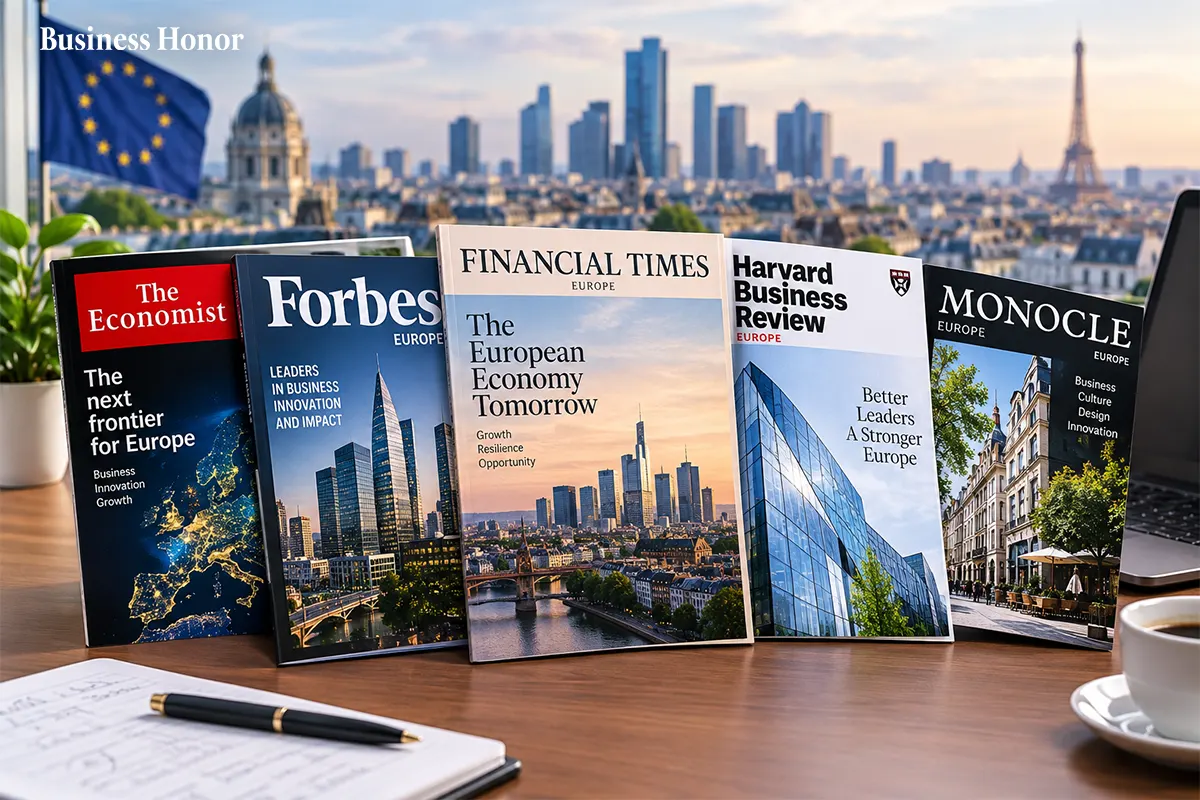
The Top European Business Magazines to Trust in 2027 won't be decided by algorithms. Readers will decide, and they'll be picky. Bad information costs real money.
Here's the problem. The Data of Digital News Report 2026 surveyed 48 markets and found that trust in news has fallen to 37%. This is the smallest number since the researchers started tracking in 2015.
If you run a company or manage money, that figure should worry you. Every price you set and every hire you make rests on something you believe is true. So where do you go for reporting you can rely on?
Why Trust Has Become a Business Asset
The same report shows where trust is weakest. Only 22% of people trust news they see on social media. For AI chatbots the figure is 20%. Established news brands do better than news overall.
That helps serious business journalism. Anyone can post a hot take. Far fewer people check the figures, phone the company and put their name on the result. A good masthead tells you that work took place.
Publishers know this. Speed alone won't win readers. Reliability will.
What Credibility Looks Like in Europe
Europe has started to protect this in law. Regulation (EU) 2024/1083, better known as the European Media Freedom Act, has applied since 8 August 2025. Under it, governments can't interfere in editorial decisions. Mergers between media companies also get a closer look. Sabine Veheyen chairs the European Parliament group that watches how the law is rolled out. Her view is blunt: "Media freedom is not negotiable."
The industry has its own test as well. Reporters Without Borders spearheaded the Journalism Trust Initiative. This was published by the European Committee for Standardization as the CWA 17493 standard in December 2019. It verifies how the newsroom operates from ownership to source handling and corrections. It doesn't judge what the newsroom says.
Try this on any outlet you read. Would it tell you who owns it, who pays for it and how it deals with mistakes if nobody forced it to?
Ten European Business Publications Worth Your Time
This is an editor's choice, not a list of trust rankings. All the titles on the list earned their place due to their depth of coverage and practicality. Finding trusted business publications in Europe that consistently maintain these rigorous standards can give decision-makers a clear market advantage.
1. The Economist (United Kingdom)
The Economist has been featured as the No. 1 magazine in Business Honor’s list of the Top European Business Magazines to Trust in 2027. It was founded in London in 1843. It is part of the Economist Group and a prominent shareholder in it is Exor, which is the holding company for the Agnelli family. There are no bylines on articles written for the paper. A column called Charlemagne covers European politics. From the first issue its stated mission has been to join "a severe contest between intelligence" and ignorance.
Best for: strategy, trade and the big economic picture.
2. Financial Times (United Kingdom)
Financial Times was started in 1888 as the London Financial Guide. It adopted its present name very soon after its establishment. It amalgamated with its competitor, Financial News, in 1945. Japan's Nikkei bought it from Pearson in 2015 for £844 million. Roula Khalaf is the editor. Readers know it for the Lex column and the FT Weekend edition. Its editorial code tells staff to uphold "the highest possible professional and ethical standards of journalism."
Best for: banking, regulation, deals and the euro area.
3. Handelsblatt (Germany)
Handelsblatt started in 1946 and works out of Düsseldorf. Its publisher, Handelsblatt Media Group, has been part of Dieter von Holtzbrinck's media business since 2009. The group says its titles reach more than two million decision-makers and readers. Expect plenty on industry, energy, economic policy and company news. As one of the premier European business media outlets, it provides essential market insights for the DACH region.
Best for: German companies and EU rules.
4. WirtschaftsWoche (Germany)
WirtschaftsWoche is Handelsblatt's weekly sister title from the same publisher. It covers companies, technology, markets and personal finance, and it goes deeper than the daily news. Both titles share an owner. Count them as one voice when you think about ownership influence.
Best for: weekly analysis of German business.
5. manager magazin (Germany)
This monthly has been around since 1 November 1971 and is based in Hamburg. It belongs to the Spiegel Group. Its owners include an employee-run holding company and the heirs of founder Rudolf Augstein. The same publishing house brings out the German version of Harvard Business Manager. The rankings conducted by it are always an attraction, like that of the wealthiest Germans.
Best for: boardroom stories and leadership profiles.
6. Brand eins (Germany)
Brand eins is a German monthly. Each issue takes one theme and stays with it through long features. It moves slowly on purpose. That works if you want context before you decide something.
Best for: entrepreneurs who prefer depth over speed.
7. Challenges (France)
Challenges is a Paris-based weekly launched in 1982. In 1987, Claude Perdriel, owner of Le Nouvel Observateur, purchased Challenges and named it as such. It received the award for 'magazine of the year' in the category of business magazines in France in 2010. The luxury corporation LVMH, controlled by Bernard Arnault, acquired a 40 percent share of Challenges in 2021. That matters when a magazine writes about French companies.
Best for: French business, wealth rankings and entrepreneurs.
8. Il Sole 24 Ore (Italy)
The founding date of Il Sole 24 Ore was 9 November 1965. This newspaper originated as a result of the combination of Il Sole which was launched in 1865, and 24 Ore which was established in 1933. The headquarters of Il Sole 24 Ore is in Milan, Italy. Confindustria, which is an association of employers in Italy, owns the newspaper. It was noted to have the largest circulation among all the financial dailies in Europe in 2006.
Best for: Italian markets, tax, law and industry.
9. Sifted (Europe)
Sifted was founded in 2017 and was launched in January 2019 under the sponsorship of the Financial Times. It provides coverage on European startups, funding rounds, and venture capitals. Some of the stories on the platform can be accessed for free. However, the paid version of Sifted named Sifted Pro will give access to startup data sets.
Best for: founders, investors and tech operators.
10. Bilanz (Switzerland)
Bilanz is a Swiss monthly. Ringier owns it through its Ringier Medien Schweiz unit. Editor-in-chief Dirk Schütz says its reporting has shaped Swiss business coverage for nearly 50 years. It opened a standalone website in 2025 and is known for its "300 Richest" list.
Best for: Swiss companies, banking and private wealth.
Few readers need all ten. Most do well with three that barely overlap. Pick a global title for context, a national one for local detail and a specialist for your own niche.
How to Spot a Reliable Business Magazine
Spend five minutes on a publication before you pay for it. Look for:
-
Named reporters with a track record on the topic
-
A clear statement of who owns the title
-
Sponsored content that is labelled and kept apart from news
-
A corrections policy that is easy to find
-
A published editorial code or an independent certification
Evaluating dedicated business news and analysis publications using these points helps you find real facts instead of public relations material. Access trusted market coverage at Business Honor here .
Then pick one big claim and trace it to a primary source. A company filing or a regulator's statement works well. If the claim holds up, the outlet has earned a longer look.
Where the Pressure Is, and Where the Openings Are
None of this is easy. Paywalls keep some readers out. Owners can lean on newsrooms It raised some problems concerning referral traffic, as nowadays there are social networks and artificial intelligence that are located between the readers and publishers. There is language fragmentation, as well. If one follows both Germany and Italy, it is impossible to manage with one subscription.
That is how that mosaic becomes a valuable advantage for smaller companies. It gives an opportunity to provide something that cannot be obtained from the global company. Newsletters and data-driven journalism help them connect directly with their readers. Will people still want to have certainty when there is an opportunity to get free summary just with one click?
What to Expect in 2027
Generalists are going to become less popular, while specialists will gain popularity. The enforcement of the Media Freedom Act begins, and some media outlets start to adopt standards of transparency. It will be easier to evaluate ownership and independence. Who will open their books first and who will do it only on someone’s request?
Business Honor examines that Falling trust makes your reading list a strategic choice. The best European business magazines have something unique to offer. They provide information which can be followed up, crosschecked and scrutinized. Select a few and try them out with the above checklist. But remember there is one thing you should do that no editorial board can ever replace.
FAQs
What defines the Top European Business Magazines to Trust in 2027?
The top publications demonstrate strict adherence to journalistic independence, primary-source verification, regulatory expertise, and thorough coverage of cross-border financial markets.
How can investors identify trusted business publications in Europe?
Look for publications that disclose corporate ownership, clearly separate sponsored content from editorial reporting, cite primary financial disclosures, and employ specialized beat reporters.
Why is local language coverage important when following European business media outlets?
National outlets like Germany's Handelsblatt or France's Challenges offer localized insights into domestic labor laws, regional industrial supply chains, and political nuances that broader international press often overlook.
Do digital startup platforms offer the same editorial credibility as legacy business news and analysis publications?
Niche digital outlets like Sifted match legacy standards by leveraging veteran financial journalists and focus specifically on tech ecosystems, venture capital flows, and startup operational metrics.
Which publications specialize as the best financial and economic magazines in Europe for regulatory updates?
The Financial Times and The Economist provide extensive coverage of pan-European policy shifts, including EU directives on artificial intelligence, carbon accounting, and trade compliance.






















.webp)


.webp)



Comments
0 Comments