
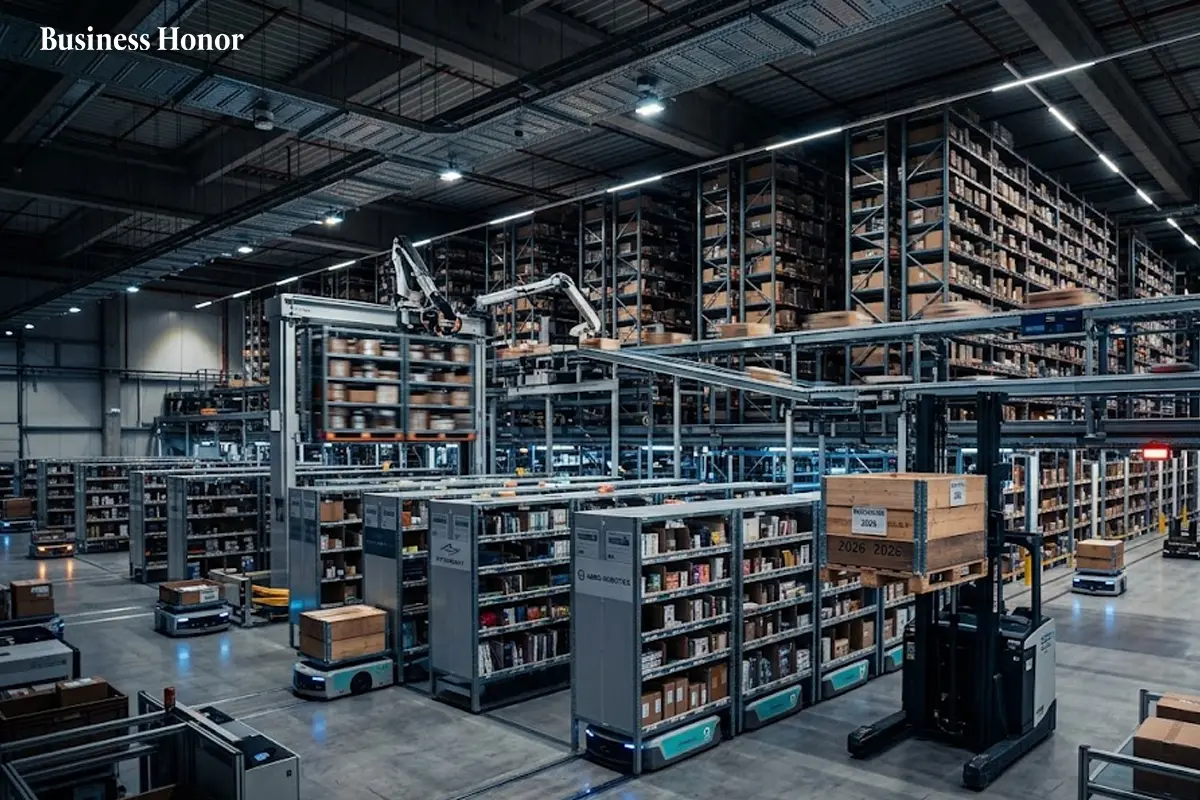
The best warehouse robotics companies are judged on one thing: how much of the warehouse they can run on their own. Buyers want orders to move from the system to the dock without delay. They also want a vendor with live sites that prove it works.
Investment is following that demand. One forecast values the market at USD 7.35 billion in 2026, rising to USD 25.41 billion by 2034. The proof this year comes from fleets already at work, not from trade-show demos.
Ten companies stand out. Their strategies also show where warehouse robotics technology is heading.
Why the market is shifting
Early automation relied on fixed conveyors and sorters. They were fast, but expensive to build and hard to change.
Today's systems come in modules. Warehouse robots, storage grids, picking arms and control software can be added in stages. A site grows its automation as its orders grow.
Trade coverage describes the sector moving "from hype to execution". Software now matters as much as hardware. The benefit is easy to state. Robots improve warehouse efficiency by cutting travel time, raising first-pass accuracy and keeping output steady at peak.
The best warehouse robotics companies to watch
1. Symbotic
Symbotic sells automation as one connected system. AI software, robots and pallet handling all work together. Fast Company ranked it ninth in its 2026 Robotics & Engineering category. Editor-in-chief Brendan Vaughan says the list honors companies that "don't just adapt to change they drive it." In February Symbotic also bought autonomous forklift maker Fox Robotics, which takes it beyond the racking aisle.
2. AutoStore
AutoStore robots move across a tight cube grid and fetch inventory as orders come in. The company has nearly 1,950 systems in more than 60 countries. Its newer push is software. CubeVerse, launched in 2026, works alongside a customer's existing warehouse management system instead of replacing it. That turns a large installed base into a steady stream of useful data.
3. Amazon Robotics
Amazon doesn't sell its robots, but it sets the pace for everyone who does. It now has one million robots and has released DeepFleet, a generative AI model that plans their routes. Robotics VP Scott Dresser compares it to "an intelligent traffic management system." It is that robots could soon equal people in Amazon's warehouses. Rivals watch closely.
4. Locus Robotics
Locus builds robots that work next to human pickers. Interact Analysis ranked it the top AMR provider by revenue in the Americas for the second year running. Its fleet tops 22,000 robots across more than 360 sites and 8.5 billion picks. One estimate puts its Robots-as-a-Service fee near $2,000 per robot each month. CEO Rick Faulk calls the Array system "a step toward a facility that runs itself."
5. Exotec
Exotec's Skypod robots climb the racks and bring bins to pickers. At DSV's site in Venlo, about 100 Skypod robots handle roughly 90,000 bins and trays. Exotec's Jan Heijblom says the system suits sites with "high demands for speed, accuracy and scalability." The company reports more than 200 customer sites and 10,000 robots built.
6. Geek+
Geek+ is stretching from mobile robots into robotic arms. At MODEX 2026 it introduced its Geek+ Brain platform and RoboShuttle V5 to US buyers, and reported Americas orders up more than 50% in 2025. More than 950 customers use its systems. Michael Sahler of Geek+ America says US operators want proven automation and "a credible path to the fully autonomous warehouse." Analysts treat its embodied-intelligence work as a long-term bet that still has to earn its keep.
7. Ocado Group
Ocado made its name in online grocery. Its fulfilment centres use fleets of robots on three-dimensional storage grids, guided by an AI control system. The company licenses that technology to grocers. Grocery margins are thin, so it is a tough test of whether warehouse robots really save money.
8. GreyOrange
GreyOrange pairs mobile robots with software that decides which machine does which job. Buyers are looking past single robots toward full systems. That software layer is GreyOrange's main pitch.
9. HAI Robotics
HAI Robotics describes itself as a leading provider of autonomous case-handling robotics. Its robots lift cases and totes straight from racks. That raises storage density without a rebuild.
10. Berkshire Grey
Berkshire Grey, a SoftBank subsidiary, goes after the dock. It launched Scoop, a robotic trailer unloader, on February 3. Scoop unloads in bulk and is built for mixed parcel sizes, collapsed walls and polybags. FedEx has announced it is putting the system to work.
Three strategies, one contest
The field divides into three camps. Density specialists such as AutoStore, Exotec and HAI fit more stock into less floor space. Flexibility specialists such as Locus and Geek+ let capacity grow without a rebuild. System builders such as Symbotic, Amazon and GreyOrange want control of the whole operation.
Which matters more: the robot or the data it gathers? AutoStore seems to be betting on data. It is using its installed base to feed CubeVerse. The company that owns the software layer may end up owning the customer.
What executives should take from this
Subscription pricing has changed how automation is bought. A large capital project becomes a monthly operating cost. Part of the risk shifts to the vendor. Smaller operators benefit too. They can start with a few robots and add more later.
Dealmaking is reshaping the field. Symbotic bought Fox. Locus acquired Nexera to help its robots handle a wider range of products. Before signing with any vendor, ask how long it is likely to stay independent.
Where projects go wrong
Robots do not guarantee returns. Kroger's decision to close several dedicated robotic fulfilment sites shows what over-automation can cost. Integration, peak-season uptime and staff training still decide most outcomes.
Many performance claims also come from the vendors themselves. Buyers should ask for site visits and independent figures.
What happens when one system sits at the center of a network and stops?
What comes next
Growth is spreading to the edges of the warehouse. Trailer unloading, cold storage and compact systems for mid-size operators are all gaining ground. Lawmakers have taken notice. The National Commission on Robotics Act was introduced in Congress on February 3, 2026. Expect more acquisitions and sharper price competition.
Business Honor examines that the winners will treat robotics as one layer of a connected operation, not a standalone purchase. If every vendor promises a self-running warehouse, who will deliver one first?
The bottom line
The best warehouse robotics companies of 2026 sell outcomes. Symbotic and AutoStore build full systems. Locus and Geek+ sell flexibility. Berkshire Grey and Exotec go after specific bottlenecks.
Leaders should start with the problem that costs them most. That might be space, labor, dock time or accuracy. Then they should choose the vendor built to solve it. The bigger debate is whether the next decade will reward the best robot or the best software.
FAQ:
Which are the best warehouse robotics companies in 2026?
Symbotic, AutoStore, Amazon Robotics, Locus Robotics, Exotec, Geek+, Ocado, GreyOrange, HAI Robotics and Berkshire Grey. Each one is strong in a different area.
How do robots improve warehouse efficiency?
They cut walking time, pick more accurately and keep output steady at peak. Software coordinates people and machines so work flows without stalls.
What are the leading warehouse automation technologies?
Mobile robots, cube and rack-climbing storage systems, robotic picking arms, trailer unloaders and AI software that directs the fleet.
Are warehouse robots affordable for mid-size operators?
More than before. Subscription pricing and modular designs let operators start small and add robots as volumes grow.
What should buyers check before choosing a vendor?
Look at how well it connects to your existing systems. Ask for references from similar sites, peak-season results and a clear software roadmap.
































.webp)

.webp)



.webp)



Comments
0 Comments