
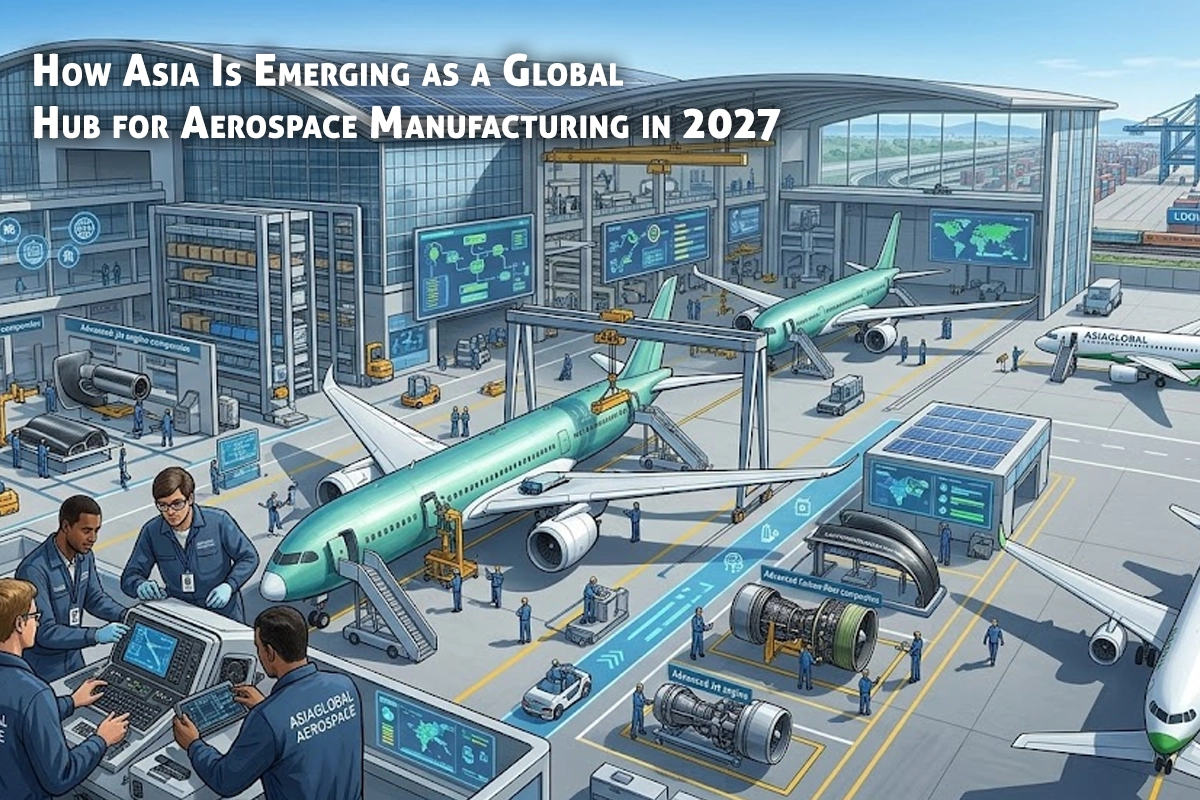
Asia's aerospace industry is gaining global importance due to the region's growing aviation market, rising demand for aircraft production, and investment in advanced engineering. Various Asian countries are increasing their abilities to manufacture aircraft, maintain aircraft, produce defense equipment, and engage in space exploration projects. These changes create opportunities for companies across the aerospace industry.
Aerospace manufacturing in Asia in 2027 is expected to be closely connected with the growth of the aviation market in Asia and the need for increased resilience in the global supply chain. Aircraft manufacturers need additional production capacity, whereas airlines need more maintenance services and efficient aircraft parts. Asian economies are reacting to such changes by developing their industries and training a qualified workforce.
According to Singapore's Economic Development Board, almost fifty percent of all new aircraft produced around the globe over the next twenty years will be delivered to the Asia-Pacific region. This reflects the increasing significance of the Asia-Pacific region in the global aircraft industry.
Why Asia Is Becoming an Aerospace Manufacturing Hub
The growth of aerospace manufacturing in Asia reflects several interconnected economic and industrial factors. There is an increase in the number of passengers, which will prompt airlines to expand their fleets, along with the development of freight services and international business, which will further increase the demand for aircraft.
Various Asian countries, like China, India, Japan, South Korea, and Singapore, are focusing on building different capabilities within the entire aerospace supply chain.
Access to developed manufacturing facilities, engineering expertise, and growing domestic markets are other advantages of the region. All of this makes Asia an attractive place for firms aiming at diversification and forging closer ties with aircraft operators.
However, establishing itself as a global aerospace hub cannot be achieved simply by raising output levels. Manufacturers need to demonstrate a high level of safety, product quality, and timely delivery of parts. This will be crucial for Asian manufacturers competing for bigger shares in global aerospace projects.
India Expands Its Aerospace Manufacturing Capabilities
India is becoming an increasingly significant market for aerospace manufacturing, engineering, and aircraft maintenance. As aviation requirements grow in India, so does the need to invest in facilities, parts manufacturing, and technical training.
In addition, there is a growing trend of international aerospace companies developing business relationships with Indian companies. There is an opportunity for Indian businesses specializing in precision parts manufacturing, engineering design, electronics, and MRO services.
India's wider manufacturing base provides a foundation for this expansion. Attempts made by the government to develop manufacturing industries and defense production are encouraging the development of indigenous aerospace capabilities.
Nevertheless, the nation needs to develop its specialized expertise, certification systems, manufacturing capabilities, and secure supply chains. Investment in research and development will allow Indian companies to progress towards more advanced products rather than concentrating mainly on manufacturing.
China, Japan, and South Korea Strengthen Regional Production
China continues to be a major player in the Asian aerospace industry due to its vast industrial capacity, domestic aviation industry, and plans for commercial aircraft programs. The Chinese aerospace industry comprises component manufacturers, engineering firms, and other companies involved in aircraft construction and defense systems.
Japan's strength in the areas of precision manufacturing, advanced materials, aircraft parts, and engineering is another advantage. Japanese industries' capabilities support international aircraft projects that require strict manufacturing standards and technical expertise.
South Korea is improving its standing in aircraft manufacturing, defense aerospace, engine manufacturing, and advanced engineering. Its well-established electronics and industrial base is providing opportunities for the production of technologies used in aircraft systems.
These countries adopt varied industrial policies, but they showcase the diverse manufacturing base in the Asian region. They will continue to expand their presence in the future, which might result in the establishment of more partnerships within the region.
Singapore Builds a Strong Aerospace Services Ecosystem
Singapore has built itself up as a center for aircraft maintenance, repair, and overhaul services, together with aerospace manufacturing and engineering. Infrastructure facilities, international connectivity, and a skilled workforce in Singapore have provided support for firms providing services to aircraft and engines for their customers in several markets.
In 2024, the Singapore Economic Development Board reported that the aerospace industry output in Singapore amounted to more than S$18 billion, growing by 19% compared with the previous year. In addition, Singapore hosts more than 130 companies in the aerospace sector engaged in manufacturing, research, MRO, and aftermarket services.
A growing fleet size for airlines will increase demand for engine maintenance services, component repair, and aircraft upgrades. It demonstrates that growth in the aerospace manufacturing industry is not necessarily dependent on the production of entire aircraft.
Technology Is Reshaping Aerospace Manufacturing
Technology is increasingly important in aerospace manufacturing. Manufacturers are using automation, digital engineering, artificial intelligence, and big data analysis to increase production efficiency and find possible issues in advance.
Through the use of digital technologies, engineers can track equipment usage, schedule maintenance, and optimize their supply chain management. Predictive maintenance technologies may also assist airlines and service providers in identifying potential component failures before they affect airline operations.
Advanced materials and precision manufacturing are also essential. Aircraft manufacturers need components that comply with stringent requirements in terms of strength, weight, durability, and reliability. Those companies that have such capabilities will be able to take part in more specialized projects within the aerospace industry.
Satellite technology is another promising area of development. Satellite manufacturing, launch systems, and aerospace engineering services expand the broader aerospace ecosystem, even though commercial aircraft manufacturing is a separate business from satellite launches.
The Aerospace Companies Driving Asia's Next Growth Phase
The future of the region depends on companies that will be able to integrate their manufacturing capacity with research, engineering, quality control, and reliable product delivery. There are already aerospace manufacturers, defense contractors, component manufacturers, and technology companies operating in this field.
Businesses seeking to understand this competitive environment can explore the Top Aerospace Companies in Asia 2026 to learn about key companies shaping the region's aerospace sector.
They are active in sectors such as aircraft and engine manufacturing, defense systems, and aerospace technologies. Understanding these companies can give you an idea of the expertise and industrial base of the region that makes it strong in the global market.
Challenges That Could Slow Aerospace Manufacturing Growth
While there are many benefits, the aerospace industry in Asia faces some challenges as well. For instance, aircraft production is very much dependent on international supply chains and can be delayed by a lack of specialized parts. A lack of qualified staff may limit the possibilities for further growth.
Quality standards and regulatory compliance requirements are another challenge. The aerospace industry is required to meet strict quality standards, as the failure of a component can lead to serious problems. Investment in production facilities and new technologies will be costly and time-consuming.
Geopolitical conflicts and trade barriers may influence the availability of raw materials and technologies. Therefore, companies will need to work on their supplier relationships and staff training programs.
What to Expect From Asia's Aerospace Industry in 2027
This is an exciting time for Asia's aerospace manufacturing industry because growing aviation requirements, investments in engineering, developments in MRO operations, and advances in production technology have created numerous business opportunities in the region.
Asian countries such as India, China, Japan, South Korea, and Singapore are expected to play an increasingly prominent part in the development of the industry through their unique capabilities in manufacturing and services. The key challenge will be to increase productivity, create specialized skills, ensure quality, and create strong supply chain networks.
As global aerospace companies are searching for reliable manufacturing and technical partners, Asia is poised to benefit immensely from the situation. Those companies that possess not only engineering expertise but also execution capabilities are likely to prosper in 2027 and beyond.











































.webp)



.webp)



Comments
0 Comments