
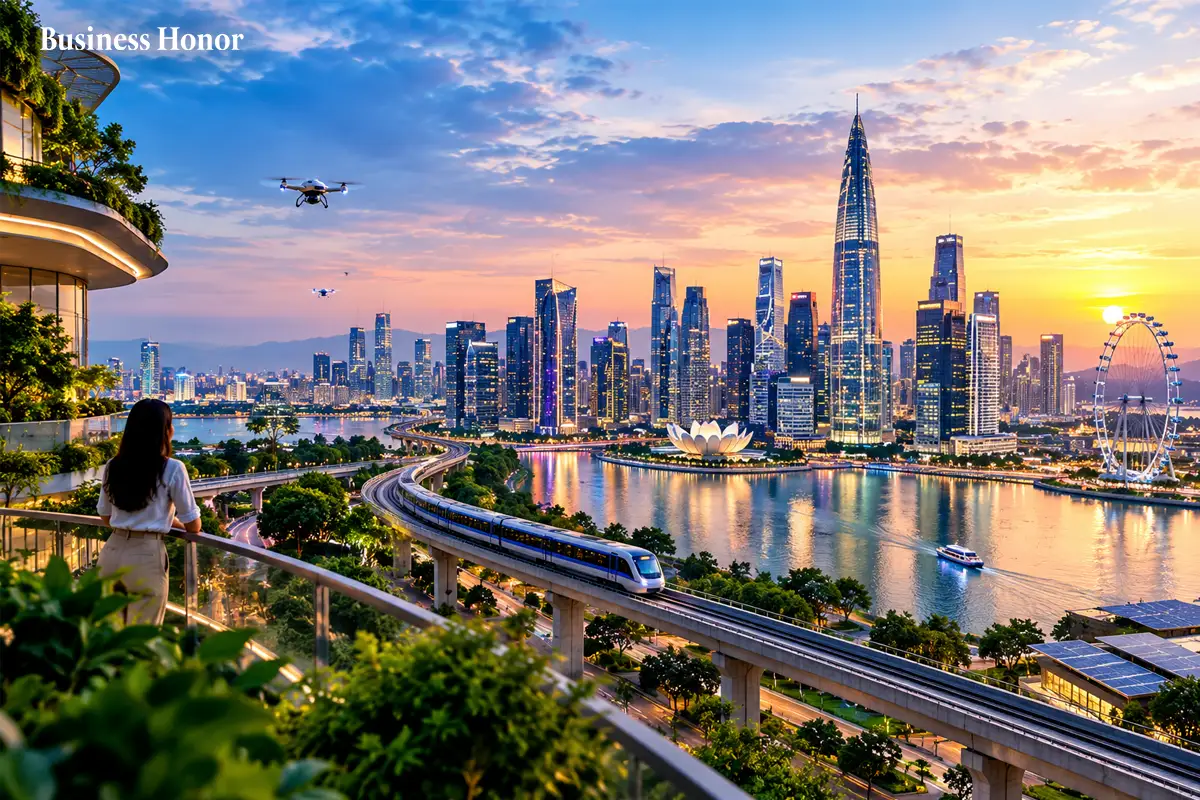
The top 10 smart cities in the world are being reshaped by one simple number. More than 55% of people on the planet now live in cities. That alone changes what "good" urban management looks like. Nobody is impressed by a skyline anymore. What matters now is whether a city's digital services actually work, whether the lights stay on when something breaks, and whether the government can spot problems before residents start complaining about them.
City budgets are shifting fast toward IoT sensor networks, AI-driven traffic and utility systems, and electric transit fleets, all aimed at keeping pace with populations that keep growing faster than the infrastructure meant to support them.
That growth brings a real problem though. Pack a city with sensors and cameras without a plan, and you start eroding the privacy and trust you were trying to build in the first place. The cities pulling ahead right now are not the ones running the flashiest pilot programme. They are the ones that figured out how to scale sensing infrastructure without residents feeling watched, and that shift, from scattered experiments to infrastructure people actually trust, is what separates the leaders from everyone still stuck testing.
Zurich has topped the top 10 smart cities in the world list for a seventh straight year, and the reason has little to do with sensors or apps. Its residents simply trust the people running the place. That single detail is now reshaping how governments and investors define "smart" in the first place, and it sets the tone for the rest of the World's Best Cities Report.
What Is a Smart City, Really?
Strip away the marketing and a smart city just uses data and connected infrastructure to run the boring stuff better: transport, energy, healthcare, permits. Nobody moves to a city because of its sensor network. They stay because the bus shows up on time and the lights work.
IMD's World Competitiveness Center makes this point well. Their 2026 Smart City Index, called The Quest for Trust and Transparency, did not just count infrastructure. It surveyed 120 residents in each of 148 cities and asked whether the technology actually changed their day-to-day lives.
How These Cities Get Ranked
The index scores two things. Structures, meaning housing, roads, transit, green space, healthcare. And Technology, meaning e-governance, smart grids, mobility apps, public Wi-Fi. Each gets measured across five areas: health and safety, mobility, activities, opportunities, governance. Then a city gets a letter grade, AAA down to D.
-
AAA: The top tier. Strong and consistent across almost every pillar, with no major weak spot dragging the score down.
-
AA to A: Solid overall, but with a noticeable gap somewhere, often strong technology paired with weaker public trust, or the reverse.
-
BBB to BB: A mixed performer. Some areas work well, others clearly do not, and the two rarely balance out.
-
B and below: Struggles across the board, not just in one category. Technology and structures both fall short of what residents need.
Exactly one city earned a AAA in 2026. Zurich.
Here is a question worth sitting with: can a city call itself smart if the tech is advanced but nobody trusts the government running it? The numbers say no. Rome and Athens both score higher on technology than on structures, and both sit near the bottom of the whole list. Fast Wi-Fi did not buy them public confidence.
The Top 10 Smart Cities in the World for 2026
This is the IMD Smart City Index 2026, currently the most cited version of the World's Best Cities Report.
1. Zurich, Switzerland
Seven years running at number one. Zurich is also the only city in the entire 2026 index to land a AAA rating. There is no single flagship project behind that. It is the boring stuff done well. Trams that show up on time. A transit system most residents actually use. A local government that scores near the top on transparency. Here is the twist though: Zurich's own residents say affordable housing worries them more than traffic or pollution. Even the world's smartest city has homework left to do.
2. Oslo, Norway
Oslo did not earn its spot with apps or dashboards. It earned it with cars. Over 30% of vehicles on the road there are electric now, the highest share of any capital in the world. Most of that power comes straight from hydroelectric dams, so the fleet runs close to carbon-free without much extra effort. The city backed the shift with real charging infrastructure and tax breaks that made buying an EV cheaper than buying a petrol car, years before most other countries even started the conversation.
3. Geneva, Switzerland
Geneva's case is built on trust and green space, not gadgets. Residents report unusually high confidence that local government actually listens. The city has held onto a large share of public parkland even while growing. One detail worth knowing: Geneva hosts more international organizations per person than almost anywhere on earth. Its public services have to work across languages and nationalities just to function day to day.
4. London, United Kingdom
London is the highest-ranked city outside that small cluster of wealthy European nations that usually dominates this list. It got there through sheer scale done right. Smart health systems link hospitals and clinics across boroughs. Buses, the Underground, and bike-share all sit inside one connected transit network. Its open data programme lets developers build on city information most governments keep locked up. Not many cities this big rank this high.
5. Copenhagen, Denmark
One number tells Copenhagen's story: 98% of the city gets hot water and heating from a single network that captures waste heat from power plants and factories instead of burning new fuel. Most cities cannot copy that without ripping up half their streets and starting over. Then there is the cycling culture, where bikes outnumber cars on the main roads. Put the two together, and Copenhagen stops looking like a tech showcase. It looks more like a city that figured out how to stop wasting energy decades before anyone made a big deal about it.
6. Dubai, UAE
Guided by its Digital Dubai program, Dubai has held the title of top-ranked city outside Europe and Australia for two years straight, and the story behind it is government money moving fast. Residents handle visa renewals, utility bills, nearly everything, without setting foot in an office. AI-driven traffic and governance systems keep expanding. What stands out is the pace. Dubai built this reputation in a fraction of the time it took older European cities to climb the same list.
7. Lausanne, Switzerland
Lausanne proves a city does not need a huge population to rank this well. It is a fraction the size of London or Singapore, yet it posts standout scores on mobility and how efficiently its administration runs, helped along by one of the densest metro systems per capita in Europe. Smart infrastructure scales down just as well as it scales up.
8. Canberra, Australia
Canberra wins on governance transparency, an area where most cities on this list quietly fall short. As Australia's purpose-built capital, it was designed around public administration from the start, and residents' trust in local decisions reflects that. It is also the only Southern Hemisphere city to crack the global top 10, a reminder that deliberate planning can outweigh raw size.
9. Singapore
Singapore stays Asia's top-ranked smart city, largely thanks to its Smart Nation programme, which has quietly wired IoT sensors into the public housing estates where most Singaporeans actually live. Residents track their energy use, access government services, and can even trade surplus solar power with neighbors through platforms tied straight into the housing system. Given how small and resource-limited the island is, this might be the most engineered achievement on the whole list.
10. Abu Dhabi, UAE
Abu Dhabi closes out the top 10, giving the UAE two cities in the global top ten, something few countries can claim. Its TAMM platform folds hundreds of government services into a single login, turning what used to be multi-day paperwork into a few minutes online. Paired with Dubai's ranking, it puts the UAE ahead of countries with far longer histories of urban planning.
Worth pointing out: Dubai and Abu Dhabi are the only cities on this list that are not European or Australian. Gulf investment in digital governance is starting to close the trust gap with older Western cities, not just the infrastructure gap.
Are These Smart Cities Actually Accessible?
This is where the report stops being flattering. A city can be genuinely advanced and still shut a lot of its own residents out.
Accessibility means more than ramps and elevators. It comes down to whether housing stays affordable, whether public services work for someone who does not speak the main language, whether a city's app still runs on an old phone, and whether the person who cannot get to a town hall still has a way to be heard. Zurich's own resident survey found that affordable housing worries people more than traffic or pollution. A city can top the global ranking and still be a hard place to actually live in.
The most accessible smart cities pair strong infrastructure with governance that reaches everyone, not just the neighborhoods that photograph well. Copenhagen makes the point clearly. Its heating network covers nearly the entire city, not just the parts visitors see.
Oslo subsidizes EV charging broadly rather than for early adopters only. Singapore ties energy savings directly into subsidized housing. These are not showcase projects. They are just infrastructure that happens to reach ordinary people.
What Business Leaders Should Actually Take From This
Three things keep showing up across the top performers.
Governance beats gadgets. Cities with strong anti-corruption and participation scores consistently beat cities with better tech but weaker institutions.
Boring infrastructure wins. Copenhagen's heating pipes and Oslo's charging stations matter more to daily life than any pilot project that never scales past one neighborhood.
Consistency gets rewarded. Zurich did not win with one big launch. It won by getting slightly better, year after year, for seven years straight.
For anyone deciding where to put long-term capital, that last point is the real signal. Would someone rather back a city with this year's newest sensors, or one that has earned seven straight years of public trust? One of those things is a lot harder to fake.
Where This Is Headed
The real risk in this sector is not the technology, it is the gap between what a city spends and how much its people actually trust it. A city can pour money into digital transformation and still slide down the rankings if residents do not buy in. Add climate pressure on top of that, plus aging infrastructure that costs a fortune to retrofit, and the challenge only gets harder from here.
Newer entrants are showing it does not have to take decades. AlUla in Saudi Arabia jumped 27 spots in a single year. So the question becomes: can a city really buy its way up this list, or does trust have to be earned one year at a time, the way Zurich did it?
Business Honor examines Livability has quietly overtaken novelty at the top of the top 10 smart cities in the world. Technology still matters, but it stopped being enough on its own a while ago. As more cities chase smart city status, the real contest is moving toward governance, toward whether residents actually feel the benefits day to day, not just whether the infrastructure is there on paper. The cities that work this out first are the ones likely to lead the next World's Best Cities Report.
FAQ
Which cities made the top 10 smart cities in the world for 2026?
Zurich, Oslo, Geneva, London, Copenhagen, Dubai, Lausanne, Canberra, Singapore, and Abu Dhabi.
What is the World's Best Cities Report actually measuring?
It blends hard infrastructure data with resident surveys covering health, mobility, opportunity, and governance, published each year.
Are smart cities actually affordable to live in?
Not always. Zurich, the top-ranked city, still names housing affordability as residents' biggest worry.
Which smart cities are the most accessible?
Copenhagen, Oslo, and Singapore stand out, since their infrastructure reaches everyday residents instead of a few showcase districts.
Why did Dubai and Abu Dhabi both crack the global top 10?
Sustained government investment in digital services pushed both UAE cities to the top outside Europe and Australia in 2026.










.webp)



.webp)

.webp)




.webp)


Comments
0 Comments