
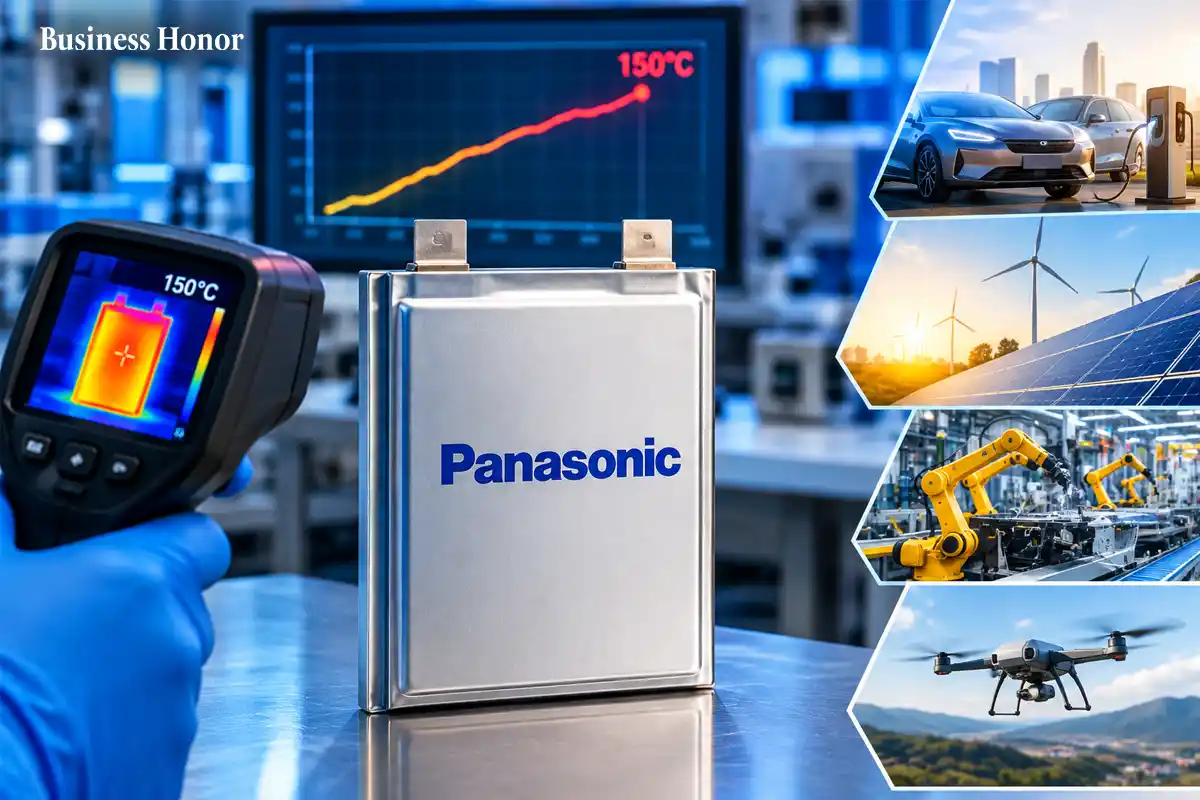
Panasonic Energy has developed a Solid-State Battery that can run at 150°C, opening potential new uses in industrial machines, vehicle sensors and robots.
|
Panasonic Energy has pushed its Solid-State Battery technology into hotter territory. The company has developed a battery that can operate at temperatures of up to 150°C, a 25°C increase over its previous limit.
The Japanese battery maker will begin sample shipments between October and December, CTO Shoichiro Watanabe said Wednesday. The company is also introducing a smaller prismatic cell designed to make battery integration easier.
Could extreme heat become the next battery advantage?
Panasonic Energy is not initially aiming this battery at electric vehicles. Instead, it is targeting industrial machinery and vehicle sensors, where equipment can face harsh operating conditions.
The higher heat tolerance could also open applications in areas such as the sterilization of medical equipment. That gives the Panasonic Battery a potential role in specialized systems where ordinary battery designs may face temperature constraints.
The company’s new Prismatic Battery design could add another advantage. Unlike coin-shaped cells, prismatic cells can offer manufacturers greater freedom when arranging components inside equipment.
But can better heat performance translate into a commercially useful battery?
Panasonic Energy plans to move toward mass production one to two years after the sample shipments. That makes manufacturing efficiency the next critical hurdle. A strong laboratory specification means little if production remains expensive or difficult to scale.
The company is also looking beyond industrial equipment. Panasonic Energy plans to accelerate development of cylindrical batteries for humanoid robots.
Watanabe said cylindrical cells suit robots because they can fit into tight spaces and rounded structures. The move reflects growing interest in battery designs built around the physical demands of machines rather than simply passenger vehicles.
Could humanoid robots create a new battleground for Battery Tech?
The development also challenges the usual focus on solid-state batteries as an EV technology. Panasonic Energy is taking a different route by pursuing specialized applications where temperature tolerance and compact designs could matter more.
That strategy could prove practical, Business Honor asks is higher operating temperature enough to justify the cost and complexity of solid-state technology?
The answer will become clearer as Panasonic Energy ships samples and moves toward production. For now, the 150°C Battery gives the company a stronger technical proposition in industrial applications, while its work on Robot Battery technology points to another market that could shape the next phase of battery development.
FAQs
What is Panasonic Energy’s new Solid-State Battery?
It is a battery designed to operate at temperatures of up to 150°C.
What is the main advantage of the 150°C Battery?
Its higher temperature tolerance could enable use in demanding industrial and sensing environments.
What applications is Panasonic Energy targeting?
The company is initially targeting industrial machinery and vehicle sensors rather than electric vehicles.
What is the new Prismatic Battery design?
It is a small-size cell design that can make product layouts easier compared with coin-shaped cells.
Will Panasonic Battery technology be used in robots?
Panasonic Energy is also accelerating development of cylindrical batteries designed for humanoid robot applications.













.webp)

.webp)




.webp)


Comments
0 Comments