
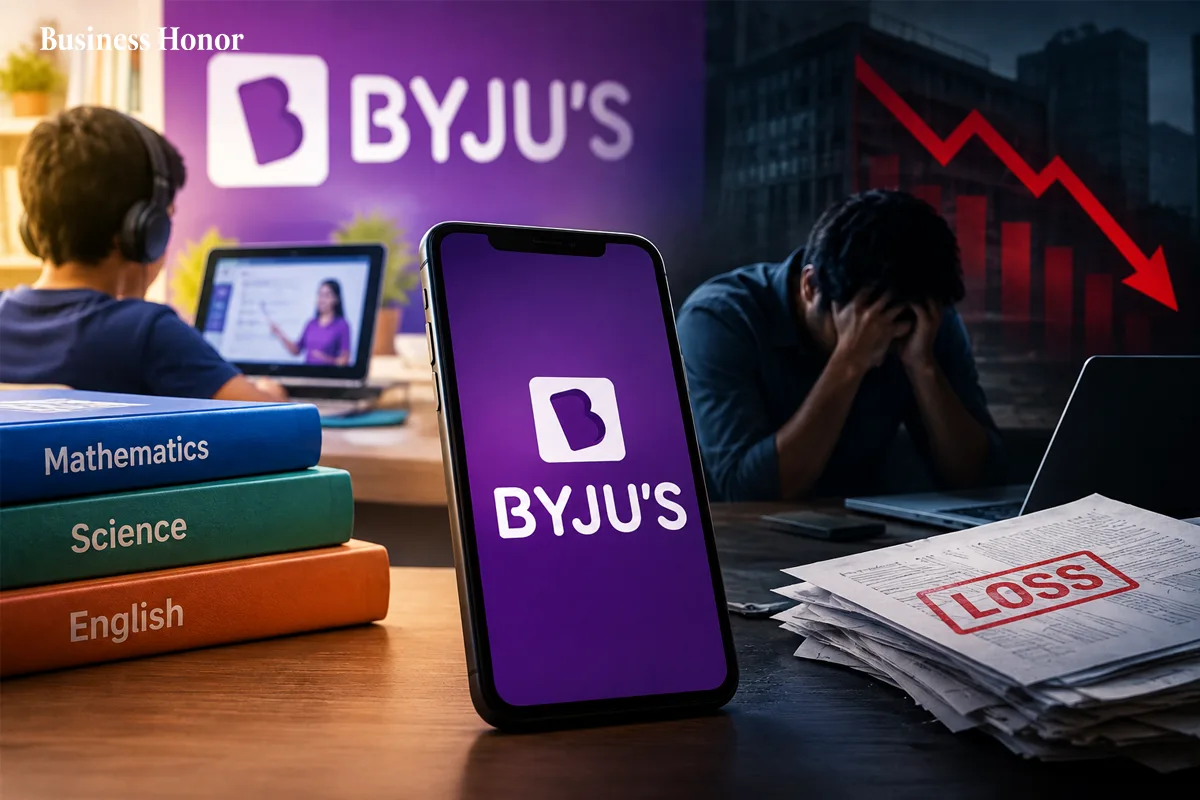
Byju's rose to become one of the most valued start-ups in India by making the conventional problem of education the basis of a technology venture. Where things started off as conventional classroom tuition, eventually developed into an educational platform for millions of students in digital format. The company experienced very fast growth during the COVID-19 pandemic period when schools went online.
However, the same approach of fast-growing the company also led to financial struggles for Byju's. This included heavy spending, acquisitions, debts, delayed financial statements, as well as a tough market after the pandemic period which ultimately led to the bankruptcy of Byju's. Business Honor examines Byju’s rise from a coaching venture to a billion-dollar edtech giant and the financial pressures that led to its downfall.
How Byju's Started
Byju Raveendran’s teaching career started before Byju’s became a technology company. In the early 2000s, he began coaching students preparing for competitive examinations. His classes became increasingly popular, moving from relatively small groups to much larger batches. Some sessions were even held in stadium-like venues.
Raveendran later began using technology to reach students outside the classroom. In 2009, his team used VSAT technology to deliver video-based lessons.
In 2011, Raveendran founded Think & Learn Pvt. Ltd. The company eventually developed what became Byju’s digital learning business.
A major turning point came in August 2015, when BYJU’S The Learning App was launched. The platform focused on subjects such as mathematics and science and used videos, animations, quizzes and other digital tools to teach students.
Byju’s said the app crossed two million downloads within three months of its launch.
That was the key change in the business. Instead of depending on a classroom in one city, Byju’s could put its lessons on a smartphone and reach students across India.
How Byju's Achieved Rapid Growth
Technology was only one part of the expansion. Paid learning programs, aggressive marketing and large amounts of investment capital helped Byju’s grow at a remarkable pace.
By 2018, reports citing company data put its user base at around 15 million, including roughly 900,000 paying users. The startup had become a unicorn and continued adding customers.
Then COVID-19 changed the market almost overnight.
Schools shut down, classrooms moved online and parents looked for digital learning options. Byju’s already had a product designed for that environment.
The company's valuation climbed sharply. It was valued at around $8 billion in January 2020, $15 billion in April 2021 and $22 billion in March 2022.
Byju's growth was not limited to its own app. The company went on an acquisition spree.
It bought WhiteHat Jr for about $300 million in 2020. In 2021, it acquired Aakash Educational Services for around $950 million and Great Learning for approximately $600 million.
These acquisitions changed the shape of the business. Byju’s was no longer focused only on digital K-12 learning. It was moving into test preparation, professional education and other segments.
The brand also became highly visible outside the classroom. Byju’s sponsored the Indian cricket team and attached its name to major sporting properties, including the 2022 FIFA World Cup.
How Byju's Actually Made Money
To understand the Byju's business model, it is necessary to look beyond the free content available through its platforms.
The basic model was straightforward: attract students through digital learning content and then sell paid educational programs to them and their families.
Students could use the platform to access learning material, while premium courses and learning packages generated revenue. Not every user was a paying customer, which meant the company had to continually convert part of its large user base into paid users.
Acquisitions then added new sources of revenue.
Aakash brought a large offline test-preparation business into the group. Great Learning added higher education and professional learning. Other acquisitions expanded the company into additional education categories.
In effect, Byju’s was building a large education group rather than operating only as an app.
The revenue numbers grew quickly. Think & Learn reported revenue of about ₹5,298 crore for FY22, compared with ₹2,428 crore in FY21. But the losses were also substantial. Consolidated losses reached about ₹8,245 crore in FY22.
That gap between rising revenue and much larger losses became a major problem.
Where the Byju's Financial Crisis Began
The Byju's financial crisis became harder to ignore once the pandemic-era online learning boom started to fade.
Schools reopened. Students returned to physical classrooms and many families went back to traditional coaching. Byju’s, meanwhile, was carrying a much larger organization than it had before the pandemic.
There were acquired companies to operate, employees to pay, marketing commitments to meet and debts to service.
Investment had played a major role in the company's expansion. By March 2022, Byju’s had reached a valuation of $22 billion following a funding round of about $800 million.
The company had also taken on a $1.2 billion term loan from a group of US lenders in 2021. The loan later became the center of a major legal dispute between Byju’s and its creditors.
Financial reporting became another problem.
Byju’s delayed the filing of its accounts. In 2023, Deloitte resigned as the company's auditor, and several board members also stepped down. Its FY2021 accounts eventually showed losses of around ₹4,588 crore.
For investors, lenders and other stakeholders, the company's financial position was becoming increasingly difficult to assess.
Why Byju's Failed
The Byju's failure did not happen because of one bad decision or one difficult year.
Several problems came together.
The company had expanded extremely quickly. Its acquisitions increased the size and complexity of the business, while marketing and operating costs remained high. At the same time, Byju’s faced demands from lenders, suppliers, employees and other creditors.
The end of the pandemic made the situation worse.
Online education had benefited enormously from school closures. Once classrooms reopened, that exceptional demand was no longer there. The business had to operate in a market that looked very different from the one that had supported its rapid expansion.
The FY2022 figures showed the scale of the problem. Revenue had increased, but consolidated losses reached ₹8,245 crore. About 45% of the losses were attributed to underperforming businesses including WhiteHat Jr and Osmo.
The dispute eventually reached India's insolvency system.
In July 2024, the National Company Law Tribunal admitted Think & Learn, Byju’s parent company, into the Corporate Insolvency Resolution Process following a petition from the Board of Control for Cricket in India over unpaid dues of ₹158 crore.
The consequences continued into 2026. The Economic Times reported that large quantities of tablets, laptops and other equipment remained stored while efforts continued to monetize the company's assets.
What the Byju's Downfall Shows
The Byju's downfall is a useful case study because the company did many things that helped it grow quickly.
It found a huge market. It built a recognizable product. It attracted billions of dollars in investment. It expanded into new areas and built a brand that became familiar to households across India.
But rapid expansion also created a much larger financial and operational burden.
An education app became a group of businesses through acquisitions. More businesses meant more employees, more expenses and more financial commitments. When the market changed, managing that structure became increasingly difficult.
That is what makes the Byju’s story more complicated than a simple tale of an edtech company losing customers.
Byju's funding, acquisitions and rapid expansion helped create a company worth billions on paper. But valuation did not remove the need for cash flow, profitability, financial reporting and effective management of debt.
Byju’s rose quickly because it understood how technology could change the way students learned. Its crisis showed the other side of that growth story: building a large company quickly is very different from building one that can remain financially sustainable when market conditions change.













.webp)

.webp)




.webp)


Comments
0 Comments