
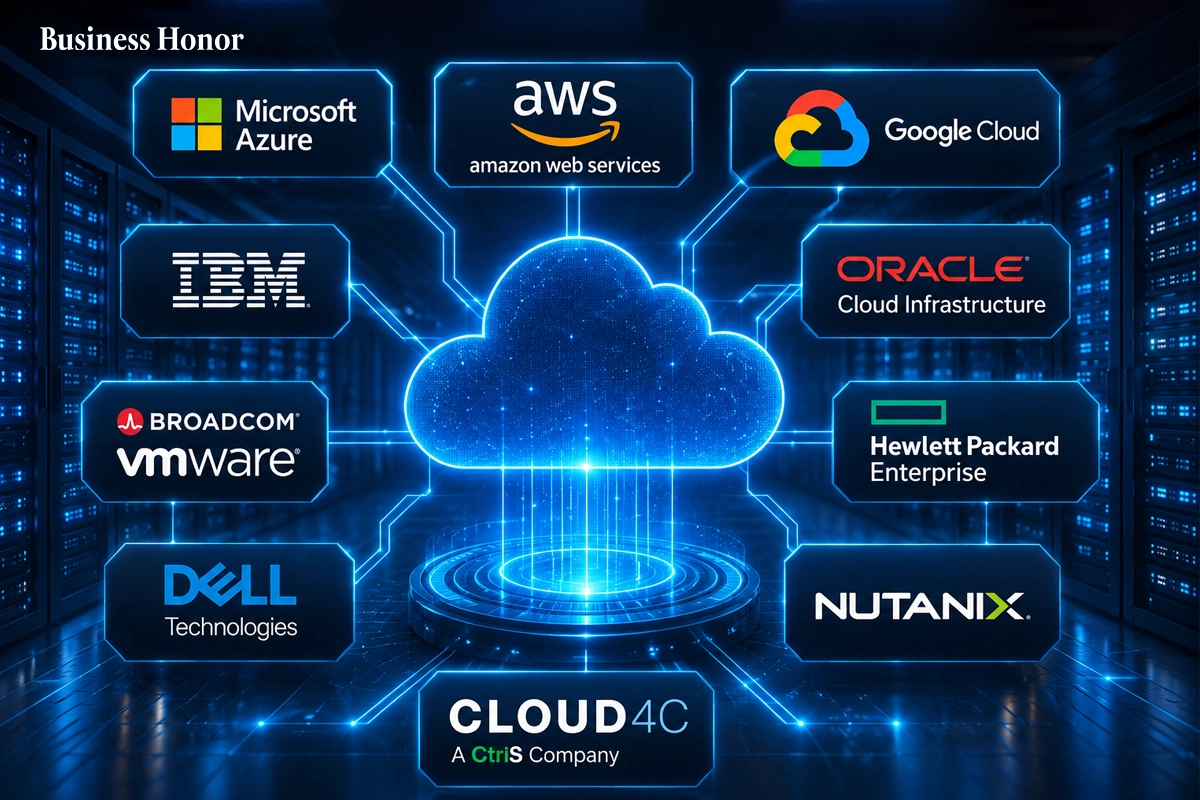
The Hybrid Cloud Solution Providers in 2026 are benefiting from a clear change in enterprise IT Service strategy: companies are becoming less interested in putting everything in one cloud. AI workloads, data-sovereignty rules, infrastructure costs, cybersecurity and performance requirements are pushing organizations toward a mix of public cloud, private infrastructure, colocation, edge and sovereign environments. More than 80% of enterprises are revisiting their cloud plans to accommodate AI, according to an ISG report.
Hybrid cloud is therefore becoming less of a temporary bridge between old and new IT systems. It is becoming an operating model in its own right. Flexera's 2026 State of the Cloud research found that 73% of organizations use hybrid cloud, showing how deeply the model has entered enterprise infrastructure planning.
But the market has changed. The question is no longer simply which provider offers the biggest cloud.
Which companies can actually make a complicated IT estate easier to run?
Business Honor presents its selection of the Top Hybrid Cloud Solution Providers in 2026, focusing on companies that combine infrastructure, cloud management, AI, security, automation and enterprise integration.
Top 10 Hybrid Cloud Solution Providers in 2026
- Microsoft Azure
Microsoft Azure has a particularly strong position in hybrid cloud because it can extend beyond public cloud into the environments enterprises already operate.
Azure Arc is central to that strategy, giving organizations tools to manage resources across data centers, multiple clouds and edge locations. For companies already using Windows Server, Microsoft 365, Active Directory and other Microsoft technologies, Azure offers an advantage that is difficult to replicate: familiarity across the stack.
The bigger opportunity is AI. Enterprises increasingly need to connect AI services with proprietary data, existing applications and controlled infrastructure. Azure's hybrid approach gives Microsoft a natural route into those decisions.
- Amazon Web Services
Amazon Web Services remains one of the most important cloud providers, but its hybrid strategy addresses a simple enterprise reality: some workloads cannot move entirely into a public cloud.
AWS Outposts extends AWS infrastructure and services into customer facilities, allowing organizations to keep selected workloads closer to their data, operations or users.
AWS's strength is scale. Its challenge is equally clear: large enterprises need more than cloud capacity. They need consistent governance, predictable costs and control across environments.
- Google Cloud
Google Cloud brings a different strength to hybrid environments, particularly around Kubernetes, analytics, AI and distributed applications.
Google Distributed Cloud is designed for environments where workloads may need to operate outside standard public-cloud regions. That becomes increasingly useful when businesses need local processing, strict data controls or low-latency AI.
Google's opportunity is to turn its cloud-native expertise into an enterprise operating advantage. The competition will depend on how easily customers can run sophisticated applications without adding another layer of infrastructure complexity.
- IBM
IBM has spent years building its position around hybrid enterprise computing, and that experience matters.
Its combination of IBM Cloud, Red Hat OpenShift, automation, security and AI gives IBM a strong proposition for organizations carrying substantial legacy infrastructure while moving toward modern applications.
The company is also adapting its hybrid strategy for AI workloads. IBM announced managed Red Hat AI Inference and Red Hat OpenShift Virtualization services on IBM Cloud in 2026, targeting enterprises that need to run AI and virtualized workloads across hybrid environments.
IBM's advantage is not being the largest hyperscaler. It understands customers for whom migration is complicated by regulations, legacy systems and mission-critical applications.
"Hybrid cloud and AI are the two dominant forces driving change for our clients, and they must be the focus of every modern enterprise," said Arvind Krishna, CEO of IBM.
- Oracle Cloud Infrastructure
Oracle Cloud Infrastructure has a powerful customer base in databases, ERP and other mission-critical enterprise systems.
For these organizations, cloud strategy is rarely about starting from scratch. It is about modernizing existing systems without breaking the applications that keep the business running.
OCI therefore has a clear role in hybrid environments where Oracle databases and applications must connect with on-premises systems and other cloud platforms.
This gives Oracle a practical advantage: it can sell hybrid cloud as an extension of an existing enterprise environment rather than as a complete technology reset.
- Broadcom VMware
Broadcom VMware remains deeply embedded in enterprise data centers through virtualization and private-cloud technologies.
That installed base gives VMware considerable relevance as companies rethink cloud costs and infrastructure strategy. Some businesses are moving workloads between environments rather than abandoning private infrastructure altogether.
The question for VMware is whether it can remain a central control layer as enterprises adopt more containers, cloud-native applications and AI infrastructure.
Can traditional virtualization keep its place as enterprise computing becomes more distributed?
Its ability to answer that question will shape its role in Hybrid Cloud Trends 2026.
- Hewlett Packard Enterprise
Hewlett Packard Enterprise approaches hybrid cloud from the infrastructure side, combining servers, storage, networking, edge computing and cloud management.
That matters for industries where computing cannot simply be moved to a distant public cloud. Manufacturing plants, hospitals, telecom networks and research environments often need processing close to where data is generated.
HPE's opportunity is especially strong as AI increases demand for specialized infrastructure. Enterprises increasingly need to decide which workloads belong in public cloud and which should remain closer to their own operations.
"The future is hybrid. Enterprise IT needs a consistent operational model that spans edge, private data centers, and public clouds seamlessly." said Antonio Neri, CEO of HPE.
- Dell Technologies
Dell Technologies remains a major supplier for enterprises building private and hybrid cloud solutions.
Its portfolio across servers, storage and networking gives organizations the physical foundation needed to operate workloads outside hyperscaler environments.
AI adds another layer to the opportunity. Companies deploying AI cannot always rely on public cloud capacity alone. Data security, latency, GPU availability and operating costs can push some workloads closer to private infrastructure.
Dell is well positioned for that conversation.
- Nutanix
Nutanix has built its business around simplifying infrastructure through hyperconverged systems and hybrid multicloud management.
Its proposition is straightforward: reduce the operational burden of running private infrastructure while giving businesses flexibility across cloud environments.
That matters because hybrid cloud's biggest weakness is often complexity. Multiple environments mean multiple policies, tools, security controls and cost structures.
Nutanix's appeal is therefore less about owning the largest cloud and more about making the infrastructure underneath enterprise applications easier to operate.
"Enterprises don't want cloud as a location; they want cloud as an operating model; wherever their applications and data live." said Rajiv Ramaswami, CEO of Nutanix.
- Cloud4C
Cloud4C represents the managed-services side of the hybrid cloud market.
Many enterprises have access to multiple cloud platforms but lack the people and operational resources to manage them effectively. Cloud4C works across major cloud ecosystems and provides services around migration, management, governance and ongoing operations.
That model is gaining relevance as hybrid environments become harder to manage internally.
The next phase of cloud competition may therefore be won not only by infrastructure providers, but also by companies that remove the operational burden from customers.
Why Hybrid Cloud Trends 2026 Are Changing Enterprise Strategy
The strongest force behind Hybrid Cloud Trends 2026 is AI.
AI has exposed weaknesses in conventional cloud planning. Training can require large-scale compute, while inference may need to sit closer to users or enterprise data. Sensitive information may also require stricter controls than a standard public-cloud deployment provides.
Recent enterprise research reflects this shift. A Cloudera study found that 66% of surveyed organizations had moved workloads from public clouds back to private or on-premises environments, while 25% planned to adopt a hybrid-first infrastructure strategy.
The decision is becoming economic as well as technical.
Cloud bills can become difficult to forecast when AI workloads consume large amounts of compute and storage. Enterprises are therefore examining where workloads deliver the best combination of cost, performance, security and control.
Is cloud-first finally giving way to workload-first?
That may be the more useful way to understand the market.
The Rise of Hybrid Cloud Technology Companies
The competitive landscape now extends well beyond traditional cloud providers.
Hyperscalers such as Microsoft, AWS and Google compete on global infrastructure and services. IBM and Oracle target complex enterprise environments. VMware, HPE, Dell and Nutanix have strong positions closer to private infrastructure. Managed providers address the operational layer.
This creates a more fragmented but also more mature market.
A Cloud Service Providers Comparison based only on price misses the real issue. Enterprises need to examine workload portability, security, governance, data residency, AI readiness, observability, automation and vendor lock-in.
The best provider for a bank may not be the best provider for a manufacturer. A healthcare company may prioritize data sovereignty, while an AI developer may care more about GPU availability and inference performance.
































.webp)

.webp)




.webp)



Comments
0 Comments