
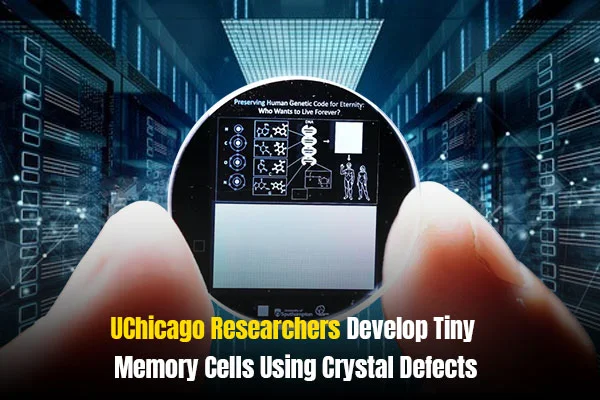
UChicago researchers create a new memory storage method using crystal defects for terabyte-scale capacity.
In order to fit terabytes of data into a millimeter-sized cube, researchers have found a method to employ individual missing atoms in crystals as memory cells. They are developing a storage mechanism that is unheard of in classical computing by utilizing rare earth elements and light-based activation. The amount of data that a device can store has historically been constrained by the physical dimensions of these binary components.
Researchers at the Pritzker School of Molecular Engineering (UChicago PME) of the University of Chicago have now devised a technique for encoding ones and zeroes using crystal defects, or atomic-level flaws. The amount of storage that traditional computer memory can hold could be greatly increased with this innovation. Nanophotonics published their findings on February 14th.
UChicago PME Assistant Professor Tian Zhong explained that each memory cell consists of a single missing atom, essentially a single defect. He further highlighted that this technology allows for the storage of terabytes of data within a tiny cube of material just a millimeter in size.
The invention exemplifies UChicago PME's multidisciplinary research, which has revolutionized classical, non-quantum computers through the use of quantum techniques and transformed studies on radiation dosimeters most famously, the devices that record the amount of radiation hospital staff absorb from X-ray machines into groundbreaking microelectronic memory storage.
First author Leonardo França, a postdoctoral researcher in Zhong's lab, explained that they discovered a way to combine solid-state physics applied to radiation dosimetry with a research group focused on quantum, even though their work isn't precisely quantum. He noted that there is a growing demand for research on quantum systems, while also highlighting the need to improve the storage capacity of classical non-volatile memories.



















.webp)

