.webp)
- Sandra Kelembeth
Architecture has always been rooted in vision. But with sustainability in the equation, turning that vision into environmentally responsible buildings requires data-backed decision-making. Simply relying on sketches and blueprints is not enough.
Factoring environmental metrics into building design isn’t as easy as it sounds. However, doing so is essential because if energy use, materials, and environmental impacts aren’t considered from the start, it can lead to expensive redesigns or missed sustainability goals.
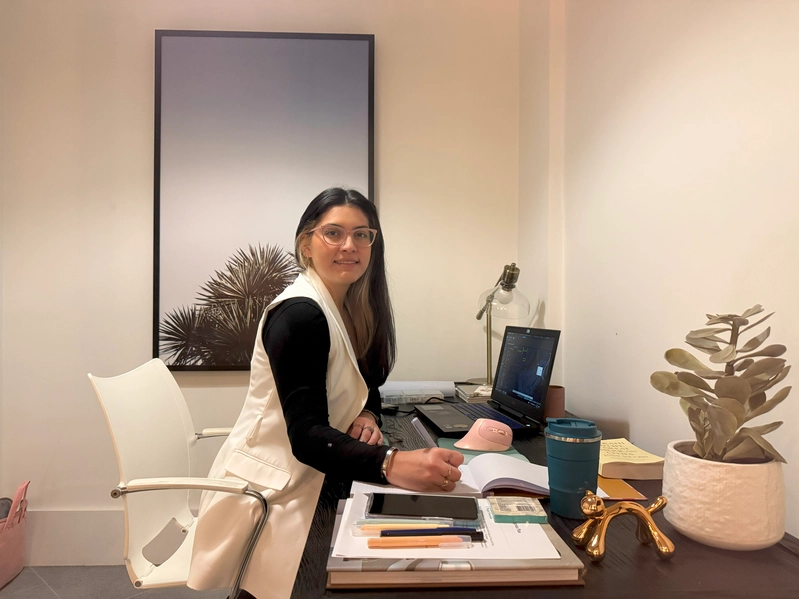
By addressing this challenge, Paula Alejandra Diaz Muñoz established her credibility as a reputable architect. With her integration of digital design tools into data-driven design and environmental thinking, she turns ambitious green ideas into practical and sustainable buildings: “Most projects start with something very simple—just sketches on paper—but then they evolve into digital models where we can refine the design and bring it closer to reality,” she explains.
Over the course of her career, this sought-after architect worked on projects for various scales, ranging from developments covering more than 2,000 acres to smaller site-specific designs of just a few acres. These projects made her realize how much urban design affects daily life: “Urban design can completely change how people live, move, and connect with each other,” Paula shares.
Through years of professional practice, Paula developed what she describes as “an eye for creating strong layouts and finding the best design solutions.” Over time, this ability became central to how she structures digital models for both architectural and urban-scale developments.
Paula emphasizes that moving from the first idea to a digital model is the perfect time to test sustainability plans. The moment construction starts, doing changes can be costly.
Paula has written a lot about her approach, especially in her manuscript Designing Environmentally Sustainable Communities: Principles and Practices in Modern Architecture. In it, she explains how careful, integrated planning can make sustainable development possible from the very start. Her work—both on paper and in real buildings—sets a model for designs that are responsible, practical, and visionary at the same time.
From Sketch to System: Her Integrated Workflow
Paula’s design process often begins with the simplest tool available: a pencil and paper: “I like to sketch, and one thing about it is that I can do it fast. That ability really helps during meetings or when I need to explain ideas on the spot.”
She shares how a quick drawing can often capture a concept faster than lengthy explanations: “It’s amazing how with a quick sketch, I can help people understand an idea instantly,” she says.
In the early stages of a project, she frequently blends these hand-drawn sketches with digital modeling. This hybrid approach allows her to explore ideas freely before gradually refining them through more technical tools. The sketches help generate concepts, while digital platforms allow those concepts to be tested and developed further: “Sketching helps me think about the emotional and spatial experience of a place. Later, data and digital models help me test those ideas to see if they really work—whether in terms of accessibility, density, or environmental impact.”
Once an idea takes shape, she converts these initial sketches into structured digital models using BIM or CAD platforms. At this stage, the project becomes easier for multidisciplinary teams to analyze and develop collaboratively: “You start with conversations and sketches, but the digital tools help you test those ideas and refine them until they actually work in the real world,” she explains.
Seamlessly transitioning conceptual sketches to fully developed digital models is one of Paula's strengths. Rather than treating creative design and technical documentation as separate phases, she approaches them as parts of a single continuous workflow.
BIM gives the detailed data for analyzing performance and coordinating projects, while CAD produces the drawings needed for construction. Complementarily using these two tools help her move quickly from early concepts to accurate design solutions. This method also makes it easier for clients and project teams to see how ideas develop over time: "When you combine BIM’s data depth with CAD’s clarity, you can see exactly how a design works. That knowledge helps us make better choices without guesswork,” she adds.
Harnessing BIM and CAD for Sustainable Design
Instead of viewing buildings as isolated infrastructures, Paula approaches every project as part of a larger environmental and urban system. This broader perspective shapes how she designs and models projects digitally: “Urban design and architecture are deeply connected. When you model projects digitally, you help shape how people will experience an entire environment.”
With this systems-based mindset, this well-regarded architect makes sure that there are digital simulations early in the design process. By combining 3D visualization with green infrastructure modeling, she creates detailed scenarios that allow teams to analyze environmental impacts long before construction begins.
With the help of real-life data, these visualizations simulations help design teams test and even refine ideas. For example, building orientations can be adjusted to capture more natural light, while stormwater systems can be designed to improve environmental resilience. Instead of relying on assumptions, teams can see how their design decisions are likely to perform in real-world conditions.
To do these, she uses digital technology in designing sustainable architecture. Rather than simply using design software to produce drawings, she uses tools like Building Information Modeling (BIM) and Computer-Aided Design (CAD) to develop intelligent digital models which guide the entire design process. Hence, a crucial part in her process is BIM. Unlike traditional drawings, BIM models contain detailed information about building materials, systems, and projected performance. Using professional platforms such as AutoCAD, Revit, and Lumion, Paula builds detailed digital environments that combine architectural design with performance data and visual simulations.
This helps her examine elements such as energy use, environmental impact, and material efficiency which helps teams identify potential improvements early on.
Through these digital simulations, she can test the sustainability of her idea: “Digital tools let us explore ideas and test them before anything is built. That way, we can see how a project will perform environmentally and improve the design while it’s still flexible.” This ability to analyze performance early helps reduce costly revisions later in the project.
In her article, “The Role of BIM and CAD Technologies in Transforming Architectural Design Efficiency,” Paula highlights the value of reviewing design decisions digitally before construction starts. According to her, this approach helps teams improve their concepts, achieve better sustainability results, and prevent expensive redesigns later on.
Paula's work shows that digital tools, when combined with intentional planning, can create environmentally-sustainable designs without disregarding people’s needs. Such belief has influenced how other architects approach sustainability-focused projects. As a result, more design teams are adopting similar digital methods, often finding that they improve coordination, provide clearer planning insights, and give greater confidence when making decisions about long-term environmental goals.
Colleagues who have worked with Paula commends her ability to combine analytical modeling with practical construction knowledge, highlighting that it makes her particularly effective when projects transition from concept to execution. One professional who observed this firsthand is Judas Germán Medina Muñoz, Legal Representative of Medina Prefabricados, Construcción Arquitectura y Diseño S.A.S., who supervised Paula during her time at the company.
Muñoz recalls her interest in prefabricated construction, an approach which is recognized for its efficiency and sustainability: “She developed a strong interest in how prefabricated systems can reduce waste and improve efficiency in construction. Over time, she gained deeper knowledge in this field, learning how prefabrication can increase efficiency and reduce the environmental impact of construction projects. Her work supported our mission to create innovative and environmentally responsible housing solutions. Today, prefabricated construction has become a central part of her expertise. Her creativity, professionalism, and proactive attitude consistently raised the standard of our projects.”
Bridging Technical Design and Clear Communication
This well-regarded architect believes that the goal does not end in producing data-heavy models. They also have to ensure that the information they contain remains understandable and useful: "Design only succeeds when both creativity and technical insight work together to turn ideas into spaces that function effectively in the real world," she shares.
Thanks to her strong background in 3D modeling, rendering, and digital imagery, she can effectively translate complex environmental data into clear visual simulations. These visualizations make technical information easier for clients and multidisciplinary teams to understand.
Paula has also examined the communication advantages of advanced digital visualization in her article “Advancing Architectural Visualization: The Impact of 3D Modeling and Rendering on Design Communication,” where she explains how visual modeling tools help architects translate technical design information into formats that clients and multidisciplinary teams can easily understand.
Earlier in her career, this sought-after architect improved her skills at communicating complex information during her role as a graphic design intern at PLACE Alliance in Orlando. There, she learned to translate complex architectural ideas into simple, clear visuals. Today, she uses those skills to share BIM insights effectively with multidisciplinary project teams.
Her technical expertise, combined with her communication skills is hard to not notice. Marc Newman, Principal at PLACE Alliance commends Paula's insights and designs: “Paula brings together technical discipline and environmental insight in every project. Her BIM workflows produce designs that perform as beautifully as they look. She really understands that design is about people’s experiences .”
Newman also commends how Paula's designs always balance sustainability with livability: “She considers how people interact with spaces and how well-thought-of design can enrich those interactions. That commitment to creating meaningful places is what makes her work so impactful,” he adds.
Applying the Method in Real Projects
With Paula's view of cities as interconnected systems rather than a collection of isolated buildings, she ensures that her designs are sustainable. This understanding eventually became the foundation of her design philosophy: "Each structure influences the neighborhood around it, while the neighborhood shapes the everyday experiences of its residents," she explains.
That's why rather than treating sustainability as something added at the end of a project, Paula embeds it into the structure of communities from the beginning, meaning, walkability, green spaces, and environmental considerations are built into the planning process itself. As a result, sustainability becomes part of everyday life for residents instead of a separate feature layered onto the design.
One example of this sustainability-embedded approach is the Sweetbay in Florida. Previously a spot for the airport, this now residential community is designed to prioritize walkability, energy-efficient homes, and shared green spaces that encourage interaction among residents.
For Paula, the project represents more than just a completed development—it reflects the transformation of an idea into a lived environment. Sweetbay remains one of the projects she feels most connected to: “It feels amazing. I can’t wait to see people walking through a space that once existed only as an idea.”
With sustainability-focused communities on the rise, Paula’s approach is gaining recognition in the industry. By using modeling-driven design, she helps teams understand how buildings will perform and make better planning decisions early in the process. This ensures projects are creative, functional, and environmentally responsible.
Beyond Buildings: Crafting Spaces Where Communities Thrive
Behind Paula’s design process is intentional listening. Even before she sketches or uses any design tools, everything begins with conversations with her clients. She believes that understanding a client’s vision is the first step in creating meaningful and functional spaces. “One of the best parts of the process is taking what a client tells you—their hints, their ideas—and turning that into something real that actually works,” she says.
For Paula, listening does not mean simply checking client requirements. These conversations give her a window into the hopes, routines, and daily lives of the people who will actually use the space: "By understanding these human experiences first, every choice—from the flow of a room to the materials —enhances how people live, interact, and connect with their surroundings," she shares.
In this way, Paula turns imagination into reality, creating spaces that are not just functional but full of life, where people can truly thrive.
This sought-after architect believes that truly effective design must also reflect the people who will eventually inhabit the space: “Every city has its own rhythm and needs. You also have to consider factors like age and the types of relationships people are in. Designing for families is very different from designing for older adults or single individuals. That’s why understanding the end user is so important,” she shares.
This perspective is the reason why Paula places strong emphasis on creating detailed environmental simulations during the planning process. While clients may initiate a project, she believes its long-term impact belongs to the wider community: “At the end of the day, the client is paying for the project but it’s the community—and the city—that will experience the design long term,” she explains.
What begins as a simple conversation, a rough sketch, or a digital model now exists in real life. Families stroll along shaded streets, neighbors gather in shared parks, and communities form in spaces that once existed only as ideas. For Paula, this is the true measure of success: "Success is not visible in the digital model or a technical drawing. It comes later, when spaces are actually lived. Watching people actually use the spaces we design is the most rewarding part,” she says.
Paula's works are proof that with careful planning and a focus on environmental responsibility, architecture can do more than just create buildings—it can shape how cities grow and how people live in them.
Sandra Kelembeth is an experienced writer who specializes in healthcare, health technology, fitness, and sports. With a sharp attention to detail and a deep passion for wellness, she creates compelling content that educates, engages, and motivates her audience. Her writing skillfully simplifies complex medical concepts, making them accessible and relevant to everyday life. She is dedicated to empowering readers with practical knowledge that supports healthier, more informed lifestyle choices.















.webp)

